January 12, 2026As winter break comes to an end, many clinicians and teachers notice a familiar pattern. Children who were communicating more consistently before the holidays may seem quieter, less engaged, or slower to jump back into routines.
If this sounds familiar, you’re not alone—and it’s not a sign that progress has been lost.At Sing and Speak 4 Kids, we often hear from professionals who are looking for ways to support speech and language development after the long winter break as they transition back into learning and therapy after time away. January can be less about “catching up” and more about helping children reconnect with familiar rhythms that support communication.
Changes After Holiday Breaks Are Common
Holiday breaks bring changes in schedules, environments, and expectations. For young children, especially those working on speech and language skills, these shifts may temporarily show up in these three behaviors:
Less frequent use of words or sounds
Reduced confidence in communication
Shorter attention spans during structured activities
Research and professional guidance show that when routines or services are interrupted, it’s common for children to need time to re-engage. With consistent support, many children return to their previous level of participation and continue building skills.
This is especially true for children with speech delays, autism spectrum disorder (ASD), or other developmental differences who benefit from repetition and predictability.
Why January Is a Reset, Not a Rush
The weeks after winter break are often most effective when they’re treated as a reset period, rather than a push for immediate progress.
Helpful strategies during this time may include:
Reintroducing familiar activities before adding new targets
Allowing extra time for children to warm back up
Prioritizing engagement, interaction, and comfort
When children feel supported and confident, communication often follows more naturally.
The Role of Consistency in Language Development
Consistency plays a key role in supporting speech and language development after winter break. When children experience similar patterns across environments—therapy sessions, classrooms, and home—it helps reinforce learning and supports carryover.
Organizations like the American Speech-Language-Hearing Association emphasize the importance of practice beyond direct sessions. Collaboration with families and access to simple, engaging tools can make consistency more achievable, especially after schedule disruptions.
Supporting Communication Between Sessions Through Play
Many clinicians and teachers already encourage families to support communication through everyday play. Music, repetition, and interactive activities can be especially helpful during transitions because they reduce pressure while encouraging participation.
Sing and Speak 4 Kids was created to support this kind of reinforcement. Our program uses music-based, interactive play to help children practice early communication skills in a way that feels familiar and motivating.
For professionals, this can offer families:
A structured option for practice between sessions
A consistent activity children can return to after breaks
A playful way to support communication without adding stress
“As an SLP, I understand the importance of collaborating with parents to support their children. SS4Kids was simple to integrate into my teletherapy sessions with my clients and was effective at eliciting language in a fun and supportive environment.” —SLP in a Public School District
Our program is designed to complement—not replace—professional services, supporting continuity when routines change.
Moving Forward With Reassurance
January transitions can be challenging, but they also offer an opportunity to reset expectations—for children, families, and professionals alike.
Supporting speech and language development after winter break often requires patience, as temporary setbacks are common when children return from time away. These changes are usually a sign that a child needs time to reconnect with familiar routines. With consistency and engaging support, children can rebuild confidence and continue moving forward.
At Sing and Speak 4 Kids, we’re here to support the important work you do by helping make carryover and consistency more accessible for families.
Have Questions About
Post-Break Language Support?Request a Consultation Today! [...]Read more...
September 13, 2025Busy parents need flexibility. Sing and Speak for Kids (SS4Kids) brings professional-quality music-based therapy into your home through an online program. Families can access songs, interactive lessons, and progress tools anytime, anywhere—making it easy to fit therapy into daily life.
Online speech therapy for kids is becoming an essential tool for families looking to support their children’s communication skills at home. Whether your child has delayed speech or is diagnosed with Autism Spectrum Disorder (ASD), the right tools can make all the difference. That’s where SS4Kids comes in—a research-backed, music-based language program that combines therapy and play in one easy-to-use platform.
Built on proven music therapy techniques, SS4Kids turns screen time into meaningful speech practice that children actually enjoy.
What Is Sing and Speak 4 Kids (SS4Kids)?
SS4Kids is a fun, interactive online program designed to support children with speech delays through music and game-based learning. Unlike traditional apps, SS4Kids is grounded in evidence-based methods and supports developmental progress through repetition, rhythm, and song. Our online speech therapy program provides structured lessons that engage children while helping them build vocabulary and expressive language skills.
Why Parents and Caregivers Love It
Busy families may struggle to schedule consistent therapy sessions. SS4Kids can offer some support by providing a supplementary online speech therapy program for kids that can be accessed anytime, anywhere. This flexibility not only increases practice time—it also empowers parents to take an active role in their child’s development.
Parent & Caregiver Benefits:
More opportunities for child-led learning at home.
Encourages parent involvement in a positive, engaging way.
Tracks progress with easy-to-use reporting features.
Serves as a powerful supplement to in-person therapy.
From morning routines to bedtime, SS4Kids fits naturally into daily life, helping families stay consistent with speech development efforts.
Support for Clinicians and Educators
Clinicians and teachers working with children who have speech and language challenges can also benefit from integrating SS4Kids into their practice. This online speech therapy program for kids is a time-saving resource that complements traditional methods while keeping students engaged.
Educator & Clinician Benefits:
Enables more speech training time in the classroom or clinic.
Automatically generates progress reports for documentation.
Keeps children engaged with music, visuals, and interactivity.
Bridges therapy from school to home seamlessly.
Whether in speech therapy sessions or special education classrooms, SS4Kids can help professionals deliver high-quality support.
How Administrators Can Maximize Impact
For administrators in early education programs, therapy clinics, and school districts, SS4Kids offers a scalable, cost-effective intervention tool. By providing online speech therapy for kids, institutions can expand access, reduce costs, and improve outcomes—especially for families in rural or underserved areas.
Administrative Benefits:
Bridges the gap between in-office and at-home learning.
Improves access for distant or underserved families.
Offers consistent data tracking and progress monitoring.
Equips staff with additional tools for client success.
By integrating SS4Kids, administrators can strengthen support systems while offering families an empowering way to engage in therapy from home.
Why Music Is So Effective
The science behind SS4Kids is clear: music activates multiple areas of the brain, supporting both language and memory development. By incorporating melody, rhythm, and repetition, SS4Kids helps children build speech skills in a way that feels natural and fun.
This is what makes it a standout in the world of online speech therapy for kids—it’s evidence-based, but designed with joy in mind.
Make Speech Development a Daily Joy
If you’re looking for a way to improve your child’s speech skills without the stress of appointments or commutes, SS4Kids is here to help! Our program offers everything families and professionals need: flexibility, fun, and real results.
Try Sing and Speak 4 Kids today—and bring speech therapy home with music, movement, and meaning! [...]Read more...
August 19, 2025September 15 is National Online Learning Day, a day to recognize the power of digital tools in making education more accessible, engaging, and effective—especially for young learners with unique needs.
At Sing and Speak 4 Kids, we’re proud to offer an evidence-based, music-powered online program designed to support speech and language development in young children, including those with Autism Spectrum Disorder (ASD) or other communication delays.
Whether you’re a teacher, speech-language pathologist, parent, or caregiver, online learning can open doors for consistent, fun, and individualized learning. And what better way to celebrate than by diving into resources that help you get the most out of our program?
Quick Links: SS4Kids Resource Roundup
Here’s a collection of our most helpful blog posts and support materials to help you make the most of Sing and Speak 4 Kids:
How to Motivate Your Child to Play SS4Kids
How Clinicians and Teachers Use SS4Kids
How to Add SS4Kids to Your Devices Home Screen
How Homeschooling Parents Can Utilize SS4Kids
How Siblings Can Help with Game Play
How to Play SS4Kids Virtually with Your Clients or Students
How to Play SS4Kids with a Group of Clients or Students
Ways to Get Your Child’s Attention to Play SS4Kids
Benefits of Using SS4Kids
Tips for Playing SS4Kids
Peer-reviewed journal publishes SS4Kids research study
Why It Matters
Online learning isn’t just convenient—it’s a powerful way to provide consistent and accessible language support for children who need it most. With Sing and Speak 4 Kids, you’re combining technology, music, and evidence-based strategies to create a learning environment that’s effective and joyful.
Let’s celebrate how far online learning has come—and how it continues to support the growth of our youngest learners! [...]Read more...
July 9, 2025When Speech Therapy Meets Play: Real Lessons from User Testing with Children
By Katherine Gu
I’m a Chapel Hill-based intern from UNC Chapel Hill working with Sing and Speak 4 Kids. This past spring, I had the opportunity to design and conduct my own user research project, testing our music-based language game with young children recruited from the University Child Care Center.
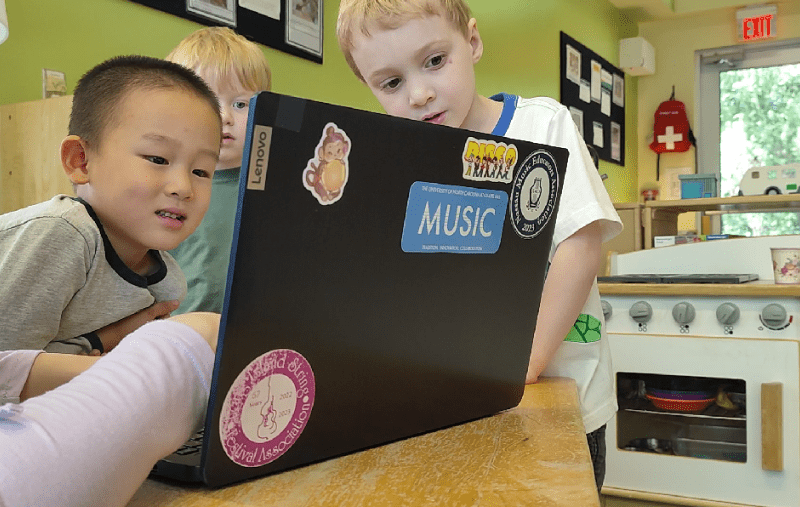
To better understand how children engage with the game, I conducted outreach, created permission slips that included preliminary questions about each child’s age and speech background, and designed a small-group user testing session with three 4-year-olds. Because we needed to stay inside their usual classrooms, I had to find creative ways to keep them focused, despite the familiar distractions of teachers, classmates, and toys nearby. While professionals often aim to create distraction-free environments during therapy, the reality is that if you’re a teacher or a parent, that’s not always possible, so how you engage the child becomes just as important as the tool itself.
With one computer, I guided the group through the game, asking each child to take turns making choices and answering questions while I kept the energy playful. I used animated language, imitated silly sound effects, and pointed excitedly at different images and words to help them stay engaged. Most importantly, I wanted them to feel like we were playing together, not just completing a task.
In a group setting, I had to consider the individual personalities of the children – some were shy, others were more outgoing or easily distracted – so learning how to speak their “language” simultaneously became essential. I drew from my years of experience working with kids at summer camps and music lessons, but this was different; instead of just keeping them entertained, I was helping them practice speech in a way that felt natural and enjoyable.
In my next post, I’ll be reviewing my observation notes, the session videos, and the children’s reactions to analyse patterns in how they engaged with the game. I will focus on what captured their attention, what confused them, and how they responded to prompts. Generating user feedback from young children is a unique process; unlike adults, they don’t often fill out surveys or explain their experience directly. Their feedback comes through observed behavior such as laughing, repeating sounds, losing focus, or asking unexpected questions (and they ask a lot of them!). These questions pulled us off track at times, so I learned the importance of answering briefly but warmly, then gently guiding the attention back to the activity. By combining these real-time observations with what I know about speech development and engagement, I hope to help improve the game’s design so it better supports a wide range of young learners. [...]Read more...
June 10, 2025Be Patient and Get Into a Routine
Elicit curiosity
Try several times, always in a quiet space
Share your enthusiasm for learning
Encourage children’s playful exploration
Prioritize social interaction during learning
Praise the process rather than the outcome
Consistency is Key to Success
Schedule 3 days/times per week (5-10 minutes)
Set an alarm on your phone
Add to your Google calendar
Put a reminder on your refrigerator
Set up a quiet space – add pillows, a beanbag chair, or a regular chair.
Talk to other family members about your time to spend with the child playing SS4Kids. Plan activities for your other children to do during this time
Older siblings can be part of playing the game [...]Read more...
June 10, 2025New to Sing and Speak for Kids? Aren’t really sure how clinicians and teachers use Sing and Speak for Kids?
Here are ways our clinician and teacher members use Sing and Speak for Kids:
Encouraging word usage with children
During in-person therapy sessions (individual and group settings)
Virtual Therapy Sessions – See an example
Tracking child’s progress
In classroom with tablets
Used in groups of children
As a supplemental tool
Family homework between sessions
How to Play SS4Kids Virtually with your clients
Advantages and Disadvantages of Online Therapy [...]Read more...
March 18, 2025With Sing and Speak 4 Kids (SS4Kids), you can make learning interactive and engaging while reinforcing important language and communication skills. Whether you’re a parent looking for creative ways to prepare your child or a clinician/teacher supporting early learners, SS4Kids offers a playful, music-based approach to language development. Read on to discover how you can use SS4Kids to make language learning fun and educational!
Sing and Speak 4 Kids for Parents and CaregiversSing and Speak 4 Kids for Clinicians and Teachers
Entering kindergarten is an important milestone for a child. Kids begin to hear new words, understand rhyming words, and practice pronunciation. They are also in a stage in their language development where they are beginning to create complex sentences. Read about ways to get your child Kindergarten ready.
Sing and Speak 4 Kids has over 18 songs you can choose from. You can use our game over the summer by playing through songs related to the outdoors and actually play the game outdoors with your child or client. For example, you can play through our songs “Play Ball” or “Garden Pig” and incorporate hands on vocabulary words such as using the ball to perform actions in the song or exploring the garden and identifying “grass” or “flowers” while playing “Garden Pig.”
A way a clinician or teacher may use Sing and Speak 4 Kids in the summer is to play the game in a group setting. Group play provides children with opportunities to interact with their peers. Especially using our game to sing the songs together and create a nurturing environment for language development. They can take turns, develop new social skills, and build cooperation and communication skills all through group play. Here are other ways clinicians and teachers use Sing and Speak 4 Kids.
Some Sing and Speak 4 Kids songs are about animals. For example, “Brown Bear,” “Pink Pig,” and “Cat Dog.” Explore a zoo or farm! Bring a device with you and play the animal related songs while seeing them in real life. It would be a fun interactive way to play our game.
Using Sing and Speak 4 Kids to help aid language development before the school year even starts will increase their overall vocabulary which will better prepare them as they navigate kindergarten. Try out some of these activities and have fun playing Sing and Speak 4 Kids over the summer!
Don’t play Sing and Speak 4 Kids yet? Try our free 7-day trial! [...]Read more...
September 17, 2024The ability to communicate and work with parents is crucial to ensuring a child’s success with Sing and Speak 4 Kids. Creating a strong team between parents and clinicians/teachers will help by increasing and ensuring the child’s time exposed to the program, as well as allowing the parent – clinician/teacher team to work together in tracking and monitoring the child’s progress. In order to register a parent for Sing and Speak 4 Kids, follow these simple steps on our website:
1. Navigate to the Home Page
Go to our website. Click on the green “SIGN IN” button located in the upper right-hand corner.
2. Sign In
Use your login credentials to access your account.
3. Send an Invitation
Once logged in, click on My Account in the menu.
In My Account, click on “Parent / Child Invitations.”
To invite a parent, click the blue “Add” button.
Fill out the form and an invitation will be sent to the parent. The parent will need to accept the invitation and follow the steps to sign up. Once the parent signs up for the game, your account will be linked to the parents account allowing you to track the child’s progress.
4. Monitor Invitations
Navigate to the “My Account” tab inside the game, and select the “Parent / Child Invitations” tab. This area can be used to check invitation status, start date, and other information regarding the invitation to the parents. [...]Read more...
September 9, 2024We are very excited to introduce you to…
BROWN BEAR
our new Sing and Speak 4 Kids mascot!
Brown Bear is so excited to get started helping you, your family, classroom, and/or clinics, grow and develop your speech skills. Look for Brown Bear in our game, on our website, in our emails, on social media, and various other places. Brown Bear will be around to help guide you to become the best SS4Kids member! Stay tuned for exciting announcements from Brown Bear. [...]Read more...
September 4, 2024Whether you’re a teacher in a traditional classroom or a clinician conducting virtual sessions, having the right resources to support young children playing SS4Kids is crucial to their success. In this guide, we’ll walk you through some of the essential materials and tools needed to implement SS4Kids effectively, along with practical ways to fund these resources.
Getting Started
Before diving into SS4Kids, it’s important to have the basic tools in place. Tablets, iPads, or computers are necessary for accessing this interactive online game, and keeping them charged is equally important for uninterrupted sessions. Headphones and microphones enhance the learning experience by ensuring clear audio and minimizing distractions. Additionally, SS4Kids Training is vital, empowering teachers and clinicians to make the most of the program. You can check out our Clinician and Teacher Training Center for gameplay tips based on your skill level with facilitating the game.
In-Classroom Resources
For teachers implementing SS4Kids in a physical classroom setting, here are a few things to improve your room’s learning environment:
Access to a space
Desk or table
Comfortable chairs or bean bag chairs
Carpet or play mat
Room lighting
Electricity
Stable Internet/Wifi
Projector/Computer
Virtual Space Resources
Using SS4Kids in a virtual setting requires a few essential resources to create an engaging and effective learning experience. Here are some of our recommendations:
Electricity
Stable Internet/Wifi
Room lighting
Desk or table
Chair
Zoom and/or Google Meet platforms
Share Screen feature
Child-appropriate virtual background
Comfortable seating for the child
Funding Resources
Securing the necessary resources to effectively implement SS4Kids can be a challenge, but there are numerous funding opportunities available to support teachers and clinicians. Crowdfunding platforms like Donors Choose, and GoFundMe offers easy ways to rally community support, while grants from organizations like AAE and Casey’s Cash for Classroom provide dedicated funds for educational tools. Additionally, creative fundraising ideas like bake sales, live auctions, and social media challenges can help bridge the gap, ensuring that every child has access to the best possible learning environment.
Donors Choose
GoFundMe
Classy
Fundly
JustGiving
Association of American Educators (AAE) Foundation
Casey’s Cash for Classroom Grants
Kickstarter
Bake Sale
Social Media Challenges
Live Auctions
Yard/Garage Sale
As teachers and clinicians, your dedication to supporting children’s speech development through SS4Kids is invaluable. Equipping your learning environment with the right tools and resources is essential to making the most of our evidence-based program. [...]Read more...
August 22, 2024As a grandparent, you’re not just a source of warm hugs and sweet treats – you’re a vital part of your grandchild’s growth and development. If your little one is facing speech challenges and using Sing and Speak 4 Kids (SS4Kids), you have a unique opportunity to be their cheerleader, coach, and playmate all rolled into one. SS4Kids isn’t just another online program; it’s an innovative tool designed to turn speech therapy into a fun, interactive adventure. But here’s the secret ingredient that can truly make it shine: you! Your involvement can transform SS4Kids from a helpful program into a powerful bonding experience that boosts your grandchild’s progress. Let’s explore how you can become an essential part of your grandchild’s SS4Kids journey, creating lasting memories while supporting their speech development.
1. Familiarize Yourself with the Program
Take some time to understand SS4Kids! It’s an evidence-based music language program that uses fun, interactive games to help children overcome delayed speech. Knowing the basics will help you engage more effectively with your grandchild especially when guiding them through different songs.
2. Create a Supportive Environment
Set up a comfortable, quiet space for your grandchild to play SS4Kids. Ensure good internet connectivity and a device with clear audio. Your presence can provide a sense of security and encouragement.
3. Join in the Fun
Don’t just watch – participate! Sing along with the songs and play the games together. Your involvement can make the experience more enjoyable and motivating for your grandchild.
4. Practice Patience
Remember that progress may be gradual. Celebrate small victories and maintain a positive attitude throughout the process.
5. Reinforce Learning Outside of Gameplay
Use the concepts and words learned in SS4Kids during everyday activities. This helps reinforce the learning and encourages your grandchild to apply their new skills in real-life situations.
6. Communicate with Parents and Therapists
Stay in touch with your grandchild’s parents and speech therapists. Understanding their goals and progress can help you provide more targeted support during SS4Kids sessions.
7. Make it a Regular Activity
Consistency is key in speech development. Try to make SS4Kids gameplay a regular part of your time with your grandchild.
8. Have Fun!
Above all, enjoy this special time with your grandchild. Your love, support, and engagement can make a significant difference in their progress and overall development.
By actively participating in your grandchild’s SS4Kids experience, you’re not only supporting their speech development but also strengthening your bond. Your involvement can turn therapy into a fun, family-oriented activity that benefits everyone involved. Your participation, combined with professional support, can create a comprehensive approach to helping your grandchild thrive in their communication skills. [...]Read more...
July 30, 2024To make using SS4Kids easier to find on your mobile device, here are some ways you can add SS4Kids to your device’s home screen:
Using an Ipad or Apple Device
Open Safari on your mobile device.
Open the website or web page you want to add to your home screen. For this, we recommend using SS4Kids’ login page. https://game.singandspeak4kids.com/sign_in
Tap the Share icon. (square with an up arrow)
Tap “Add to Home Screen.”
To give the link a new name, tap on the website name in the box that appears. Change the name.
Tap “Add” to add to home screen.
Using an Android Device
Open Chrome on your mobile device.
Open the website or web page you want to add to your home screen. For this, we recommend using SS4Kids’ login page. https://game.singandspeak4kids.com/sign_in
Tap the menu icon or the 3 dots in the upper right-hand corner, and tap Add to home screen.
Once you choose a name for your new website shortcut, you’ll be able to access the game by once click. [...]Read more...
March 18, 2024Utilizing SS4Kids can help improve the homeschooling experience
If you are a homeschooling parent and are looking for a fun and interactive game for your child that also targets speech development, consider implementing SS4Kids in your child’s school day. Below are ways homeschooling parents can utilize SS4Kids.
Implementing SS4Kids as a fun “break time” between academic coursework for at least 10 minutes a day will give your child new words to say.
Playing SS4Kids with your child will benefit both you and your child’s relationship because it can also be seen as bonding time.
Including SS4Kids in your child’s homeschooling schedule will give your child a chance to learn in a different way than usual because they are given the chance to sing along with the game.
Using SS4Kids with your child will give you the ability to track your child’s abilities and growth.
After using SS4Kids with your child consistently, you will see an improvement in their vocabulary.
Utilizing SS4Kids with your child consistently will not only teach your child new words, but it will also improve your child’s engagement that they can implement in other areas of learning. [...]Read more...
November 10, 2023Playing with siblings can help encourage gameplay
We understand the difficulty of trying to get your child to do something new or maintain their attention. Below are ways that siblings can help encourage each other during gameplay.
If one sibling is playing the game and is having fun playing it, the other siblings may become interested in playing as well.
Siblings can support each other. If one sibling is having trouble answering the fill in the blank portions of the game, the parent or clinician can allow the other sibling to give them a hint or help them out.
When one sibling gets a fill in the blank correct, the other sibling can cheer them on and celebrate with them. This will boost the sibling’s confidence making it more likely that they will want to continue playing the game.
Competition could also be a fun way to encourage gameplay as well. For example, who can fill in the blank to the song the fastest, etc. Many siblings enjoy this type of competitive atmosphere and ultimately leads to more gameplay.
Children learn from exposure. If one child in the house is playing a game consistently, the likelihood of siblings being interested in the game as well would increase. For example, if I practiced piano everyday, my younger brother would also want to practice after observing me.
If siblings play together, they can also strengthen their relationship because they are playing a game that they can enjoy together.
When siblings play together it aids in building skills such as patience, cooperation, and sharing. [...]Read more...
July 30, 2023Many of the professionals who use Sing and Speak 4 Kids with their clients have reported that they are using it both in-person and virtually. We want to share with you how professionals play Sing and Speak for Kids with their clients virtually.
Quick Links
Virtual Platforms | Virtual Tools | Watch Example Session | Step-by-Step Instructions for Zoom | Step-by-Step Instructions for Google Meet
Virtual Platforms
Zoom
Google Meet
Google Classroom
HIPAA-compliant telehealth apps
Helpful Tools to Use During Game Play
Tools Within Zoom and Google Meet You Can Use with Your Clients or Students
There are many helpful tools available for you to use on Zoom and Google Meet while playing Sing and Speak 4 Kids with your student or client. We have listed some helpful tools within both platforms that can be used during game play.
Google Meet:
Virtual Background
Whiteboard Function
Closed Captioning
Recording sessions for play back to review; students like to see themselves online
Raise Hand Feature
Emojis
Share Screen
Use filters or change background feature to help client/student to be more engaged during gameplay
Zoom:
Whiteboard
Remote Control Access to help the student on their end
Closed Captions
Recording sessions for play back to review; students like to see themselves online
Share Screen
Raise Hand Feature
Reactions
Use filters or change virtual background to help client/student to be more engaged during gameplay
There are some tools that you can use during a Zoom/Google Meet game play session that are not in Zoom or Google Meet. Here are some tools that may help your client or student effectively play Sing and Speak 4 Kids:
Toys that correspond to the song (Teddy Bear, Keys, etc..)
Physical Whiteboard and markers
Using ASL or hand motions that coordinate with the target words
Toy microphone to make singing songs more fun
Make sure to share computer sound so your client/student and their parent can hear the song
Watch How a Clinician Used SS4Kids Virtually
https://vimeo.com/809530785
Step-by-Step Instructions for Professionals using Zoom
PRO TIP: Before starting the Zoom meeting, make sure that the parent has received the “Sing and Speak 4 Kids – Invitation to Join Our Program” email and completed all that is asked of them in that email. Once the parent has registered for the game, you as the clinician will be able to Track a Child’s Progress within SS4Kids.
Step 1: Sign-in to Zoom
Step 2: Click “Copy Invitation” under My Personal Meeting ID (PMI)
Step 3: Send Zoom invitation to parent through email or text
Step 4: Log into SS4Kids
Step 5: Click “Start” under My Personal Meeting ID (PMI) to start the Zoom meeting
Step 6: A small box will appear on the top of your screen that reads “(Child’s name) entered the waiting room”. Make sure to click the blue button that reads “Admit”.
Step 7: Click the green button at the bottom of your screen that reads “Share Screen” once you’re ready to begin the SS4Kids game
Step 8: You can either click the small box that reads “Desktop” or the small box that has the SS4kids tab
Step 9: Once you choose which box to share (the “Desktop” or the tab containing the SS4Kids program), make sure to click the small box at the bottom that says “Share sound”
Step 10: Click the blue button at the bottom right that reads “Share” and the child and parent should be able to see your screen and hear the sound from the SS4Kids game
Step 11: Once you are ready to stop sharing your screen click the red bottom at the top of your screen that reads “Stop Share”
Step 12: Once you have completed the session with the child you can end the meeting by clicking the small red button at the bottom right that reads “End”
Step-by-Step Instructions for Professionals using Google Meet
PRO TIP: Before starting the Google Meet meeting, make sure that the parent has received the “Sing and Speak 4 Kids – Invitation to Join Our Program” email and completed all that is asked of them in that email. Once the parent has registered for the game, you as the clinician will be able to Track a Child’s Progress within SS4Kids.
Step 1: Sign into Google Meet
Step 2: Click New Meeting. You will have three options to choose from. Create a meeting for later, start an instant meeting, or schedule in Google Calendar
Step 3: If creating a meeting for later, an information tab will appear with a link and PIN for participants to join
Step 4: Once the parent has received an invitation email to join the video meeting, have them click on the button Join Call.
Step 5: After they click on Join Call a tab will open that reads “Ready to Join” Have the parent click on Join Now.
Step 6: Once the child and parent are both in the meeting, you can choose to record the meeting by clicking the button with three vertical dots. Click on manage recording. You can select a language for captions as well as a caption. Click Start Recording
Step 7: Click on the button at the bottom of the video call with the arrow pointing up. This is the present button which will enable you to share your entire screen, window, or a tab with your student or client.
Step 7: Once you click on the present button, you can open up Sing and Speak 4 Kids and begin playing the game with your student or client. Before playing the game make sure that you have selected a child on the top right hand corner of the game in order to track their progress!
Step 8: Once finished with the game. Click on the present button and select stop presenting. This will stop the screen share.
Step 9: When you are ready to end the meeting, click the red phone button. The recording for the meeting will appear in your Google Drive.
How Clinicians and Teachers Use SS4Kids
Advantages and Disadvantages of Online Therapy [...]Read more...
July 17, 2023We have been hard at work creating new game features for you this summer. Check them out below!
How to Play the Game Video
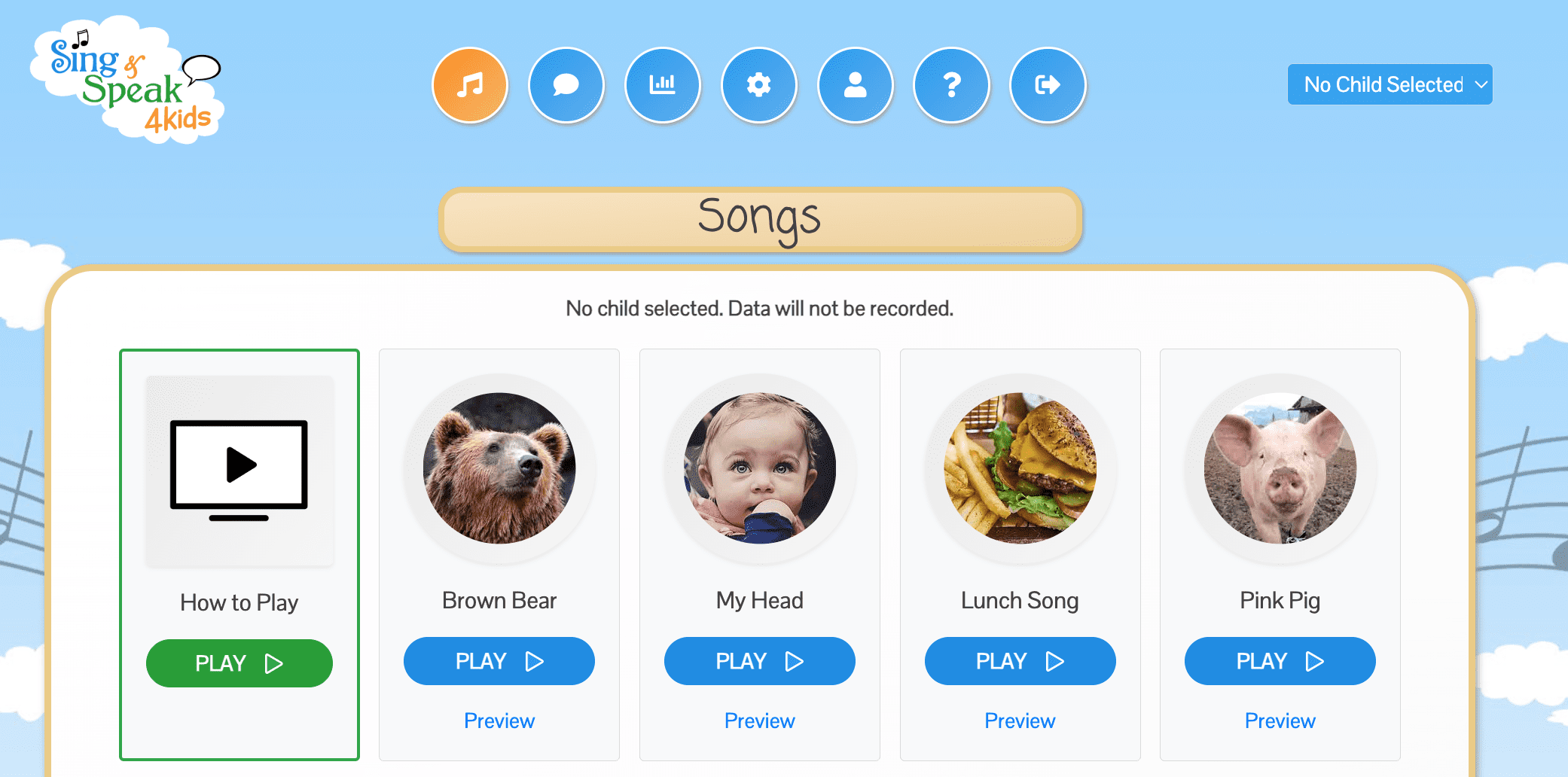
When you log in to SS4Kids, you’ll now notice the Green Play button where you can watch a tutorial on how to play SS4Kids. This makes it easier for new members to learn how to play our game!
Two New Songs
We have two new songs in our game library! Enjoy learning new vocabulary words with your child!
Preview of Songs
You will soon be able to listen to and preview songs inside the game before playing them with your child.
Want to see other new game features?
Fill out our feedback form and let us know what you’d like to see in our game. [...]Read more...
July 12, 2023FREE FOR PROFESSIONALS
We offer Sing and Speak 4 Kids free to clinicians, teachers, paraprofessionals, and others looking to use our program with their clients! You may access our game resources at no charge to you as the professional, however no assessment tools or child progress tracking will be available until your client is registered in SS4Kids as a member.
To abide by HIPAA and FERPA requirements, the child’s parent must first consent via our game to share data tracking with you as a professional before you may track child’s progress. Steps to obtain parents’ permission and to track child’s progress are below.
https://vimeo.com/464859499
PROGRESS TRACKING VIDEO
PARENT TRIFOLD
Give this trifold to parents to help you introduce SS4Kids to them. English and Spanish versions included.
STEP 1: Parent Registers for SS4Kids
Have the parent scan the QR Code to register or fill out the registration form. Parent or Sponsor pays for membership via credit card or coupon code. If the parent is already registered, move to step 2.
STEP 2: Parent Gives Consent
Professional, log into SS4Kids and send an invitation via game to the parent. Scan the QR Code for a direct link to the invitation form.
Parent will then receive an email and click consent.
STEP 3: Play the Game
Professional may play the game with the child by accessing their account in the dropdown menu.
Toggle between different children if you are playing with more than one child.
PDF Download
How Professionals Track Child’s Progress
Want to track a child’s progress? Here’s how. Print this and give them to your team.
Having trouble with these steps?
If you are having trouble with these steps, please reach out to us at [email protected]. [...]Read more...
July 11, 2023Many of clinicians and teachers use Sing and Speak 4 Kids in a group setting. Whether that is with a group of two or five children, Sing and Speak 4 Kids can be utilized and played in a group setting either virtually or in person.
Group Virtual Platforms
Zoom
Google Meet
Apple FaceTime
In-person Locations
Classrooms
Homes
Day Cares
Therapy Centers
Tips for Virtual Group Game Play
Make Sure Audio is Shared
Record sessions and play back for review; both professional and parents; students like to see themselves online
Have toys that correspond to the song (Teddy Bear, Keys, etc..)
Tips for In-Group Game Play
Try to play in a quiet environment to minimize distractions
Have toys that correspond to the song (Teddy Bear, Keys, etc..)
Helpful Tools to Use During Game Play
There are so many helpful tools that are available virtually and in-person that can aid in group gameplay. Here are some helpful tools that you can utilize during gameplay as a professional playing in a group setting.
Virtual Game Play:
Raise hand feature
Recording
Share Screen
Reactions
Whiteboard
Chat Feature
Hand Motions or ASL
In-person Game Play
Toy Microphone
Whiteboard
Paper and Crayons/Markers
Stuffed Animals during gameplay (Bear, Pig, etc.)
Hand Motions or ASL
Step-by-Step Instructions for Virtual Group Setting
PRO TIP: Before starting the Zoom meeting, make sure that the parents in the group setting have received the “Sing and Speak 4 Kids – Invitation to Join Our Program” email and completed all that is asked of them in that email.
Step 1: Sign-in to Zoom
Step 2: Click “Copy Invitation” under My Personal Meeting ID (PMI)
Step 3: Send Zoom invitation to parent through email or text
Step 4: Log into SS4Kids
Step 5: Click “Start” under My Personal Meeting ID (PMI) to start the Zoom meeting
Step 6: A small box will appear on the top of your screen that reads “(Child’s name) entered the waiting room”. Make sure to click the blue button that reads “Admit”.
Step 7: After ensuring that all of the children are present, click the green button at the bottom of your screen that reads “Share Screen” once you’re ready to begin the SS4Kids game
Step 8: You can either click the small box that reads “Desktop” or the small box that has the SS4kids tab
Step 9: Once you choose which box to share (the “Desktop” or the tab containing the SS4Kids program), make sure to click the small box at the bottom that says “Share sound”
Step 10: Click the blue button at the bottom right that reads “Share” and the children and parents should be able to see your screen and hear the sound from the SS4Kids game
Step 11: Once you are ready to stop sharing your screen click the red bottom at the top of your screen that reads “Stop Share”
Step 12: Once you have completed the session with the children you can end the meeting by clicking the small red button at the bottom right that reads “End”
PRO TIP: Before starting the Zoom meeting, make sure that the parents in the group setting have received the “Sing and Speak 4 Kids – Invitation to Join Our Program” email and completed all that is asked of them in that email.
Step 1: Sign into Google Meet
Step 2: Click New Meeting. You will have three options to choose from. Create a meeting for later, start an instant meeting, or schedule in Google Calendar
Step 3: If creating a meeting for later, an information tab will appear with a link and PIN for participants to join
Step 4: Once the parents have received an invitation email to join the video meeting, have them click on the button Join Call.
Step 5: After they click on Join Call a tab will open that reads “Ready to Join” Have the parents click on Join Now.
Step 6: Once the children and parents are both in the meeting, you can choose to record the meeting by clicking the button with three vertical dots. Click on manage recording. You can select a language for captions as well as a caption. Click Start Recording
Step 7: Click on the button at the bottom of the video call with the arrow pointing up. This is the present button which will enable you to share your entire screen, window, or a tab with your students or clients.
Step 7: Once you click on the present button, you can open up Sing and Speak 4 Kids and begin playing the game with your students or clients.
Step 8: Once finished with the game. Click on the present button and select stop presenting. This will stop the screen share.
Step 9: When you are ready to end the meeting, click the red phone button. The recording for the meeting will appear in your Google Drive.
Example of How to Play Virtually with your Client or Student [...]Read more...
April 18, 2023A fun club with social support for SS4Kids users
Stay up-to-date on the latest info, news and resources to best benefit your child in our friendly community of parents and professionals.
Pink Pig Club offers connections through text messages, social media and e-newsletters
Receive Text Messages
Don’t miss out on getting helpful reminders and game tips through our SMS!Sign up to receive text messages
Follow Us on Social Media!
Stay connected so you are up-to-date on our latest happenings.LinkedInInstagramFacebookYouTube
Update Your Email Preferences
Let us know which types of emails you’d like to receive from us. We provide game tips, SS4Kids news and announcements, parent and professional resources, educational activities, events and much more!Update Your Email Preferences
Join our Support Group
Our private SS4Kids Facebook Support Group members include parents, caregivers, clinicians, teachers, and our team to help one another. From general child care advice to game specific questions, our support group is there for you to lean on. Join FB Support Group [...]Read more...
February 7, 2023We understand the difficulties of trying to get your child to do something new or keep their attention on this new activity. Below are a few ways that our experts have come up with to help you.
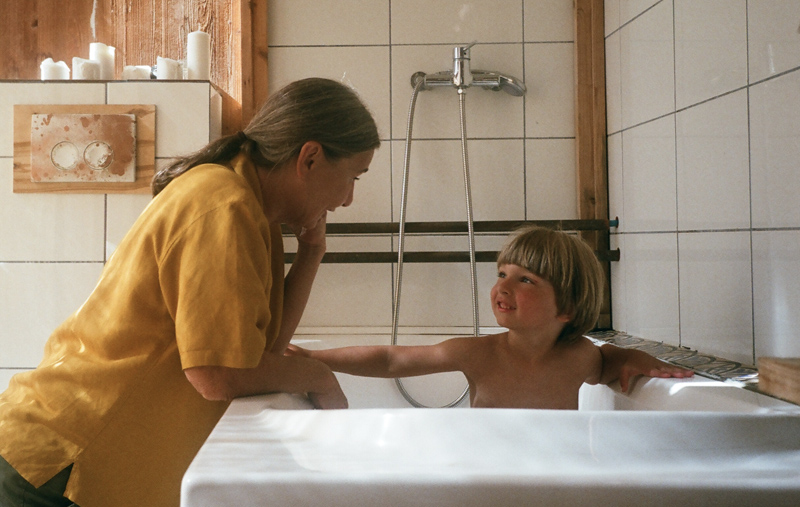
Bring game to child while child is in the bathtub
Sing songs during daytime activities, like body parts when getting dressed, or food during meals, or during a time of day when child can relate to a song, i.e. Let’s Go Fast song (sing when you are traveling, incorporate during your daily routines or before you play the game, make it a reward system)
Incorporate favorite toys, action figures, stuffed animals, dolls, etc. that correspond to songs to help “sing along”
Use a prop microphone to aid in singing songs
Meet the child’s sensory needs to improve focus–allow a weighted lap pad, use active/flexible seating
Parent and child use headphones or earbuds during game play to limit distracting background noise
Use a splitter for two headphones, or have bluetooth synced. Otherwise, the parent may not be able to easily follow if the audio is in the headphones.
Invite an older / younger sibling to play the game with them. This, of course, is dependent on the type of dynamic the child has with their sibling. Some kids are more motivated to engage with an activity if it involves their sibling. Conversely, sibling involvement could also serve as a distraction. Have conversations with the parent on the most effective way to incorporate sibling involvement, if necessary. [...]Read more...
February 1, 2023We’ve heard this debate many times. “What are the advantages and disadvantages of online therapy?” We are answering that question today. Every situation has advantages and disadvantages. Everyone learns and develops differently. So here is what we think the advantages and disadvantages of online therapy are.
Advantages
Can be done at home when child is most receptive
A shy child might be at more ease in front of a screen
Children with autism may be able to focus more easily on a 2D screen with fewer visual distractions than a 3D environment. This is potentially the opposite of the disadvantage compared to a clinical environment, assuming the 2D screen commands more attention than the distractions of the 3D home environment.
If done as a joint media interaction – more control and ability to shift from the online game to reality
Bonding time with caregiver
Much more accessible and convenient
Able to conduct therapy sessions virtually to clients who are remote or have little access to services
Disadvantages
Not having the same in-depth connection as in person
Having too much screen time and getting detached
More distractions than a clinical environment
Possibly more difficult to provide direct assistance
Considering the time zone of client and clinician during virtual therapy sessions
Wi-fi and internet connection; potential for more lag or game delays
How Clinicians and Teachers Use SS4Kids
How to Play SS4Kids Virtually with your clients [...]Read more...
November 16, 2022There are many wonderful benefits to playing Sing and Speak 4 Kids. Below are a few to help you make your decision.
View Testimonials
How Parents and Caregivers Benefit
Home interventions provides more child training time.
Helps motivate and empower parents and caregivers.
Evidenced-based supplemental learning game
How Clinicians and Teachers Benefit
In-school or in-office interventions provides more child training time.
Helps motivate and empower clinicians and teachers.
Time-saving progress reports available.
Evidenced-based supplemental learning game
How Administrators Benefit
Providing SS4Kids to your network and clients can:
Bridge activities from the institution to the home.
Give access for families in need who live at distance.
Maintain updated progress reports of children.
Help train parents to be engaged in the learning program.
Provide staff with more tools and resources to offer to their clients.
Offers cost effective intervention and learning tools. [...]Read more...
November 16, 2022New to SS4Kids? Here are tips to get you started.
Play the game before playing with your child. Click on the various links throughout the game to become acquainted with the game.
Let your child listen to all songs before playing the game.
Repetition and scheduling are keys to learning. Schedule 3 times a week for 5-10 minutes each time for maximum development. See more tips for scheduling.
Have a quiet space for your child to focus.
Repetition and scheduling are keys to learning.
Go at your child’s pace.
Use headphones or earbuds during game play to limit distracting background noise. Use a splitter for two headphones, or have bluetooth synced. Otherwise, the parent may not be able to easily follow if the audio is in the headphones.
Meet the child’s sensory needs to improve focus–allow a weighted lap pad, use active/flexible seating
Use a prop microphone to aid in singing songs
Bring game to child while child is in the bathtub
Reinforce the words outside of gameplay time. (this will give them more opportunities to Apply the vocabulary)
Provide rewards for children that finish song Sessions.
Start off by playing the game with a computer or a tablet.
Keep a journal of how the child performed each day in terms of overall progress, emotional changes, speed, and engagement (in terms of active playing or needing guidance or incentive to continue).
Enjoy home activities with new words. [...]Read more...
February 20, 2026At Sing and Speak 4 Kids, we believe children learn best when they feel safe, supported, and engaged. Our evidence-based program uses music, play, and interaction to support young children with delayed speech development, including children with Autism Spectrum Disorder (ASD) and English Language Learners.
So when we came across “STEM: Unlocking Brilliance Through Structure and Creativity” by James Watts, MEd, in Autism Parenting Magazine (No. 187), it resonated with us right away. The article explores how structured, hands-on learning environments can help autistic children build confidence, communication, and self-expression, and the parallels to our own approach were hard to miss.
Learning That Fits the Way Their Brains Work
One of the article’s key insights is that many autistic children thrive with structure, predictability, and clear routines. STEM activities like coding, building, or hands-on experiments offer defined steps, visual supports, and measurable outcomes. That predictability can reduce anxiety and give children the space to focus on learning and exploration.
Watts also notes that autistic learners may be visual or tactile thinkers, may need extra time to process spoken language, or may be sensitive to sensory input like noise or light. When learning environments are designed with these needs in mind, children tend to be more engaged and more confident. That’s something that we reflected deeply about and built into Sing and Speak 4 Kids. The game features a variety of levels, including ones with music and singing, listening only, singing only, and speaking only, so children can engage in whatever way feels most comfortable for them.
Executive Function Skills Start Early
STEM learning supports the development of executive functioning skills like planning, focus, working memory, and flexibility. Tasks like building a model or writing a simple program encourage children to follow steps, adapt to challenges, and stick with something even when it gets tricky.
These skills are also foundational to language development. Through repetition, rhythm, and interactive play, our game helps children practice attention, imitation, and responsiveness, all of which support communication growth over time.
Communication Grows Through Shared Purpose
For many children with autism, traditional social interactions may feel overwhelming. The article points out how STEM creates opportunities for connection through shared goals and clearly defined roles, making communication feel more natural and less pressured.
Music works in a similar way. At Sing and Speak 4 Kids, singing and listening together creates shared attention between children, parents, and professionals, encouraging communication in a safe, playful environment where there’s no pressure to perform.
Creativity Looks Different, and That’s a Strength
The article is a good reminder that creativity doesn’t always look the same. For many autistic learners, it shows up through patterns, systems, and structured problem-solving rather than open-ended expression.
We celebrate that at Sing and Speak 4 Kids. Whether a child is repeating a word, responding to a rhythm, or engaging with the game entirely on their own terms, every step forward is worth recognizing.
Building Skills Today for a Brighter Tomorrow
As Watts concludes, when we design learning environments that honor neurodiverse strengths, we don’t just teach—we open doors. That mission is central to what we do at Sing and Speak 4 Kids, and it’s why we’re always looking for research and perspectives that deepen our understanding of the children we serve.
We encourage you to check out the full article in Autism Parenting Magazine—it’s a thoughtful read for parents, caregivers, and professionals alike.
Read the article at Autism Parenting Magazine
And if you’re looking for a fun, evidence-based way to support your child’s communication, or tools to support the children you work with, we’d love to welcome you to Sing and Speak 4 Kids.
Sign up today and start building communication through music, play, and connection. [...]Read more...
February 13, 2026Spring is in the air, and there’s no better time to breathe new life into your classroom! As the season of growth and renewal unfolds, why not bring that same energy into your lessons? We’ve gathered six creative and fun springtime activities designed to spark curiosity and encourage hands-on learning.
Nature Scavenger Hunt
Engage your students with an exciting nature scavenger hunt by providing them with a list of natural items to discover outside. As they explore, they’ll learn to observe subtle details in their environment, fostering curiosity and critical thinking skills.
Outdoor Storytime
Transform storytime by taking your class outdoors where the fresh air and natural surroundings create a magical reading environment. The change of scenery not only captivates students’ attention but also enhances their imagination as they visualize the story.
Sidewalk Chalk Art
Encourage artistic expression by letting students create colorful, spring-themed sidewalk chalk art outside the classroom. Kids can experiment with colors and designs while celebrating the season through murals of blooming flowers, buzzing bees, or sunny skies.
Recycle & Upcycle Craft Project
Provide items like bottle caps, paper rolls, and old magazines, and encourage students to transform them into imaginative crafts such as flower sculptures or seasonal decorations. This project not only nurtures artistic skills but also teaches valuable lessons about reusing resources and caring for the environment.
Spring Music Parade
we’re passionate about blending music with learning, and a spring music parade is a perfect way to celebrate that spirit. Have students craft simple instruments from everyday objects—like shakers from dried beans or drums from empty containers—and then play together.
Plant a Classroom Garden
This hands-on activity teaches students about plant biology, the importance of caring for living things, and the rewards of patience as they watch their garden grow. As the garden blossoms, students can track progress, learn about seasonal changes, and celebrate the beauty of nurturing life.
We hope these activities ignite your creativity and encourage your students to explore, discover, and grow. Here’s to a vibrant, engaging, and memorable spring semester! [...]Read more...
February 13, 2026March is the official month that we recognize National Music in Our Schools Month, designated by the National Association for Music Education. Music is the cornerstone of the work that we do at Sing and Speak 4 Kids. We believe that it can be used as a bridge to communication, especially for nonverbal children. Music has been proven to be beneficial among all facets of life, a composer quoted in Appreciating Music as a Foundational Aspect of Creativity, reflected that “when we sing or create music, we use all the parts of the brain: left, right, front, and back. All these parts collaborate. That is very unique! Music is complex; that is, it uses so many aspects of a person’s being”.
Research has shown that music can stimulate many areas of the brain, including those responsible for language processing. Rhythm and melody can be a way for nonverbal children to develop communication skills in an accessible and engaging way. Music can help with many other aspects of language including:
Producing and understanding speech patterns
Semantic processing
Grammar and phonological awareness
Memory and recall
The Department of Defense Education Activity has been teaming up with the National Association for Music Education and Schools to advocate for music in schools and to raise awareness of the benefits that music can bring to the classroom. Music education has been an underfunded and overlooked sector of the American education system, but has been shown to positively impact students in various ways, from academic achievement to social and emotional development. Research has indicated that students who participate in music programs often perform better in all school subjects. Furthermore, engaging in music enhances creativity, discipline, and even teamwork. Skills that will benefit the student, that go way past addition or subtraction.
National Music in Our Schools Month is an opportunity to advocate for music education and programs that use music as a way to improve other skills, much like what we try to do at Sing and Speak 4 Kids. Raising awareness is one of the highest priorities of National Music in Our Schools Month, parents, educators, and community members can take action by:
Attend board meetings to voice support for music programs.
Organizing school concerts and events to showcase student talent.
Spreading awareness through social media using hashtags like #MIOSM and #MusicMatters.
Go to the National Association for Music Education to get more information!
National Music in Our Schools Month is also about finding creative ways to share music with students and clients. Some ideas for clinicians and educators on how to celebrate MIOSM:
Start each school day by playing some of your own favorite songs and telling fun facts about the artist.
Host special concerts or performances by student musicians for parents and community members.
Invite local musicians to schools to speak about their experiences.
Integrate music into lessons, because after all, there are songs written about everything!
Play music during quiet work or downtime.
Use music-based exercises to enhance listening skills and comprehension.
Music education can extend far beyond the classroom and in our schools. Music can foster lifelong skills and individual passions, while also being a way to connect with others. For many students, music education programs can begin a love for music, whether as a career, a hobby, or even a means of personal expression. The skills learned in music education can have a real-world impact. The discipline required to learn an instrument, the ability to work collaboratively, and the confidence gained in performances can help with personal and professional success. Many careers, even outside music, can benefit from the creativity and critical thinking skills that are learned in music education programs.
Culturally, music connects individuals and communities. For example, The Beatles hit their peak in the 1960s but even today we can still relate and draw meaning from their music. Music plays a role in traditions, celebrations, and social movements, making it a preservation of history and cultural significance. By supporting music education, we can continue the legacy of music having an impact on our youth.
By celebrating National Music in Our Schools Month, we acknowledge the significant influence music has on education and the future of young students. Let’s continue to advocate for music education programs and for the implementation of more music within our school systems so that all children get to experience the positive impact of music.
How will you celebrate National Music in Our Schools Month this year? [...]Read more...
February 13, 2026March 1st is World Music Therapy Day, a celebration of a powerful therapeutic practice that can benefit people of all ages and backgrounds. Music therapy uses the power of sound, rhythm, and melody to enhance well-being across a variety of dimensions. Led by a trained music therapist, music therapy sessions are carefully tailored to meet the unique needs of the participant, targeting mental, emotional, physical, social, and cognitive health. Whether through singing, playing instruments, exploring the meaning of lyrics, composing, improvising, dancing, or simply listening, music therapy offers a diverse range of activities designed to bring positivity into your life.
Methods of Music Therapy: Receptive vs. Active
There are two primary methods of music therapy: receptive and active.
Receptive Music Therapy
Receptive music therapy focuses on the participant’s engagement with music primarily through listening. In this method, individuals listen to carefully chosen pieces of music, followed by discussions about the lyrics and the emotions evoked. The central goals of receptive music therapy are to promote relaxation, reduce anxiety, and alleviate stress. By allowing participants to explore the music’s emotional undertones, this method offers a therapeutic environment where they can express their feelings in a safe and supportive space.
Active Music Therapy
On the other hand, active music therapy involves hands-on participation, allowing individuals to engage directly with music through activities like composing, singing, playing instruments, or improvising. This interactive approach fosters the development of important skills such as social interaction, communication, and language abilities. It provides a creative outlet for self-expression and often helps individuals connect with others in meaningful ways. Both receptive and active music therapy offer a variety of benefits, and many individuals engage in both approaches to maximize their achievements.
What to Expect in a Music Therapy Session
The first session with a music therapist usually focuses on an assessment of the individual’s current state and identifying potential goals. The therapist will want to learn more about the client’s emotional and physical health, social functioning, perceptual and motor skills, communication abilities, and cognitive skills. Although no musical talent is necessary to participate in music therapy, the therapist may also want to learn about any musical background, skills, and preferences
Who Can Benefit from Music Therapy?
Music therapy can be beneficial to people of all ages and abilities, including those experiencing:
Dementia
Traumatic brain injury
Stroke
Parkinson’s disease
Cancer
Autism spectrum disorder
Mood disorders
Anxiety disorders
Learning disabilities
Developmental disabilities
Chronic pain
Substance use disorders
Where Is Music Therapy Available?
Although many people may not be aware of the power of music therapy, it is widely available and accessible in various healthcare and therapeutic settings. Music therapists work in:
Hospitals
Schools
Nursing homes
Senior centers
Outpatient clinics
Mental health centers
Residences for people with developmental disabilities
Treatment facilities for substance use disorders
Correctional facilities
Music Therapy for Individuals with Special Needs
Music therapy can be incredibly beneficial for individuals with special needs. One key benefit is the enhancement of communication skills. Through engaging with music, individuals can develop more effective ways to express themselves, whether it’s through singing, playing instruments, or non-verbal communication.
Music therapy also works to improve motor skills, allowing participants to work on fine and gross motor coordination through rhythm exercises, instrument playing, and movement activities. Additionally, music therapy helps boost cognitive abilities, emotional regulation, and social skills.
The Benefits of Music Therapy
One of the most prominent benefits of music therapy is its ability to help you relax and reduce stress levels. Music has the power to soothe the mind and body, promoting a sense of calm and tranquility. It also provides a healthy way to explore emotions, allowing individuals to process complex feelings and experiences in a supportive environment.
For those struggling with anxiety or depression, music therapy can serve as an outlet for emotional expression, reducing symptoms and promoting overall well-being. Other important benefits of music therapy include:
Regulating mood
Strengthening communication skills
Improving speaking and language abilities
Building social skills
Strengthening self-confidence
Helping form healthy coping skills
Developing problem-solving skills
Reducing perceived levels of pain
Improving physical coordination, motor functions, and movement
Enhancing overall quality of life
In conclusion, music therapy is a versatile and impactful practice that offers a multitude of benefits for everyone. Whether you are looking to enhance communication, improve emotional regulation, or reduce stress, music therapy provides a powerful, creative outlet for healing and personal growth.
From helping individuals with special needs to offering therapeutic support for those navigating anxiety, the positive impact of music therapy is far-reaching. As we celebrate World Music Therapy Day, it’s important to recognize how music has the ability to foster connection and improve overall well-being. No matter your age or background, music therapy can offer you a unique path toward a healthier, more fulfilled life. [...]Read more...
February 13, 2026When a child picks up a paintbrush, molds a lump of clay, or creates a colorful collage, they’re doing much more than making something pretty for the refrigerator door. They’re engaging in a powerful developmental process that shapes their growing brain in remarkable ways. Art is not merely a recreational activity or a way to keep young hands busy; it is a fundamental tool for cognitive, emotional, and physical development that yields benefits far beyond the art table.
The impact of art on brain development begins with cognitive skills. As children engage with art materials, they strengthen visual-spatial abilities that form the foundation for understanding mathematical concepts, scientific reasoning, and reading comprehension. Each artistic choice—whether selecting colors, arranging shapes, or determining composition—represents a critical thinking exercise where children practice decision-making and problem-solving in a low-pressure environment. When children remember patterns or attempt to replicate drawings, they’re exercising memory and recall functions that will serve them across all academic areas.
The Connection Between Art, Motor Skills, and Emotional Expression
Fine motor development represents another crucial benefit of artistic engagement. The manipulation of brushes, pencils, and modeling materials requires precise coordination between the eyes and hands. As children grip, control, and direct these tools, they develop the dexterity and finger strength necessary not only for writing but for countless everyday tasks requiring manual precision. The seemingly simple act of controlling a crayon across paper involves complex neural coordination that supports developmental milestones.
Perhaps one of art’s most valuable contributions to childhood development lies in emotional expression and self-awareness. In a world where children may struggle to verbalize complex feelings, art provides an alternative language—a safe, non-judgmental outlet for expressing thoughts, fears, joys, and confusions. Through artistic expression, children develop emotional intelligence and gain insights into their own internal landscapes. This self-knowledge forms the foundation for healthy emotional regulation and psychological well-being throughout life.
Encouraging Creativity and Lifelong Learning
Creativity and imagination flourish in the artistic process. Unlike many structured activities with predetermined outcomes, art encourages children to explore different ideas and perspectives freely. This exploration nurtures their imaginative capacities and cultivates the kind of divergent thinking essential for innovation. When faced with artistic challenges, children learn to approach problems from multiple angles—a skill that transfers readily to other domains of learning and life. The completion of art projects also builds self-confidence in tangible ways. Creating something provides children with concrete evidence of their capabilities and agency in the world. Each finished artwork represents a personal achievement that contributes to a growing sense of competence. When adults take the time to display children’s art—whether in home, school, or community settings—they reinforce this sense of accomplishment and communicate respect for the child’s efforts and perspective.
Art activities also play a vital role in sensory development. Many artistic processes engage multiple senses simultaneously—the feel of textured materials, the visual processing of colors and shapes, the smell of art supplies, and sometimes even sound elements in certain projects. This multi-sensory engagement enhances sensory integration, helping children process and respond appropriately to sensory information. Strong sensory processing abilities form an essential foundation for fundamental learning tasks like reading and writing.
From Finger Painting to Sculpting: Art Activities for Every Stage
Families and educators can easily incorporate developmental art activities suitable for various ages.
Younger Children
Young children benefit from sensory-rich experiences like:
finger painting
clay modeling
collage-making
free drawing
Older Children
Older children can explore more complex artistic avenues including:
various painting mediums
three-dimensional sculpting
observational drawing
specialized crafts like weaving or jewelry making
Exposing children to diverse artistic traditions through museum visits expands their cultural understanding and provides inspiration for their own creative expressions and exposing them to historical context. Group activities offer particularly rich developmental opportunities. Collaborative murals allow children to practice cooperation and communication while creating something larger than they could accomplish individually. Art journaling combines visual expression with written reflection for holistic development. Nature-inspired projects connect children with the environment while incorporating organic materials into creative works.
The benefits of artistic engagement extend far beyond aesthetic appreciation. When we provide children with regular opportunities for meaningful artistic expression, we’re supporting neural connections that enhance cognitive abilities, motor skills, emotional intelligence, and creative thinking. In a world increasingly focused on standardized outcomes, art remains a powerful, accessible tool for nurturing the unique potential of each developing brain—painting pathways to lifelong learning in all aspects of life.
Sources
Art – an Opportunity to Develop Children’s Skills
Art Promotes Healthy Child Development (and Here’s How to Do It)
Your Brain on Art: The Healing Power of Expressive Arts
Art and brain: insights from neuropsychology, biology and evolution [...]Read more...
February 4, 2026With President’s Day coming up, we are honoring and acknowledging the great accomplishments of this world’s extraordinary leaders. SS4Kids wants to reflect on presidents and leaders who have speech disorders and have had to overcome challenges in their work due to these disorders.
Former President Joe Biden
The first leader that we want to honor is former President Joe Biden. The 46th President of the United States is a person who stutters. This has given him a unique set of challenges, like ridicule from his peers, but has made him resilient and confident to handle struggles that are presented in high-stress jobs, much like being the president. President Biden has been determined to not let his stuttering define his journey. He found speaking in front of a class to be frightening and was seen as having low intelligence due to his stutter. This only gave Biden more motivation to overcome his fears and made him a harder worker. Biden and those close to him see his stutter as a sign of strength and “the main source of his grit and his determination.”
Thomas Jefferson
Thomas Jefferson, one of America’s influential Founding Fathers, is known for drafting the Declaration of Independence and was the third president of the United States. Many do not know that Thomas Jefferson also had a stutter. Jefferson’s speech disorders are not widely known or documented, but many accounts suggest that he struggled with his verbal communication, and opted out of a lot of social settings. Despite his challenges with speaking, he is regarded as one of the brightest minds in our nation’s history. He was a leader and his work continues to be a cornerstone of United States history. He used written messages as a way to convey his thoughts and ideas, and when he had to give public speeches, he would practice them until he felt confident about delivering them. His story demonstrates that leadership is not just about speaking, it’s about having original ideas and finding ways to communicate thoughts in unique ways.
Winston Churchill
Winston Churchill, while not a United States president, was the United Kingdom’s Prime Minister during World War II. He faced challenges with his speech, particularly difficulty with the ‘s’ sounds. According to Speech Pathology Graduate Programs, Churchill had to work hard and persevere to improve his speech, using techniques like repetition and controlled breathing. Due to his hard work on his speech, Churchill gave legendary speeches, inspiring hope and a sense of pride in those he ruled. His story shows that speech disorders do not hinder one’s ability to lead, but his challenges became a source of strength, making his work more impactful.
J. Edgar Hoover
J. Edgar Hoover, the first Director of the Federal Bureau of Investigation (FBI), also was a person who stuttered. According to the Stuttering Foundation, Hoover worked hard on his speech, implementing strategies that allowed him to speak confidently and with authority. Hoover’s work at the FBI was marked by significant achievements, including modernizing law enforcement techniques, creating the FBI National Academy, and combatting organized crime. While there were controversies surrounding his leadership, Hoover’s career reflects his ability to overcome personal obstacles to success, reminding us that persistence and adaptability are key to navigating any challenge.
These leaders all share traits of resilience, dedication, and a refusal to be limited by their speech disorders. These leaders have been presented with challenges due to their speech disorders, but it did not prevent these individuals from achieving greatness. Instead, these experiences shaped their character, only enhancing their dedication and work ethic. For those with speech disorders today, these leaders offer a powerful message, that everyone’s voice matters and great strengths come with great challenges. Through speech therapy and supportive social networks, anything is possible and these leaders are great examples of this.
As we honor these figures on President’s Day, we’re reminded of the importance of inclusivity and representation in leadership. Leaders with speech disorders have shown us that diversity is integral to creating inclusive and unique environments. Their success challenged stereotypes and paved the way for future generations to embrace differences as strengths. We use this day not only to celebrate past achievements of our leaders but also to reaffirm our commitment to creating a world where everyone, regardless of their challenges, has the same opportunities. These leaders have left a legacy that greatness comes from resilience, perseverance, and willingness to overcome adversity. [...]Read more...
January 30, 2026On February 23, 1994, Congressman John Porter read a proclamation before Congress to make February National Bird Feeding Month, highlighting the struggles wild birds face in harsh winter climates:
“I would like to recognize February, one of the most difficult months in the United States for wild birds, as National Bird-Feeding Month. During this month, individuals are encouraged to provide food, water, and shelter to help wild birds survive. This assistance benefits the environment by supplementing the wild bird’s natural diet of weed seeds and insects. Currently, one-third of the U.S. adult population feeds wild birds in their backyards.”
Porter went on to emphasize that bird feeding is more than just a way to help wildlife—it’s also an enjoyable, inexpensive, and educational pastime:
“Bird feeding provides a needed break from today’s frantic lifestyles. Adults enjoy the relaxation and peacefulness afforded by watching birds. Children are naturally drawn to the activities involved in feeding wild birds, which can serve as excellent educational tools. Feeding wild birds in the backyard is an easy hobby to start and need not overtax the family budget. Parents can challenge an inquisitive child’s mind as they explore the factors in trying to encourage visits by their favorite birds.”
Since then, National Bird Feeding Month has inspired countless families, classrooms, and individuals to support wild birds during the harshest time of year. Whether you’re looking for winter activities to do with your kids or planning a lesson about wildlife in your classroom, bird feeding offers a perfect way to connect with nature, learn about the environment, and bond as a group. Here are some simple, engaging activities for you to try this February.
Make Your Own Bird Feeders
Pine Cone Feeders: Spread peanut butter or sunflower seed butter over a pine cone, roll it in birdseed, and hang it outdoors.
Recycled Feeders: Decorate an empty milk carton or plastic bottle, cut out openings, and fill it with seed.
Orange Cup Feeders: Hollow out an orange half, fill it with seed or suet, and hang it with string.
Birdwatching Journals
Provide kids with journals to document the birds they see. Include sections for sketches, descriptions, and notes on behavior. Challenge them to identify species using a field guide or an app like Merlin Bird ID.
Bird Scavenger Hunt
Create a list of common birds in your area and challenge participants to spot as many as possible. Reward the effort with small prizes like stickers or bird-themed bookmarks.
Seasonal Art Projects
Encourage creativity with bird-themed art activities. Kids can draw, paint, or collage their favorite bird species or create feathered masks inspired by the birds visiting their feeders.
Plant for the Birds
Teach kids about bird-friendly landscaping by planting native bushes, trees, or flowers that provide natural food and shelter for birds year-round.
By feeding birds this February, you’re not only helping wildlife but also creating opportunities for learning, bonding, and enjoying the beauty of nature. Whether you’re a parent looking for quality time with your children or a teacher planning an engaging lesson, bird feeding is a meaningful way to connect with both the environment and each other. [...]Read more...
January 29, 2026Our hearts work hard for us every single day, pumping blood and keeping us alive and active. That’s why it’s so important to take care of them! Heart health is essential for everyone, and teaching good habits early can set the foundation for a lifetime of well-being. By focusing on heart health together as families and classrooms, we can make learning about it fun and engaging. Whether you’re a parent, caregiver, teacher, or professional, there are simple and enjoyable ways to protect and nurture your heart. Let’s explore some of the best tips for creating heart-healthy habits that last a lifetime.
Maintain Healthy Eating Habits
What we eat plays a big role in heart health. Choosing the right foods doesn’t have to be boring or difficult—it can even be delicious and fun!
For Families:
Fill your plates with colorful fruits and vegetables. Try making a rainbow on your plate with different produce.
Swap out unhealthy snacks for heart-friendly ones like air-popped popcorn, nuts, or yogurt with fresh berries.
Limit sugary drinks. Instead, try flavored water with slices of lemon, lime, or cucumber.
For Classrooms:
Organize a “Heart-Healthy Snack Day” where students bring in their favorite healthy snacks to share.
Teach kids to read food labels and identify ingredients that are good for their hearts.
Stay Active
Getting enough exercise is key to keeping our hearts strong. The good news is that staying active can be easy and enjoyable.
For Families:
Make it a goal to move together as a family. Take a walk after dinner, have a dance party, or ride bikes together.
Aim for at least 30 minutes of physical activity most days of the week.
For Classrooms:
Start the day with short physical activity breaks like jumping jacks, stretching, or a quick round of “Simon Says.”
Organize a “Step Challenge” and track how many steps your class takes in a week.
Manage Stress
Stress affects our hearts, so learning how to manage it is essential.
For Families:
Practice mindfulness together. Try simple breathing exercises or a 5-minute meditation before bedtime.
Create a family tradition of sharing something you’re grateful for each day.
For Classrooms:
Introduce “Mindfulness Minutes” during the school day. This could be a time to sit quietly, breathe deeply, or listen to calming music.
Set up a “Calm Corner” in the classroom where students can go to relax and regroup.
Schedule Regular Check-Ups
Visiting the doctor regularly helps catch any health issues early and keeps everyone on track for a healthy lifestyle.
For Families:
Schedule annual check-ups for the whole family. Talk with your doctor about heart health screenings.
Teach kids that visiting the doctor is a normal and positive part of staying healthy.
For Classrooms:
Invite a local nurse or doctor to visit the classroom for a heart health Q&A session.
Explore Resources
American Heart Association – Tips, recipes, and educational materials.
Million Hearts – Tips, educational information, and resources including the ABCS of Heart Health
Go Red for Women – Information specifically for women and opportunities to donate or volunteer
Taking care of your heart is a lifelong journey, and it’s never too early to start. Let’s commit to making small, heart-healthy changes that will have a big impact. Whether you’re at home with your family or in the classroom with your students, these tips will help you build habits that keep hearts strong and healthy for years to come. [...]Read more...
January 12, 2026As winter break comes to an end, many clinicians and teachers notice a familiar pattern. Children who were communicating more consistently before the holidays may seem quieter, less engaged, or slower to jump back into routines.
If this sounds familiar, you’re not alone—and it’s not a sign that progress has been lost.At Sing and Speak 4 Kids, we often hear from professionals who are looking for ways to support speech and language development after the long winter break as they transition back into learning and therapy after time away. January can be less about “catching up” and more about helping children reconnect with familiar rhythms that support communication.
Changes After Holiday Breaks Are Common
Holiday breaks bring changes in schedules, environments, and expectations. For young children, especially those working on speech and language skills, these shifts may temporarily show up in these three behaviors:
Less frequent use of words or sounds
Reduced confidence in communication
Shorter attention spans during structured activities
Research and professional guidance show that when routines or services are interrupted, it’s common for children to need time to re-engage. With consistent support, many children return to their previous level of participation and continue building skills.
This is especially true for children with speech delays, autism spectrum disorder (ASD), or other developmental differences who benefit from repetition and predictability.
Why January Is a Reset, Not a Rush
The weeks after winter break are often most effective when they’re treated as a reset period, rather than a push for immediate progress.
Helpful strategies during this time may include:
Reintroducing familiar activities before adding new targets
Allowing extra time for children to warm back up
Prioritizing engagement, interaction, and comfort
When children feel supported and confident, communication often follows more naturally.
The Role of Consistency in Language Development
Consistency plays a key role in supporting speech and language development after winter break. When children experience similar patterns across environments—therapy sessions, classrooms, and home—it helps reinforce learning and supports carryover.
Organizations like the American Speech-Language-Hearing Association emphasize the importance of practice beyond direct sessions. Collaboration with families and access to simple, engaging tools can make consistency more achievable, especially after schedule disruptions.
Supporting Communication Between Sessions Through Play
Many clinicians and teachers already encourage families to support communication through everyday play. Music, repetition, and interactive activities can be especially helpful during transitions because they reduce pressure while encouraging participation.
Sing and Speak 4 Kids was created to support this kind of reinforcement. Our program uses music-based, interactive play to help children practice early communication skills in a way that feels familiar and motivating.
For professionals, this can offer families:
A structured option for practice between sessions
A consistent activity children can return to after breaks
A playful way to support communication without adding stress
“As an SLP, I understand the importance of collaborating with parents to support their children. SS4Kids was simple to integrate into my teletherapy sessions with my clients and was effective at eliciting language in a fun and supportive environment.” —SLP in a Public School District
Our program is designed to complement—not replace—professional services, supporting continuity when routines change.
Moving Forward With Reassurance
January transitions can be challenging, but they also offer an opportunity to reset expectations—for children, families, and professionals alike.
Supporting speech and language development after winter break often requires patience, as temporary setbacks are common when children return from time away. These changes are usually a sign that a child needs time to reconnect with familiar routines. With consistency and engaging support, children can rebuild confidence and continue moving forward.
At Sing and Speak 4 Kids, we’re here to support the important work you do by helping make carryover and consistency more accessible for families.
Have Questions About
Post-Break Language Support?Request a Consultation Today! [...]Read more...
September 13, 2025Every year on October 22, people around the world recognize International Stuttering Awareness Day (ISAD) — a day devoted to understanding, acceptance, and advocacy for those who stutter.
Though often misunderstood, stuttering (also called stammering) is a common speech difference affecting roughly 1% of the world’s population — more than 80 million people globally. It typically begins in early childhood, with around 5% of children experiencing stuttering for six months or more. Of those, about 1% continue to stutter into adulthood. (Learn more stuttering facts here.)
Despite its prevalence, people who stutter often face social stigma, teasing, and even exclusion—especially when their unique way of speaking is misinterpreted.
A Brief History of ISAD
International Stuttering Awareness Day was first held in 1998 in the United Kingdom and Ireland. Since then, it has grown into a global observance supported by organizations such as the International Stuttering Association, National Stuttering Association (USA), and the European League of Stuttering Associations.
Each year, the day includes:
Online conferences with people who stutter, speech-language pathologists, and advocates
Community events and school activities
Media campaigns to challenge stereotypes and promote understanding
Efforts to amplify stuttering awareness
Stuttering Is Not What You Think
One of the goals of ISAD is to break down the many misconceptions surrounding stuttering. It is not caused by nervousness, parenting style, or lack of intelligence. It is a neurological condition that affects the timing and flow of speech.Yet, because of these myths, people who stutter are often misunderstood. The impact can go far beyond the mechanics of speech—it can affect social participation, self-esteem, and access to opportunities.
This year’s ISAD online conference theme, “A Diverse Stuttering Community – Meeting Challenges With Strengths,” encourages us to shift the conversation. Rather than focusing solely on obstacles, this theme recognizes the strengths that people who stutter bring to their communities—such as resilience, creativity, empathy, and persistence. Explore the 2025 ISAD Conference.
How Adults Can Support Children Who Stutter
Whether you’re a parent, educator, caregiver, or clinician, you can make a lasting difference in a child’s life by creating environments where they feel safe and respected when communicating.
Here are a few important ways to participate in stuttering awareness and offer support:
Be Patient and Present – Allow children to speak at their own pace without interrupting or finishing their sentences. This reinforces that what they have to say matters.
Normalize Communication Differences – Use classroom or family discussions to highlight that everyone communicates differently—and that’s okay. Representation in books and media can also help.
Celebrate Participation, Not Perfection – Encourage children to express themselves, even if their speech is disfluent. Praise effort and confidence rather than focusing on fluency alone.
Model Respect and Inclusion – Intervene when you hear teasing or mimicry, and set the tone for respectful communication. Empower peers to be supportive, too.
Sing and Speak 4 Kids: Helping Children Find Their Voice
At Sing and Speak 4 Kids, we believe every child deserves to feel confident in their ability to communicate. Our online, evidence-based program uses music, rhythm, and interactive play to support speech and language development in a joyful, low-pressure way. Try it today!
For children who stutter, musical experiences can offer a valuable outlet for expression while building communication skills and self-assurance. On International Stuttering Awareness Day—and every day—we are proud to stand with families, educators, and clinicians working to create a more inclusive world for children who speak differently.
Let us continue to listen with empathy, speak with compassion, and create spaces where every child’s voice is welcomed and respected. [...]Read more...
September 13, 2025Busy parents need flexibility. Sing and Speak for Kids (SS4Kids) brings professional-quality music-based therapy into your home through an online program. Families can access songs, interactive lessons, and progress tools anytime, anywhere—making it easy to fit therapy into daily life.
Online speech therapy for kids is becoming an essential tool for families looking to support their children’s communication skills at home. Whether your child has delayed speech or is diagnosed with Autism Spectrum Disorder (ASD), the right tools can make all the difference. That’s where SS4Kids comes in—a research-backed, music-based language program that combines therapy and play in one easy-to-use platform.
Built on proven music therapy techniques, SS4Kids turns screen time into meaningful speech practice that children actually enjoy.
What Is Sing and Speak 4 Kids (SS4Kids)?
SS4Kids is a fun, interactive online program designed to support children with speech delays through music and game-based learning. Unlike traditional apps, SS4Kids is grounded in evidence-based methods and supports developmental progress through repetition, rhythm, and song. Our online speech therapy program provides structured lessons that engage children while helping them build vocabulary and expressive language skills.
Why Parents and Caregivers Love It
Busy families may struggle to schedule consistent therapy sessions. SS4Kids can offer some support by providing a supplementary online speech therapy program for kids that can be accessed anytime, anywhere. This flexibility not only increases practice time—it also empowers parents to take an active role in their child’s development.
Parent & Caregiver Benefits:
More opportunities for child-led learning at home.
Encourages parent involvement in a positive, engaging way.
Tracks progress with easy-to-use reporting features.
Serves as a powerful supplement to in-person therapy.
From morning routines to bedtime, SS4Kids fits naturally into daily life, helping families stay consistent with speech development efforts.
Support for Clinicians and Educators
Clinicians and teachers working with children who have speech and language challenges can also benefit from integrating SS4Kids into their practice. This online speech therapy program for kids is a time-saving resource that complements traditional methods while keeping students engaged.
Educator & Clinician Benefits:
Enables more speech training time in the classroom or clinic.
Automatically generates progress reports for documentation.
Keeps children engaged with music, visuals, and interactivity.
Bridges therapy from school to home seamlessly.
Whether in speech therapy sessions or special education classrooms, SS4Kids can help professionals deliver high-quality support.
How Administrators Can Maximize Impact
For administrators in early education programs, therapy clinics, and school districts, SS4Kids offers a scalable, cost-effective intervention tool. By providing online speech therapy for kids, institutions can expand access, reduce costs, and improve outcomes—especially for families in rural or underserved areas.
Administrative Benefits:
Bridges the gap between in-office and at-home learning.
Improves access for distant or underserved families.
Offers consistent data tracking and progress monitoring.
Equips staff with additional tools for client success.
By integrating SS4Kids, administrators can strengthen support systems while offering families an empowering way to engage in therapy from home.
Why Music Is So Effective
The science behind SS4Kids is clear: music activates multiple areas of the brain, supporting both language and memory development. By incorporating melody, rhythm, and repetition, SS4Kids helps children build speech skills in a way that feels natural and fun.
This is what makes it a standout in the world of online speech therapy for kids—it’s evidence-based, but designed with joy in mind.
Make Speech Development a Daily Joy
If you’re looking for a way to improve your child’s speech skills without the stress of appointments or commutes, SS4Kids is here to help! Our program offers everything families and professionals need: flexibility, fun, and real results.
Try Sing and Speak 4 Kids today—and bring speech therapy home with music, movement, and meaning! [...]Read more...
September 1, 2025By Caleb Empig
Now that we’re reaching the end of summer season, the time for going back to school is here! Whether you’re a parent hoping to have your kid put the best foot forward to starting school, or a student preparing for a new semester, or even a teacher who wants to plan the best first day of class, getting back into the school routine can feel overwhelming a lot to think about. But with the below steps, you can be sure that you will be going into the school year strong and confident.
Tip #1: Getting Back into a Routine
As school starts, so does the importance of having a routine. While summer could often mean late nights and late mornings, school is entirely different. One of the best things you could do is establish a consistent time to work up and a consistent time to go to bed. Parents can encourage students to be independent and plan for enough time to eat breakfast and prepare their materials in order to get to school on time.
Tip #2: Cost-Cognizant Shopping
Back to school shopping doesn’t have to break the bank. Make a list of all the essentials: backpacks, notebooks, pens, and other classroom supplies—and take advantage of back to school sales. Stores such as Target and Amazon all offer back to school discounts to help you get all the materials your child or students may need.
Tip #3. Making Sure to Organize Your Space
Being successful at school can start at home. Whether it’s a desk or a quiet corner of the kitchen, having a clean, organized, and distraction free space for homework and reading makes the biggest difference. Organize folders, schedule important dates, and create a clear workspace to maximize productivity. Work to label folders, set dates on a calendar, and have a clear workspace that maximizes productivity.
Tip #4. Goal Setting
Back to school season is a great time to set long term goals to strive for. Parents can go over goals with their children about academic and personal motivations. Whether it’s improving performance and mastery in a subject, joining a new club of interest for a hobby or subject, or making new friends, having goals helps keep motivation high.
Tip #5. Managing First-Day Jitters
It’s entirely normal to feel some nerves about heading back to school, particularly for those who are younger or those who are starting at a new school. Parents and teachers can talk to children and students about what to expect during their first days. If time allows, parents can arrange to visit the school before the first day to familiarize students with their new environment. Lastly, both parents and teachers can help children see the positives like meeting new friends and learning new things!
As the summer winds down, it’s the perfect time to explore the best speech and language programs for children going back to school. These programs help students build confidence, improve communication skills, and start the year on the right foot. Every school year is a fresh start with new opportunities, let’s make this one the best yet!
Give your child confidence this school year! Sing and Speak for Kids Online Speech Therapy helps improve communication and language skills.
Learn more. Sign up now and start strong today! [...]Read more...
August 26, 2025As the leaves change color and autumn settles in with its crisp air and cozy vibes, it’s a wonderful time to bring the season into your classroom or therapy space. Fall activities aren’t just festive—they can also support language development, sensory exploration, and social interaction, especially for children with speech delays or Autism Spectrum Disorder (ASD).
This season, consider integrating activities for kids with speech challenges into your routine. These experiences combine fun with function, creating opportunities for growth through engaging, hands-on learning.
Here are some autumn-themed activities for kids with speech challenges that align with the goals of Sing and Speak 4 Kids and provide meaningful, language-rich experiences for your students or clients:
Visit (or Simulate) a Pumpkin Patch
If a field trip isn’t possible, bring the pumpkin patch indoors! Set up a pretend patch using small pumpkins, gourds, or even paper cutouts.Use it to support:
Vocabulary building (e.g., big/little, round, orange, bumpy)
Turn-taking (“Pick a pumpkin!”)
Functional phrases (“I want the big one,” “That one, please”)
This classic fall setup doubles as one of the most adaptable activities for kids with speech challenges, fostering participation, descriptive language, and choice-making.
Apple Picking & Tasting Station
Create a sensory apple tasting or sorting station. Include red, green, and yellow apples and invite children to explore with their senses.Use it to support:
Descriptive language (crunchy, sweet, sour, smooth)
Comparing and contrasting
Choice-making and opinion sharing (“I like this one!”)
Pro tip: Integrate our Sing and Speak 4 Kids song “Frooty Toot” to make the activity even more engaging!
The playful lyrics and rhythm help reinforce fruit vocabulary and speech patterns. Sing the song before, during, or after your apple-tasting experience to strengthen language connections and retention.
Example extension:After singing, ask:
“Which fruit did we sing about?”
“What color was the apple in the song?”
These types of activities for kids with speech challenges help strengthen recall, vocabulary, and expressive language.
Autumn Nature Walk
Take a short walk outside or bring nature into the classroom with leaves, pinecones, and twigs. Use it to support:
Prepositions and location words (“under the leaf,” “next to the tree”)
Sequencing and storytelling
Sensory description and labeling
Nature walks are incredibly flexible activities for kids with speech challenges, encouraging exploration while targeting functional communication goals.
Autumn-Themed Crafts
Crafting helps build fine motor skills and provides a hands-on way to reinforce seasonal vocabulary. Try:
Leaf rubbings or collages
Pumpkin painting
Pinecone animals
Use it to support:
Following directions
Labeling tools and colors
Expressing preferences (“I like the red leaf”)
Creative crafts offer a calm, engaging setting for communication and interaction—making them ideal activities for kids with speech challenges in both classroom and therapy settings.
Corn Maze-Inspired Motor Play
Create a simple indoor “maze” using tape, cushions, or cones. Guide children through with prompts and language cues. Use it to support:
Directional language (left, right, turn, go straight)
Listening and following instructions
Social communication and cooperative play
Use rhythmic clapping or music to accompany movement for greater engagement—just like in Sing and Speak 4 Kids!
Why It Matters
These activities aren’t just festive—they are developmentally rich and language-focused, aligning with the evidence-based practices behind Sing and Speak 4 Kids. Music, rhythm, movement, and repetition are powerful tools for children with speech delays or ASD, and seasonal themes help keep things fresh and engaging.
Encourage collaboration with families by sharing activities for kids with speech challenges they can try at home too. Together, we can turn every season into a meaningful opportunity for language growth and joyful learning. [...]Read more...
August 19, 2025September 15 is National Online Learning Day, a day to recognize the power of digital tools in making education more accessible, engaging, and effective—especially for young learners with unique needs.
At Sing and Speak 4 Kids, we’re proud to offer an evidence-based, music-powered online program designed to support speech and language development in young children, including those with Autism Spectrum Disorder (ASD) or other communication delays.
Whether you’re a teacher, speech-language pathologist, parent, or caregiver, online learning can open doors for consistent, fun, and individualized learning. And what better way to celebrate than by diving into resources that help you get the most out of our program?
Quick Links: SS4Kids Resource Roundup
Here’s a collection of our most helpful blog posts and support materials to help you make the most of Sing and Speak 4 Kids:
How to Motivate Your Child to Play SS4Kids
How Clinicians and Teachers Use SS4Kids
How to Add SS4Kids to Your Devices Home Screen
How Homeschooling Parents Can Utilize SS4Kids
How Siblings Can Help with Game Play
How to Play SS4Kids Virtually with Your Clients or Students
How to Play SS4Kids with a Group of Clients or Students
Ways to Get Your Child’s Attention to Play SS4Kids
Benefits of Using SS4Kids
Tips for Playing SS4Kids
Peer-reviewed journal publishes SS4Kids research study
Why It Matters
Online learning isn’t just convenient—it’s a powerful way to provide consistent and accessible language support for children who need it most. With Sing and Speak 4 Kids, you’re combining technology, music, and evidence-based strategies to create a learning environment that’s effective and joyful.
Let’s celebrate how far online learning has come—and how it continues to support the growth of our youngest learners! [...]Read more...
August 19, 2025Each year on September 23, the world celebrates the International Day of Sign Languages—a day that highlights the importance of sign language in promoting communication access, inclusion, and early language development.
For teachers, speech-language pathologists (SLPs), and other early childhood professionals, this is a powerful opportunity to introduce basic signs in the classroom or therapy room to support all learners—especially those with delayed speech development or who are nonverbal.
Why Use Sign Language in Early Childhood Settings?
At Sing and Speak 4 Kids, we believe communication should be accessible to every child. Teaching basic signs alongside speech and music can:
Bridge communication gaps for children who are not yet speaking
Reduce frustration
Support vocabulary growth and concept development
Provide multisensory learning through movement, visuals, and sound
Reinforce language targets for children with ASD, speech delays, or limited expressive language
Research supports that introducing signs early on does not hinder speech—it enhances it by giving children another mode of expression while their verbal skills develop.
10 Simple Signs to Start With
You don’t need to know full American Sign Language (ASL) to make a difference. Start small with signs that are functional and frequently used in your classroom or therapy sessions.
Here are 10 simple signs to teach and use:
More – Tap fingertips of both hands together repeatedly
All done – Turn open hands palm-in to palm-out (like “finished”)
Help – One hand flat, the other makes a thumbs-up on top and lifts
Please – Open hand circles on your chest
Thank you – Hand at mouth, move outward
Eat – Tap fingers to mouth (as if eating)
Drink – Mimic holding and tipping a cup to your mouth
Stop – One hand flat, the other chops into it
Yes – Fist nods like your head
No – Tap index and middle finger to thumb (like a mouth saying “no”)
Tip: Pair signs with spoken words and music. The repetition, rhythm, and visuals work beautifully together to strengthen comprehension and expression.
Make It Musical: Integrating Signs with Sing and Speak 4 Kids
Our Sing and Speak 4 Kids program naturally supports sign language integration. When singing about daily routines, use signs for “eat,” “drink,” and “all done” to help nonverbal or minimally verbal children follow along and participate.
Bonus: Signs provide an additional visual cue for children with ASD who benefit from structured, consistent routines.
Classroom Ideas to Celebrate Sign Language Day
Looking for simple ways to bring Sign Language Day into your classroom or therapy room? Try these:
Sign of the Day: Introduce one new sign each morning during circle time
Sign-and-Sing Storytime: Pair a picture book with a few relevant signs (e.g., Brown Bear, Brown Bear + colors and animals)
Visual Cue Cards: Create visual aids with both the word and the sign image for daily routines
Interactive Wall Chart: Post common signs with pictures and practice them during transitions
Peer Practice: Encourage children to sign to each other during snack, play, or sharing time
The Bigger Picture
International Day of Sign Languages reminds us that language comes in many forms, and all are valid, powerful tools for connection.
Whether you’re a speech therapist working one-on-one with a child with ASD or a preschool teacher leading group circle time, introducing even a few simple signs can empower your learners—giving them the tools to express themselves, be understood, and feel heard.
Want to Do More?
Looking for visual supports, videos, or song ideas that pair with signs? Sing and Speak 4 Kids can help! Reach out or explore our program resources to see how music, visuals, and gestures come together to support early language development. [...]Read more...
June 10, 2025Celebrate Coral Reef Awareness Week with hands-on, sensory-rich activities perfect for preschoolers and kindergarteners. These engaging lessons are ideal for teachers, SLPs, and professionals working with young children during the summer.
Ocean Sensory Bins
Photo: Little Bins, Little Hands
Create a “mini coral reef” sensory bin using blue sand or water beads, plastic sea animals, shells, and scoopers. Kids can explore textures, sort items, and build stories around their “undersea world.” Enhance the bin with matching mats or alphabet cards for added learning. Check out this resource from Little Bins, Little Hands for more ideas and instructions.
Why it works:
Develops fine motor skills through pouring and scooping
Expands vocabulary (e.g., coral, starfish, anemone)
Sparks creativity and narrative skills through imaginative play
Coral Reef Printable Pack
Download a free printable pack, like this one from Rock Your Homeschool, featuring mazes, I‑Spy, word searches, and coloring pages all themed around coral reef creatures.
As an extra bonus, check out SS4Kids’ Ocean Vocabulary Sheet!
Why it works:
Builds early literacy and problem-solving skills
Offers a calm, seated activity ideal for mixed‑ability settings
Serves as a springboard for arts, crafting, and discussion
Ocean Sounds Activity
Play recorded ocean sounds (waves, bubbling coral, marine life) and let the kids listen quietly or use simple instruments—rain sticks, shakers, drums—to mimic the sounds they hear. Follow up with a movement activity. Encourage children to “move like a fish,” “sway like seaweed,” or “float like a jellyfish” to build awareness of how sounds and motion connect.
Why it works:
Enhances auditory discrimination and listening skills
Supports speech and language development through imitation
Promotes body awareness and expressive movement
These three activities provide a vibrant, interactive way to celebrate Coral Reef Awareness Week—perfect for young learners this summer! Even small moments of learning can spark big ideas about caring for the natural world. [...]Read more...
June 10, 2025In such a fast-paced world, it is easy for adults to get caught up in all of the responsibilities they have and forget the simple yet profound action of listening. When it comes to our children, listening becomes even more important. Why is listening to our children crucial? Read below to find out why.
Every time we truly listen to a child, we validate their feelings, thoughts, and experiences. This act of attentive listening does more than just acknowledge their presence; it nurtures their self-esteem and fosters a sense of security. When children feel heard, they learn that their voices matter, building a foundation of trust and open communication.
Listening isn’t just about hearing words; it’s about understanding the emotions and intentions behind them. It means putting aside distractions, making eye contact, and engaging fully in the moment. This kind of presence can transform a child’s world, making them feel valued and loved.
By listening, we show our children that we respect them as individuals. This respect encourages them to express themselves more freely and confidently. It also sets an example for them to become good listeners, cultivating empathy and understanding in their interactions with others. [...]Read more...
May 28, 2025World Music Day is on June 21st. It is a day that is celebrated to honor music in its entirety. It is a day to enjoy your favorite tunes and pay tribute to the music that plays a significant role in our lives. Music has a huge impact on society. It has the power to bring people together, shape cultures, and evoke emotion. Here are just a few ways you can celebrate World Music Day with your friends and family.
Create a Playlist
Create your own playlist on your favorite music platform to listen to on world of music day. Whether you use Spotify or Apple Music or other music listening platforms, you can create playlists to suit your specific moods or organize songs to a certain theme. Have some fun with creating a playlist that fits how you are feeling and enjoy playing through songs that you love throughout the day.
Attend a Live Concert
There are a lot of different concerts or events that take place on World Music Day. Check out local venues in your area to see if any bands or fun events are planned for the 21st of June. World Music Day actually started in France. It was a day where residents were urged to play live music outside or in their neighborhoods in public spaces. This tradition continues today globally. Hopefully you can find an event or concert near you!
Have an Online Musical Adventure
The World Music Day is the perfect time to explore new genres of music. Spend some time exploring videos of different music from around the world. Every country has different folk tunes or instruments that you may have never heard of before. Why not explore a new genre of music or discover an artist that you have never listened to before.
Play Music in the Community
A fun interactive way to celebrate World Music Day is for musicians to share their music making abilities with friends, families, or their community. There isn’t a more perfect way to honor a day dedicated to music than sharing music with others. You could even have others play or make music with you! Maybe start a jam session or teach others how to play different instruments that you know how to play. The possibilities are endless.
These are just a few ways to celebrate this special observance. World of Music day celebrates all kinds of music and hopefully you can enjoy this day with others who else share a love for music! [...]Read more...
May 28, 2025Father’s Day is a significant holiday that honors the vital role fathers and father figures play in families and society. It celebrates the hard work, love and dedication required for fatherhood. The holiday highlights the profound influence and positive impact that nurturing father involvement can have on children’s development and well-being.
Additionally, it recognizes diversifying family structures by including stepfathers, grandfathers, and other father figures. It encourages men to embrace engaged fatherhood as an essential part of their identity.
Here Are Tailored Activities To Different Age Groups:
Early Childhood (Preschool to Kindergarten)
Handprint/ Finger Paint Art
Students create handprint art with paint on paper. Add a sweet message like “Best Dad Hands Down” with the child’s name and date.
Educational Value:
Enhances fine motor skills and creativity.
Materials needed:
Non-toxic paint
Paper
Markers
Story Time
Read books that celebrate dads, such as “Hair Love” by Matthew A. Cherry or “Because I’m Your Dad” by Ahmet Zappa.
Educational Value:
Promotes literacy and strengthens the parent-child bond through shared reading experiences.
Materials needed:
Age-appropriate books about fathers.
Elementary School (Grades 1-5)
Crafting Cards
Have students create personalized Father’s Day cards with drawings, stickers, and heartfelt messages.
Educational Value:
Encourages artistic expression and writing skills.
Materials needed:
Construction paper
Markers
Stickers
Glue
Father’s Day Poems
Guide students in writing acrostic poems using the letters in “Father” or “Dad.”
Educational Value:
Enhances poetry writing skills and creativity.
Materials needed:
Paper
Pencils
Markers
Interview Projects
Students interview their dads, father figures, staff that are teachers and present their findings to the class or it can be turned in as an assignment.
Educational Value:
Develops communication and presentation skills.
Materials needed:
Question sheets
Pencils
Optional audio/video recording devices
Middle School (Grades 6-8)
Memory Book
Students create a small memory book or scrapbook filled with photos, drawings, and notes about their favorite moments with their dads.
Educational Value:
Fosters reflection and organizational skills.
Materials needed:
Scrapbook paper
Photos
Markers
Glue
Service Project
Organize a school-wide project where students do something meaningful for their community in honor of Father’s Day, like a clean-up event or charity drive.
Educational Value:
Encourages social responsibility and teamwork.
Materials needed:
Varies based on project
Tips for Teachers
Inclusive Activities:
Be mindful that not all students have fathers or positive father figures. Frame activities to include any significant male figures in their lives, such as grandfathers, uncles, or mentors.
Celebration Day:
Host a special Father’s Day event where students can showcase their projects and performances.
Communication: Keep parents informed about the planned activities so they can participate or support their child’s involvement.
By integrating these creative and inclusive activities, teachers can help students express their love and appreciation for their dads by using practical educational skills. [...]Read more...
April 22, 2025Memorial Day often feels like the unofficial start of the summer season, celebrating with a long weekend full of barbecues, pool parties, and sunshine. This usually leads to many of us forgetting the true meaning of Memorial Day. Children must understand that Memorial Day is more than a day off or a reason to hit the beach. It’s a day of remembrance, a time to honor and reflect on those who have served our country. Memorial Day helps instill values of gratitude and respect for the sacrifices that others have made to protect our freedom.
Fostering Gratitude
It’s easy for kids to not understand what Memorial Day is about or to take freedom for granted. Teaching them about Memorial Day provides an opportunity to recognize the privileges that we enjoy, like freedom of speech, the right to attend school, to vote, and to feel safe, which have come at a great cost. By learning about those who made these sacrifices and the families who have lost loved ones, children can begin to develop a deeper appreciation for what it means to live in the United States and have freedom.
Connecting with History
Going to history class, studying through a textbook, or reading books is a great way to engage with history and to learn, but connecting it to real people and real families makes it more meaningful. Memorial Day invites us to learn about the stories of heroes, whose service and dedication to our country are essential in protecting and shaping our nation. Visiting a local memorial, attending ceremonies, and placing flowers or flags on graves may make history feel more personal and important to kids.
Promoting Empathy and Respect
Memorial Day can help promote skills of empathy and respect in children. Explaining why we fly flags at half-staff, observing moments of silence, and sharing stories of friends and family members shows children that honoring the lives of those we have lost matters. These are powerful, respectful acts that teach kids to honor loss and show compassion, especially to those who have given so much for our nation.
Encouraging Civic Responsibility
By learning about Memorial Day, children can begin to understand what it means to be a part of the United States. It’s a way to develop civic responsibility and understand the role of fighting for the freedoms others fought to protect. It can spark conversations about the freedoms that mean a lot to them and what they can do to contribute to the world around them. This can be through community service and standing up for what they believe to be right.
Creating Traditions
When we teach children about Memorial Day, we create traditions that go beyond pool parties and fireworks. Whether it’s going to the local parade, visiting memorials of lost loved ones, or simply engaging in conversations, these traditions can begin to promote awareness and appreciation in children that they can carry into adulthood.
This Memorial Day, you can celebrate by honoring the spirit of the day and telling children why it matters. When we take a moment to honor Memorial Day, we can use it as an opportunity to shape children into compassionate, informed, and grateful young citizens of the United States. [...]Read more...
April 22, 2025In today’s digital age, many children spend hours each day on electronic devices, often at the expense of physical activity and real-world interaction. While screens may offer convenience and entertainment, outdoor play provides far more lasting benefits for a child’s development. From boosting physical health to building stronger social skills, time spent outside lays the foundation for a well-rounded and active lifestyle. Encouraging children to step outside and explore the world around them isn’t just fun—it’s essential for their growth.
Language Development
Outdoor play creates a rich and dynamic environment for language growth in children. When kids are outside, they tend to speak with more energy and a wider vocabulary, inspired by the exciting and unpredictable world around them. For quieter children, open space and a playful atmosphere can help them find their voice and build confidence in expressing themselves.
Unlike more restrictive indoor settings, outdoor environments naturally lead to movement and exploration, which spark more interaction, storytelling, questioning, and imaginative play. As children navigate new situations, they strengthen critical thinking skills and develop deeper, more complex thought patterns. Real-world conversations—like taking turns on the slide or chatting with new friends—help reinforce communication skills, making outdoor play an important part of language development.
Creativity and Imagination
Nature inspires creative expression by offering endless opportunities for unstructured play. Whether they’re building forts, splashing in puddles, or mimicking the sounds of birds, kids are free to explore and invent. These open-ended experiences fuel imaginative thinking and allow children to come up with their own games, rules, and stories using what they find around them.
Beyond the joy of discovery, this type of play helps kids develop essential life skills such as innovation, experimentation, and flexible thinking. Unlike indoor games with fixed outcomes, outdoor environments encourage kids to think outside the box and engage with their surroundings in unique and meaningful ways.
Social Skills
Outdoor environments are key to helping children build meaningful relationships and strong social abilities. Playing outside with peers fosters empathy, teamwork, and friendship through shared experiences. Without the structure and pressure of a classroom, kids feel more relaxed and open, making it easier for them to connect emotionally with others.
Unstructured outdoor play promotes collaboration and creativity, which help children practice listening, negotiation, and problem-solving. As they interact with peers, kids also begin to understand different perspectives and become more emotionally aware—essential traits for healthy, lasting relationships. Spending time in nature can even deepen their sense of care for the environment, as they form personal connections with the spaces they play in.
Motor Skills and Physical Confidence
Outdoor play is vital for developing motor skills, particularly during the early years when children are growing quickly. Activities like climbing, jumping, balancing, and running help build strength, coordination, and endurance—physical foundations that indoor environments often can’t fully support.
These challenges not only support physical development but also boost confidence. As kids improve their coordination and feel more capable in their movements, they become more eager to stay active. This positive loop of movement, health, and self-esteem lays the groundwork for a lifelong relationship with physical activity.
Health and Well-Being
With childhood obesity on the rise, encouraging kids to spend more active time outdoors is more important than ever. In the United States, the number of children considered obese has grown dramatically, from just 7% in 1980 to nearly one-third today, largely due to poor diets and a lack of physical activity. Outdoor play gets kids moving naturally, helping them maintain a healthy weight and avoid the risks associated with a sedentary lifestyle. Research shows a direct link between regular outdoor activity and healthier body mass index (BMI) levels in children.
The benefits go beyond weight control. Outdoor play helps prevent conditions like asthma, diabetes, and heart disease, while sunlight exposure supports vitamin D production—essential for strong bones, immune function, and emotional well-being. When healthy habits start early, they’re more likely to continue into adulthood, promoting long-term wellness.
In a world where screens compete for children’s attention, creating space for outdoor play is more important than ever. Whether they’re running through the grass, building with sticks, or just lying in the sun imagining new adventures, time spent outside nurtures growth in ways indoor environments often can’t replicate.
By encouraging outdoor exploration, we’re not just promoting health—we’re helping children become confident, curious, and capable individuals. So let’s open the door, step outside, and let kids rediscover the magic of unstructured play in the great outdoors! [...]Read more...
April 21, 2025Mother’s Day is less than a month away! Mother’s Day is a heartfelt occasion dedicated to honoring the incredible women who fill our lives with love, guidance, and endless support. Whether through thoughtful gestures, heartfelt words, or cherished gifts, Mother’s Day is a beautiful opportunity to shower these remarkable individuals with the recognition and love they deserve. If you are looking for ways to help children celebrate Mother’s Day in meaningful ways, inside or outside the classroom, check out these ideas:
Create Cards
Cards provide students with a chance to show their gratitude and admiration for the mothers in their lives while also fostering creativity.
Here’s what you’ll need:
Construction paper (assorted colors)
Markers, Colored Pencils, and Crayons
Scissors
Glitter, stickers, and any other embellishments to add vibrancy and excitement to the cards!
Make a Coupon Book
Middle school students can engage in a delightful Mother’s Day project by crafting a booklet of coupons, pledging acts of kindness or gestures of appreciation for their loved ones. This activity fosters creativity and thoughtfulness, as students tailor coupons to suit their mother’s preferences. For instance, a coupon offering assistance in meal preparation can promote family bonding and impart valuable collaboration and cooking skills to the student.
Here’s what you’ll need:
Paper
Scissors
Markers, Crayons, or Colored
Pencils
Glue or Tape
Stapler or Hole Punch Decorative Items
Decorate Vases
For this Mother’s Day project, students have the opportunity to craft vases suitable for both real and artificial flowers, adding their personal touch through decoration.
Here’s what you’ll need:
Glass or Plastic bottles
Tissue Paper
Glue
Paintbrushes
Handprint Art
Have kids create handprint art using washable paint on paper or canvas. They can turn their handprints into flowers, butterflies, or animals, and write a message for their mom alongside their artwork.
Here’s what you’ll need:
Washable Paint
Construction Paper or Canvas
Flower Pot Painting
Set up a painting station with small flower pots and non-toxic paints. Kids can decorate the pots with colorful designs and messages for their moms. You can also provide seeds or small plants for them to plant in the pots.
Here’s what you’ll need:
Small Flower Pots
Paint
Paintbrushes
Seeds or Small Plants (optional)
Kindness Jar
Create a kindness jar where kids can write down acts of kindness they want to do for their moms. They can draw a random act of kindness from the jar and pledge to do it for their mom on Mother’s Day.
Here’s what you’ll need:
Jar with a lid
Paper
Pen or Pencil [...]Read more...
April 11, 2025National Teacher Appreciation Week is a time dedicated to expressing our gratitude for the teachers, but how did this observance become nationally recognized? In 1953, Eleanor Roosevelt, former First Lady of the United States, proposed the establishment of a day solely dedicated to honoring educators. This resulted in the declaration of National Teacher Day, which was initially celebrated on the first Tuesday of March but is now celebrated on the first Tuesday of May.
It wasn’t until 1984 that National Teacher Appreciation Week as we know it today was officially recognized. The National Parent Teacher Association (PTA), in collaboration with the National Education Association (NEA) advocated for a week-long tribute. Their efforts led to a proclamation by Congress designating the first full week of May as National Teacher Appreciation Week.
SS4Kids encourages everyone to only to express gratitude to the teachers in your life but also to reflect on the profound impact teachers have on shaping the lives of students. Here are some ways to show your appreciation:
Personalized Notes
Take a moment to write a sincere note expressing your gratitude to your teacher. Share specific memories or lessons that have impacted you as a learner or as a parent/caregiver of a learner.
Small Gifts
Consider making or purchasing a small gift for your teacher. If they have mentioned a particular hobby or interest, choose something they would enjoy having or using, perhaps even related to classwork.
Leave a Kind Review
If your teacher appears busy or you haven’t interacted with them much, consider leaving a positive review. Public acknowledgment, especially in a college setting, can greatly benefit educators. Highlight what you appreciate about them and their teaching style.
Volunteer Time
Offer to assist your teacher with tasks they may need help with. Teachers often have many responsibilities and any support you can offer, whether it’s cleaning the classroom, supervising students, or organizing papers, would be greatly appreciated.
Donate to Their Classroom
Support their efforts by donating school supplies, books, or funds to enhance their classroom environment.
Nominate Them for an Award
Check if their school or community offers awards for outstanding teachers, and nominate your teacher for recognition. [...]Read more...
March 19, 2025Volunteering is a powerful way to connect with the community and make a meaningful impact beyond the classroom. Teaching students the value of service at a young age fosters empathy, teamwork, and a lifelong commitment to helping others. By incorporating volunteer activities into the classroom, students can learn valuable life lessons while having fun and building friendships. Here are some exciting and impactful ways your classroom can volunteer together!
Campus Clean-Up
A campus clean-up is a hands-on way for students to see the direct impact of their actions. Getting rid of litter can be a great way to show students how much work needs to be done in the world, even in their schoolyard. Everyone can wear gloves and spend a couple of hours finding litter and trash that need to be thrown away. It’s a great way to clean the school and also show students how much of an impact they can make on the environment.
Create Care Packages for Homeless Shelters
Assembling care packages is a meaningful indoor volunteer activity that helps students connect with those experiencing homelessness. Set up classroom stations with essential items like hygiene products, socks, snacks, and handwritten notes of encouragement. This is a great way for students to feel connected with people in their community who are less fortunate.
Make DIY Blankets for Pet Shelters
Many pet shelters accept used and homemade blankets that can help keep the pets warm in the winter months. This is a crafty way for kids to feel an impact on the furry friends in their community. Making simple no-sew fleece blankets is a fun and creative way for students to contribute to the well-being of animals in need.
Send Thank You Notes to Soldiers
Writing thank-you notes is a meaningful way to show appreciation and gratitude for those who are serving in the military. Each student can write a message or draw a picture to brighten the soldier’s day. These notes can be sent to organizations that distribute them to active military personnel. It’s a simple yet, impactful way to say ‘thanks’ to those who serve.
Participate in a Book Buddy Program
A book buddy program pairs older students with younger students to read together, promoting literacy and mentorship. This is a great way to help younger students feel better about their journey towards learning to read. Whether held at local schools or libraries, book buddy programs foster a positive and supporting learning environment for everyone involved!
Volunteer at a Local Food Pantry
Helping at a food pantry is a wonderful way for classrooms to make a direct impact on their community. Students can sort donations, pack food boxes, or distribute meals at the pantry. This can help students understand food insecurity and the importance of support from community members. Volunteering at a local food pantry can teach teamwork and understanding to students.
There are so many ways to get a classroom involved in the community and help out those who need it. Any opportunity you do, will help someone in need and have students feel they have an impact! [...]Read more...
March 18, 2025We’ve put a list of books together to help your child begin to read on their own and practice speaking words out loud. Partner these books with playing our game and see how your child’s speech development progresses.
18-Months – Kindergarten
My first animals
Brown Bear, Brown Bear, What Do You See?
A Color of His Own
Go Dog Go
Pete the Cat Series
Bob Books Set
My First Learn-To-Talk Book
What Are They Doing? A Fun Book of Animals and Verbs
Say Aaah!
Talk with Me! The Big Book of Exclamations 2
Mirriam-Webster’s 150 First Words
Baby Actions: Baby on the Go Series 1
Let’s Go, Puppy!
Chicka Chicka Boom Boom
Llama Llama Red Pajama
The Very Hungry Caterpillar
Goodnight Moon
If You Give a Mouse a Cookie
1st Grade – 5th Grade
Articulation Sound-Loaded Stories
“Stellaluna” by Janell Cannon
I Speak up
The Name Jar
The Dot
Spider School
Thank you, Mr. Falker
How I Spent my Summer Vacation
Liam’s First Cut
Unstuck
A Day with Mom
Jabari Jumps
Ella Bella Just Can’t Tell Ya
Nia Skye’s Friend on Wheels!
A Doll for Me
I Am Enough
Eyes That Kiss in the Corner
I Got the Rhythm
Madeline
Bridge to Terabithia
Harriet the Spy
6th Grade – 8th Grade
Clear speech, students book with audio CD
The Mighty Miss Malone
Because of Winn Dixie
Holes
The Giver
Animal Rescue Friends
Wish
Because of Winn-Dixie
The Outsiders
Wonder
Anne of Green Gables
Counting by 7s
9th Grade – 12th Grade
The Hunger Games Series
Of Mice and Men
The Joy Luck Club
Life of Pi
Nonverbal
Autumn Nights: 12 Chilling Tales for Midnight
Sustaining Disabled Youth [...]Read more...
March 17, 2025Many libraries in your local area may offer a wide range of resources and services for families. Here are some common resources that libraries often provide for families.
Books and Media
Libraries offer a vast collection of books and educational materials that support children and adults of all ages. For early readers, libraries offer captivating stories and picture books that help ignite an early reader’s passion for learning. For adult readers, libraries offer a wide array of books spanning various genres and topics, from parenting resources to personal entertainment.
Storytime and Hands-on Activities
Many libraries host regular storytime sessions tailored to families with young children and early learners. In addition to providing interactive storytelling with sing-alongs and creative activities, these activities also cultivate an interest in reading and nurture early literacy skills essential for early developmental stages.
Digital Resources
Libraries provide access to e-books, audiobooks, online databases, and educational websites. Whether accessed at home or in the library, these resources support families of all reading levels and learning needs.
Computers and Internet Access
Libraries often have computer workstations with internet access that families can use for educational purposes, job searching, accessing online resources, and other needs.
Family Activities and Community Engagement
Some libraries organize family-friendly events such as movie screenings, cultural celebrations, holiday programs, and author readings. Additionally libraries provide opportunities for families to connect with each other through discussion and support groups. [...]Read more...
March 17, 2025Each year on April 22nd, Earth Day serves as a tribute to the accomplishments of the environmental movement and serves as a reminder to prioritize the preservation of Earth’s natural resources for the well-being of future generations. With Earth Day just around the corner, we have a few ways to celebrate in your Early Childhood Classroom.
Classroom Recycling
This ongoing activity offers you and your students the chance to commemorate Earth Day daily. Establishing a recycling center in your classroom serves as an enduring way to engage with the principles of sustainability beyond the Earth Day festivities. Start by simply designating an empty bin and labeling it “Recycling.” Enhance the experience by listing recyclable items such as scratch paper, cardboard, clean plastic bottles, food boxes, and cans on a piece of paper taped to the bin. This initiative not only educates students about recycling but also instills a long-lasting commitment to environmental stewardship.
Classroom Composting
Establish a composting system in your classroom by acquiring an empty bin and taping a paper containing a list of acceptable compostable items for students. Suitable materials for the compost bin encompass food scraps, paper products contaminated with food residue, dry leaves, and shredded paper. This classroom compost bin not only facilitates the decomposition process but also opens opportunities for utilizing the compost in potential classroom gardens or plant projects. Students can contribute to decorating the compost bin during Earth Day festivities, fostering a sustainable activity that can engage them throughout the academic year.
Nature Scavenger Hunt
Create a nature scavenger hunt for your students that they can do outdoors. By exploring and learning about their local environment, students gain a greater appreciation for the importance of protecting it. Overall, a nature scavenger hunt on Earth Day is a fun and educational way for students to celebrate and learn about the environment while promoting important skills and values.
Bottle Planting
Here’s a delightful hands-on activity perfect for celebrating Earth Day. Begin by cutting plastic bottles in half horizontally and recycling the top part. Then, with scissors, carefully create several small holes in the bottom of the bottle planter for drainage. Fill the bottom half with soil, and either plant the seeds or small plants. Afterwards, water the soil to moisten it. For an added touch, students can decorate their bottle planters with markers, stickers, or other craft supplies. This activity offers an engaging and educational experience, encouraging students to connect with nature and the environment.
Materials needed: cleaned plastic bottles (labels removed), soil, small plants or seeds, scissors, water, and optional decorations.
Read Books about the Earth Outside
Choose a suitable location outside of the school for your reading activity. Pick a selection of child friendly books that have to do with the Earth and read them to your students. Reading books about the Earth outside is a wonderful way to celebrate Earth Day by connecting with nature, gaining knowledge, and fostering a deeper appreciation for our planet. [...]Read more...
February 4, 2025In honor of Black History Month, we examine a critical intersection of race, language, and professional practice that affects millions from diverse communities. The field of Speech-Language Pathology (SLP) plays a crucial role in addressing disparities and fostering equitable opportunities for communication. Two significant reports shed light on the systemic biases within the field and provide a roadmap for transformative change.
The Hidden Weight of Bias
ASHA’s research article “Perceptions of African American English By Students in Speech-LanguagePathology Programs” has unveiled a concerning reality: even as we progress in recognizing linguistic diversity, implicit biases against African American English (AAE) persist in professional settings, particularly in speech-language pathology.
The journey toward equity in healthcare and education is often hindered by invisible barriers. RaMonda Horton’s book Critical Perspectives on Social Justice in Speech-Language Pathology notes, “contextual factors impact the availability, accessibility, and acceptability of health services and educational opportunities” (Horton, 2021). This observation cuts to the heart of a complex issue: how unconscious biases shape the quality of care and support that Black communities receive. Speech-language pathology stands at a crucial role in many settings, where these biases can have far-reaching consequences. Despite professional guidelines clearly stating that no dialect constitutes a disorder , research reveals a troubling disconnect between stated beliefs and unconscious attitudes toward African American English (Hendricks, 2021).
Understanding the Disparity
Biases against non-mainstream dialects, such as African American English (AAE), can have significant negative consequences for clients. These biases often manifest through lower expectations, where SLPs may unconsciously diminish their expectations of clients’ communication abilities based on their use of AAE (Hendricks, 2021). “Similarly, students preparing to become teachers also demonstrate negative opinions about the use of AAE” (Hendricks, 2021). Research in education has consistently shown that such lowered expectations can significantly impact student outcomes, and this principle extends to the relationship between SLPs and their clients (Hendricks, 2021).
The impact of these biases becomes particularly concerning in assessment situations. When SLPs lack proper understanding of AAE features and their differences from Mainstream American English (MAE), they risk misinterpreting typical AAE usage as a communication disorder. Despite the availability of resources outlining AAE-MAE differences, underlying biases can still lead to misdiagnosis and inappropriate interventions that stems from the challenge of distinguishing: “dialect versus disorder” (Hendricks, 2021). Furthermore, even when SLPs adjust their assessment practices to account for dialect differences, their underlying biases may continue to influence intervention strategies (Hendricks, 2021).
These biases can also profoundly affect clients’ self-perception. When SLPs communicate negative attitudes about a client’s dialect, whether explicitly or implicitly, it can damage the client’s self-esteem and confidence in their communication abilities, often reducing their willingness to engage in therapy (Hendricks, 2021). Moreover, the practice of categorizing certain dialects as “standard” inherently implies that others are “non-standard,” reinforcing harmful notions of linguistic inferiority that can impact both individual clients and their broader communities (Hendricks, 2021).
Social Justice Framework for SLPs, Educators, and Students
To address these profound challenges in serving diverse communities, practitioners and educators can draw upon three powerful theological frameworks of justice—interactional, distributive, and procedural—each offering concrete strategies for more equitable practice. When practitioners understand that “interactional justice is concerned with equity in interpersonal relationships,” they can better recognize how their own cultural perspectives and potential biases might influence their interactions with clients from different backgrounds (Horton, 2021). This awareness encourages professionals to develop more culturally responsive practices, such as adapting communication styles, showing respect for cultural values, and building trust through authentic engagement with clients’ lived experiences.
The framework of distributive justice, which emphasizes “prioritizing the needs and concerns of marginalized communities and allocating resources and support based upon where they are needed most,” guides practitioners in making more equitable decisions about resource allocation (Horton, 2021). In practice, this might mean providing additional support services for families facing language barriers, ensuring culturally appropriate materials are available, or extending office hours to accommodate varying work schedules. Meanwhile, procedural justice, which focuses on “macro-level structures and the acquisition of knowledge about broad-based systems and ideologies that reinforce institutional and structural injustices,” empowers practitioners to advocate for systemic changes within their institutions (Horton, 2021). This could involve developing more inclusive assessment tools, creating diversity training programs, or establishing community advisory boards to ensure services truly meet community needs. Together, these frameworks provide a practical roadmap for practitioners to move beyond surface-level cultural competency toward genuine equity in service delivery, acknowledging that serving diverse communities requires both individual growth and institutional transformation.
Moving Forward: Embracing Linguistic Diversity as Strength
AAE highlights the richness and resilience of Black linguistic traditions. Rather than viewing dialectal differences through a deficit lens, recognizing AAE fosters more inclusive and equitable practices. This asset-based approach enhances professional understanding and improves ability to serve diverse communities. In speech-language pathology, embracing linguistic diversity leads to better outcomes by shifting our focus from “correction” to celebration and support. Recognizing dialects as expressions of cultural identity strengthens assessment, intervention, and client engagement across all linguistic communities.
Looking ahead, achieving equity requires ongoing growth through bias training, self-reflection, institutional reform, meaningful community partnerships, and continued research. The legacy of AAE scholarship during Black History Month underscores that honoring and learning from linguistic diversity fosters more effective, respectful, and inclusive practices for all.
Works Cited
Hendricks, A. E., Watson-Wales, M., & Reed, P. E. (2021). Perceptions of African American English by students in speech-language pathology programs. American Journal of Speech-Language Pathology, 30(5), 1962–1972. https://doi.org/10.1044/2021_ajslp-20-00339
Horton, R. (2021). Critical perspectives on social justice in speech-language pathology. Information Science Reference, an imprint of IGI Global. [...]Read more...
November 21, 2024As the weather gets colder and the days get shorter, teaching professionals have a hard task at hand of keeping a classroom engaged as winter comes. The holidays and break from routine can make it tough to maintain productivity. However, integrating some fun winter-themed activities into your lessons is a great way to captivate your students’ interests for learning. Here are some winter activity ideas to try in your classroom:
Arts and Crafts
Have students make paper snowflakes to decorate the room
Let them create winter scenes with cotton balls for snow
Make winter animals out of construction paper or other materials
Design winter-themed cards
Educational Activities
Writing Prompts
Writing Prompts provide an excellent opportunity for students to spark their creativity and improve writing skills. Try assigning these festive prompts for short stories or poems:
Describe your favorite winter activity
What would you do if you got snowed in at school for a week?
Write a whimsical story about building the perfect snowman
If you could go anywhere for winter break, where would you go and why?
Science Experiments
Science Experiments are a fun, hands-on way to teach concepts while keeping students engaged. Try these winter-themed experiments in your classroom:
Explore why certain objects freeze faster with an ice experiment
Grow dazzling crystal snowflakes on a string which explores saturation, evaporation, solutions, how temperature affects chemistry, etc.
Investigate insulation by making tiny “hand warmers” to keep the classroom warm
Math Problems
Math Activities can easily incorporate seasonal themes to make lessons more relatable and exciting. Depending on the grade level, try ideas like:
Example: For younger students, use miniature gingerbread man candies or printouts to create, extend, and identify repeating patterns
With a little creativity, you can make winter activities in school educational and memorable! [...]Read more...
May 13, 2024By: Kathleen M. Howard, Ph.D.
Advisor for SS4Kids
www.kathleenhowland.com
I recently saw the documentary Bully on Netflix. My heart was broken for the bullying endured by tender and vulnerable children. Bullying has long created a false hierarchy. People who look a certain way or act a certain way are targeted for peer rejection, abuse and even violence. How can we as adults help to decrease these acts?
Typically how adults address bullying includes posters, assemblies and reminders. I typically ask my college students if they had K to 12 school programs and assemblies on this subject. They generally all say, “Yes.” When I ask them about the content, they don’t remember what they learned. They don’t recall the stories or a lesson beyond just don’t do it.
The content of these lessons need to be more memorable in order to change behavioral patterns and influence societal norms. And I think we should be looking at prevention instead of trying to undo patterns that are already set in motion. Perhaps a song is in order, an ear worm that plays over and over, one where the message is readily recalled even in a stressful moment.
The song Don’t laugh at me is a great start. The song was written by Allen Shamblin and Steve Seskin and recorded by Peter, Paul and Mary on their albums Songs of Conscience and Concern. A later recording by Mark Wills earned the artist a number 2 placement on the Billboard country charts and an award by the Country Music Association for song and video in the year of 1998. The verses describes the vulnerable people who are prone to bullying- the kid who’s always chosen last, the kid who is called a “geek,” the homeless person holding a sign for money or food. The chorus is the message that needs to get sticky in a child’s brain:
Don’t laugh at me, don’t call me names
Don’t get your pleasure from my pain
In adult programming, we think to change the mindset of the bully. With a song, we can empower the person being bullied to create responses. If this song is taught to very young children, they grow up with a broader and more empathic view.
I work in an urban neighborhood that is rife with issues related to homelessness. In the past 5 years, it has gotten noticeably. While I am conscious of my safety, especially at night, my heart has been transformed by the line from the song that says:
I lost my wife and little boy when someone crossed that yellow line
The day we laid ’em in the ground is the day I lost my mind
Right now I’m down to holdin’ this little cardboard sign
I see the humanity in the person. It reminds me that nobody is in this position because their life path was uneventful, happy and supported. They are here with trauma, addictions and hopelessness. The song always reminds me to keep my heart open and it can do the same for children.
The song also presents a format that is open to adding lyrics that children can write, tailoring the song to their situation and life experiences. As children grow older, they can learn to sing it in harmony and continue to grow with it emphatically and musically. This writing serves as a reminder and invitation to songwriters to write music that can reflect empathy and social consciousness. They might ascend the charts and contribute to the world at the same time.
Bullying Awareness Resources
Dealing with bullying – a guide for parents and carers
Bullying: Tips for Parents
Understanding Bullying and Cyberbullying
Bullying: What to do if I’m bullied
Helpful vs Harmful: Ways to Manage Emotions
Websites and Apps to be Aware of: A Cheat Sheet for Parents
National Bullying Prevention Month
Exploring the Involvement of Bullying Among Students with Disabilities Over Time
Recognize, Respond, Report: Preventing and Addressing Bullying of Students with Special Needs
Effects of Bullying
The National Child Traumatic Stress Network
StopBullying.gov [...]Read more...
February 20, 2026At Sing and Speak 4 Kids, we believe children learn best when they feel safe, supported, and engaged. Our evidence-based program uses music, play, and interaction to support young children with delayed speech development, including children with Autism Spectrum Disorder (ASD) and English Language Learners.
So when we came across “STEM: Unlocking Brilliance Through Structure and Creativity” by James Watts, MEd, in Autism Parenting Magazine (No. 187), it resonated with us right away. The article explores how structured, hands-on learning environments can help autistic children build confidence, communication, and self-expression, and the parallels to our own approach were hard to miss.
Learning That Fits the Way Their Brains Work
One of the article’s key insights is that many autistic children thrive with structure, predictability, and clear routines. STEM activities like coding, building, or hands-on experiments offer defined steps, visual supports, and measurable outcomes. That predictability can reduce anxiety and give children the space to focus on learning and exploration.
Watts also notes that autistic learners may be visual or tactile thinkers, may need extra time to process spoken language, or may be sensitive to sensory input like noise or light. When learning environments are designed with these needs in mind, children tend to be more engaged and more confident. That’s something that we reflected deeply about and built into Sing and Speak 4 Kids. The game features a variety of levels, including ones with music and singing, listening only, singing only, and speaking only, so children can engage in whatever way feels most comfortable for them.
Executive Function Skills Start Early
STEM learning supports the development of executive functioning skills like planning, focus, working memory, and flexibility. Tasks like building a model or writing a simple program encourage children to follow steps, adapt to challenges, and stick with something even when it gets tricky.
These skills are also foundational to language development. Through repetition, rhythm, and interactive play, our game helps children practice attention, imitation, and responsiveness, all of which support communication growth over time.
Communication Grows Through Shared Purpose
For many children with autism, traditional social interactions may feel overwhelming. The article points out how STEM creates opportunities for connection through shared goals and clearly defined roles, making communication feel more natural and less pressured.
Music works in a similar way. At Sing and Speak 4 Kids, singing and listening together creates shared attention between children, parents, and professionals, encouraging communication in a safe, playful environment where there’s no pressure to perform.
Creativity Looks Different, and That’s a Strength
The article is a good reminder that creativity doesn’t always look the same. For many autistic learners, it shows up through patterns, systems, and structured problem-solving rather than open-ended expression.
We celebrate that at Sing and Speak 4 Kids. Whether a child is repeating a word, responding to a rhythm, or engaging with the game entirely on their own terms, every step forward is worth recognizing.
Building Skills Today for a Brighter Tomorrow
As Watts concludes, when we design learning environments that honor neurodiverse strengths, we don’t just teach—we open doors. That mission is central to what we do at Sing and Speak 4 Kids, and it’s why we’re always looking for research and perspectives that deepen our understanding of the children we serve.
We encourage you to check out the full article in Autism Parenting Magazine—it’s a thoughtful read for parents, caregivers, and professionals alike.
Read the article at Autism Parenting Magazine
And if you’re looking for a fun, evidence-based way to support your child’s communication, or tools to support the children you work with, we’d love to welcome you to Sing and Speak 4 Kids.
Sign up today and start building communication through music, play, and connection. [...]Read more...
February 13, 2026March is the official month that we recognize National Music in Our Schools Month, designated by the National Association for Music Education. Music is the cornerstone of the work that we do at Sing and Speak 4 Kids. We believe that it can be used as a bridge to communication, especially for nonverbal children. Music has been proven to be beneficial among all facets of life, a composer quoted in Appreciating Music as a Foundational Aspect of Creativity, reflected that “when we sing or create music, we use all the parts of the brain: left, right, front, and back. All these parts collaborate. That is very unique! Music is complex; that is, it uses so many aspects of a person’s being”.
Research has shown that music can stimulate many areas of the brain, including those responsible for language processing. Rhythm and melody can be a way for nonverbal children to develop communication skills in an accessible and engaging way. Music can help with many other aspects of language including:
Producing and understanding speech patterns
Semantic processing
Grammar and phonological awareness
Memory and recall
The Department of Defense Education Activity has been teaming up with the National Association for Music Education and Schools to advocate for music in schools and to raise awareness of the benefits that music can bring to the classroom. Music education has been an underfunded and overlooked sector of the American education system, but has been shown to positively impact students in various ways, from academic achievement to social and emotional development. Research has indicated that students who participate in music programs often perform better in all school subjects. Furthermore, engaging in music enhances creativity, discipline, and even teamwork. Skills that will benefit the student, that go way past addition or subtraction.
National Music in Our Schools Month is an opportunity to advocate for music education and programs that use music as a way to improve other skills, much like what we try to do at Sing and Speak 4 Kids. Raising awareness is one of the highest priorities of National Music in Our Schools Month, parents, educators, and community members can take action by:
Attend board meetings to voice support for music programs.
Organizing school concerts and events to showcase student talent.
Spreading awareness through social media using hashtags like #MIOSM and #MusicMatters.
Go to the National Association for Music Education to get more information!
National Music in Our Schools Month is also about finding creative ways to share music with students and clients. Some ideas for clinicians and educators on how to celebrate MIOSM:
Start each school day by playing some of your own favorite songs and telling fun facts about the artist.
Host special concerts or performances by student musicians for parents and community members.
Invite local musicians to schools to speak about their experiences.
Integrate music into lessons, because after all, there are songs written about everything!
Play music during quiet work or downtime.
Use music-based exercises to enhance listening skills and comprehension.
Music education can extend far beyond the classroom and in our schools. Music can foster lifelong skills and individual passions, while also being a way to connect with others. For many students, music education programs can begin a love for music, whether as a career, a hobby, or even a means of personal expression. The skills learned in music education can have a real-world impact. The discipline required to learn an instrument, the ability to work collaboratively, and the confidence gained in performances can help with personal and professional success. Many careers, even outside music, can benefit from the creativity and critical thinking skills that are learned in music education programs.
Culturally, music connects individuals and communities. For example, The Beatles hit their peak in the 1960s but even today we can still relate and draw meaning from their music. Music plays a role in traditions, celebrations, and social movements, making it a preservation of history and cultural significance. By supporting music education, we can continue the legacy of music having an impact on our youth.
By celebrating National Music in Our Schools Month, we acknowledge the significant influence music has on education and the future of young students. Let’s continue to advocate for music education programs and for the implementation of more music within our school systems so that all children get to experience the positive impact of music.
How will you celebrate National Music in Our Schools Month this year? [...]Read more...
February 13, 2026March 1st is World Music Therapy Day, a celebration of a powerful therapeutic practice that can benefit people of all ages and backgrounds. Music therapy uses the power of sound, rhythm, and melody to enhance well-being across a variety of dimensions. Led by a trained music therapist, music therapy sessions are carefully tailored to meet the unique needs of the participant, targeting mental, emotional, physical, social, and cognitive health. Whether through singing, playing instruments, exploring the meaning of lyrics, composing, improvising, dancing, or simply listening, music therapy offers a diverse range of activities designed to bring positivity into your life.
Methods of Music Therapy: Receptive vs. Active
There are two primary methods of music therapy: receptive and active.
Receptive Music Therapy
Receptive music therapy focuses on the participant’s engagement with music primarily through listening. In this method, individuals listen to carefully chosen pieces of music, followed by discussions about the lyrics and the emotions evoked. The central goals of receptive music therapy are to promote relaxation, reduce anxiety, and alleviate stress. By allowing participants to explore the music’s emotional undertones, this method offers a therapeutic environment where they can express their feelings in a safe and supportive space.
Active Music Therapy
On the other hand, active music therapy involves hands-on participation, allowing individuals to engage directly with music through activities like composing, singing, playing instruments, or improvising. This interactive approach fosters the development of important skills such as social interaction, communication, and language abilities. It provides a creative outlet for self-expression and often helps individuals connect with others in meaningful ways. Both receptive and active music therapy offer a variety of benefits, and many individuals engage in both approaches to maximize their achievements.
What to Expect in a Music Therapy Session
The first session with a music therapist usually focuses on an assessment of the individual’s current state and identifying potential goals. The therapist will want to learn more about the client’s emotional and physical health, social functioning, perceptual and motor skills, communication abilities, and cognitive skills. Although no musical talent is necessary to participate in music therapy, the therapist may also want to learn about any musical background, skills, and preferences
Who Can Benefit from Music Therapy?
Music therapy can be beneficial to people of all ages and abilities, including those experiencing:
Dementia
Traumatic brain injury
Stroke
Parkinson’s disease
Cancer
Autism spectrum disorder
Mood disorders
Anxiety disorders
Learning disabilities
Developmental disabilities
Chronic pain
Substance use disorders
Where Is Music Therapy Available?
Although many people may not be aware of the power of music therapy, it is widely available and accessible in various healthcare and therapeutic settings. Music therapists work in:
Hospitals
Schools
Nursing homes
Senior centers
Outpatient clinics
Mental health centers
Residences for people with developmental disabilities
Treatment facilities for substance use disorders
Correctional facilities
Music Therapy for Individuals with Special Needs
Music therapy can be incredibly beneficial for individuals with special needs. One key benefit is the enhancement of communication skills. Through engaging with music, individuals can develop more effective ways to express themselves, whether it’s through singing, playing instruments, or non-verbal communication.
Music therapy also works to improve motor skills, allowing participants to work on fine and gross motor coordination through rhythm exercises, instrument playing, and movement activities. Additionally, music therapy helps boost cognitive abilities, emotional regulation, and social skills.
The Benefits of Music Therapy
One of the most prominent benefits of music therapy is its ability to help you relax and reduce stress levels. Music has the power to soothe the mind and body, promoting a sense of calm and tranquility. It also provides a healthy way to explore emotions, allowing individuals to process complex feelings and experiences in a supportive environment.
For those struggling with anxiety or depression, music therapy can serve as an outlet for emotional expression, reducing symptoms and promoting overall well-being. Other important benefits of music therapy include:
Regulating mood
Strengthening communication skills
Improving speaking and language abilities
Building social skills
Strengthening self-confidence
Helping form healthy coping skills
Developing problem-solving skills
Reducing perceived levels of pain
Improving physical coordination, motor functions, and movement
Enhancing overall quality of life
In conclusion, music therapy is a versatile and impactful practice that offers a multitude of benefits for everyone. Whether you are looking to enhance communication, improve emotional regulation, or reduce stress, music therapy provides a powerful, creative outlet for healing and personal growth.
From helping individuals with special needs to offering therapeutic support for those navigating anxiety, the positive impact of music therapy is far-reaching. As we celebrate World Music Therapy Day, it’s important to recognize how music has the ability to foster connection and improve overall well-being. No matter your age or background, music therapy can offer you a unique path toward a healthier, more fulfilled life. [...]Read more...
February 13, 2026We’ve all been there. Our day gets packed with activities and appointments, and our kids beg for our attention. Throw in a daylight savings time change and our entire week is now off course. Keeping kids on a regular schedule or routine can really help impact both our children’s day-to-day and our own. Here are some helpful ways to keep your kids on a schedule:
Establish Consistent Bedtime and Wake-Up Times
Go to bed every night at the same time and wake up every morning at the same time.
Ensure a calming bedtime routine to help with transitions, such as dimming lights and using soft music.
Create Structured Morning and Nighttime Routines
Morning Routine: Get up, use the bathroom, brush teeth, get dressed, make bed.
Nighttime Routine: Use the bathroom, brush teeth, put on PJs, read a bedtime story.
Narrate each step of the routine to reinforce language development (e.g., “Now we brush our teeth.”).
Adapt Expectations Based on Age and Needs
For younger kids, set smaller, manageable expectations.
As they grow, gradually introduce more complex routines and communicate these expectations clearly.
For children with sensory sensitivities, use timers with soft sounds instead of loud alarms and allow extra transition time.
Use Visual Schedules
Utilize charts, picture-based communication boards, or apps to help children with speech delays follow the routine.
Consider using a first-then board (e.g., “First brush teeth, then storytime”) to support transitions.
Free printable visual schedules are available online from speech therapy resources and parenting websites. Here are chart ideas we found on Pinterest.
Make It Fun and Engaging
Use songs or rhymes to signal transitions (e.g., a clean-up song before bedtime).
Let kids help create their own schedules with stickers, colors, or drawings.
Turn routine tasks into games (e.g., “Let’s see how fast we can put on pajamas!”).
Integrate Speech and Language Development into Routines
Embed speech activities into daily tasks (e.g., naming objects while getting dressed, asking open-ended questions during meals).
Use interactive bedtime stories that encourage language development (e.g., books with rhyming patterns or picture descriptions).
Encourage conversation by allowing children to narrate their routine steps.
Stay Consistent but Flexible
Be patient, consistent, and stick to the schedule as much as possible.
If disruptions happen, calmly guide your child back to the routine.
Evaluate the schedule every few weeks and tweak anything that isn’t working.
Don’t worry! You’ve got this and you have us for support! [...]Read more...
February 13, 2026Spring is finally here, which means it’s time to get outside and enjoy the warmer weather with your family! The change of seasons brings so many opportunities for fun, quality time together. Spending time outdoors and connecting as a family has numerous benefits, from boosting physical and mental health to creating cherished memories. Here are 6 springtime activities to try with your loved ones:
Go for a Nature Hike
Take advantage of the beautiful blooming flowers and mild temperatures by going for a family hike at a local park or nature preserve. Being in nature has been shown to reduce stress and improve mood, while the physical activity of hiking is great for your overall health.
Plant a Garden
Get the kids involved in picking out seeds, preparing the soil, and planting a vegetable or flower garden. Tending to a garden together teaches responsibility and appreciation for the natural world. Plus, you’ll get to enjoy the fruits (or veggies!) of your labor later on.
Have a Picnic
Pack a basket with your family’s favorite springtime foods and find a scenic spot, like a park or your own backyard, to spread out a blanket and enjoy a meal. This provides a change of scenery that brings everyone closer together.
Go for a Bike Ride
Dust off those bicycles and go for a fun family ride around your neighborhood or a local trail, taking in all the sights and sounds of spring. Biking is a great way to exercise together and explore your surroundings.
Have a Springtime Arts and Crafts Day
Get creative with the kids by making nature-inspired crafts like flower finger painting, designing bird feeders, or painted rocks. Crafting together encourages creative expression and quality bonding time.
Attend a Spring Festival
Many communities host fun springtime festivals with music, food, games, and other family-friendly activities. Attending local events is a wonderful way to immerse your family in the community and make shared memories.
No matter which activities you choose, the most important thing is spending quality time together as a family and enjoying all that the spring season has to offer. Don’t forget to wear sunscreen, take lots of pictures, but most importantly, have fun! [...]Read more...
February 13, 2026When a child picks up a paintbrush, molds a lump of clay, or creates a colorful collage, they’re doing much more than making something pretty for the refrigerator door. They’re engaging in a powerful developmental process that shapes their growing brain in remarkable ways. Art is not merely a recreational activity or a way to keep young hands busy; it is a fundamental tool for cognitive, emotional, and physical development that yields benefits far beyond the art table.
The impact of art on brain development begins with cognitive skills. As children engage with art materials, they strengthen visual-spatial abilities that form the foundation for understanding mathematical concepts, scientific reasoning, and reading comprehension. Each artistic choice—whether selecting colors, arranging shapes, or determining composition—represents a critical thinking exercise where children practice decision-making and problem-solving in a low-pressure environment. When children remember patterns or attempt to replicate drawings, they’re exercising memory and recall functions that will serve them across all academic areas.
The Connection Between Art, Motor Skills, and Emotional Expression
Fine motor development represents another crucial benefit of artistic engagement. The manipulation of brushes, pencils, and modeling materials requires precise coordination between the eyes and hands. As children grip, control, and direct these tools, they develop the dexterity and finger strength necessary not only for writing but for countless everyday tasks requiring manual precision. The seemingly simple act of controlling a crayon across paper involves complex neural coordination that supports developmental milestones.
Perhaps one of art’s most valuable contributions to childhood development lies in emotional expression and self-awareness. In a world where children may struggle to verbalize complex feelings, art provides an alternative language—a safe, non-judgmental outlet for expressing thoughts, fears, joys, and confusions. Through artistic expression, children develop emotional intelligence and gain insights into their own internal landscapes. This self-knowledge forms the foundation for healthy emotional regulation and psychological well-being throughout life.
Encouraging Creativity and Lifelong Learning
Creativity and imagination flourish in the artistic process. Unlike many structured activities with predetermined outcomes, art encourages children to explore different ideas and perspectives freely. This exploration nurtures their imaginative capacities and cultivates the kind of divergent thinking essential for innovation. When faced with artistic challenges, children learn to approach problems from multiple angles—a skill that transfers readily to other domains of learning and life. The completion of art projects also builds self-confidence in tangible ways. Creating something provides children with concrete evidence of their capabilities and agency in the world. Each finished artwork represents a personal achievement that contributes to a growing sense of competence. When adults take the time to display children’s art—whether in home, school, or community settings—they reinforce this sense of accomplishment and communicate respect for the child’s efforts and perspective.
Art activities also play a vital role in sensory development. Many artistic processes engage multiple senses simultaneously—the feel of textured materials, the visual processing of colors and shapes, the smell of art supplies, and sometimes even sound elements in certain projects. This multi-sensory engagement enhances sensory integration, helping children process and respond appropriately to sensory information. Strong sensory processing abilities form an essential foundation for fundamental learning tasks like reading and writing.
From Finger Painting to Sculpting: Art Activities for Every Stage
Families and educators can easily incorporate developmental art activities suitable for various ages.
Younger Children
Young children benefit from sensory-rich experiences like:
finger painting
clay modeling
collage-making
free drawing
Older Children
Older children can explore more complex artistic avenues including:
various painting mediums
three-dimensional sculpting
observational drawing
specialized crafts like weaving or jewelry making
Exposing children to diverse artistic traditions through museum visits expands their cultural understanding and provides inspiration for their own creative expressions and exposing them to historical context. Group activities offer particularly rich developmental opportunities. Collaborative murals allow children to practice cooperation and communication while creating something larger than they could accomplish individually. Art journaling combines visual expression with written reflection for holistic development. Nature-inspired projects connect children with the environment while incorporating organic materials into creative works.
The benefits of artistic engagement extend far beyond aesthetic appreciation. When we provide children with regular opportunities for meaningful artistic expression, we’re supporting neural connections that enhance cognitive abilities, motor skills, emotional intelligence, and creative thinking. In a world increasingly focused on standardized outcomes, art remains a powerful, accessible tool for nurturing the unique potential of each developing brain—painting pathways to lifelong learning in all aspects of life.
Sources
Art – an Opportunity to Develop Children’s Skills
Art Promotes Healthy Child Development (and Here’s How to Do It)
Your Brain on Art: The Healing Power of Expressive Arts
Art and brain: insights from neuropsychology, biology and evolution [...]Read more...
February 4, 2026With President’s Day coming up, we are honoring and acknowledging the great accomplishments of this world’s extraordinary leaders. SS4Kids wants to reflect on presidents and leaders who have speech disorders and have had to overcome challenges in their work due to these disorders.
Former President Joe Biden
The first leader that we want to honor is former President Joe Biden. The 46th President of the United States is a person who stutters. This has given him a unique set of challenges, like ridicule from his peers, but has made him resilient and confident to handle struggles that are presented in high-stress jobs, much like being the president. President Biden has been determined to not let his stuttering define his journey. He found speaking in front of a class to be frightening and was seen as having low intelligence due to his stutter. This only gave Biden more motivation to overcome his fears and made him a harder worker. Biden and those close to him see his stutter as a sign of strength and “the main source of his grit and his determination.”
Thomas Jefferson
Thomas Jefferson, one of America’s influential Founding Fathers, is known for drafting the Declaration of Independence and was the third president of the United States. Many do not know that Thomas Jefferson also had a stutter. Jefferson’s speech disorders are not widely known or documented, but many accounts suggest that he struggled with his verbal communication, and opted out of a lot of social settings. Despite his challenges with speaking, he is regarded as one of the brightest minds in our nation’s history. He was a leader and his work continues to be a cornerstone of United States history. He used written messages as a way to convey his thoughts and ideas, and when he had to give public speeches, he would practice them until he felt confident about delivering them. His story demonstrates that leadership is not just about speaking, it’s about having original ideas and finding ways to communicate thoughts in unique ways.
Winston Churchill
Winston Churchill, while not a United States president, was the United Kingdom’s Prime Minister during World War II. He faced challenges with his speech, particularly difficulty with the ‘s’ sounds. According to Speech Pathology Graduate Programs, Churchill had to work hard and persevere to improve his speech, using techniques like repetition and controlled breathing. Due to his hard work on his speech, Churchill gave legendary speeches, inspiring hope and a sense of pride in those he ruled. His story shows that speech disorders do not hinder one’s ability to lead, but his challenges became a source of strength, making his work more impactful.
J. Edgar Hoover
J. Edgar Hoover, the first Director of the Federal Bureau of Investigation (FBI), also was a person who stuttered. According to the Stuttering Foundation, Hoover worked hard on his speech, implementing strategies that allowed him to speak confidently and with authority. Hoover’s work at the FBI was marked by significant achievements, including modernizing law enforcement techniques, creating the FBI National Academy, and combatting organized crime. While there were controversies surrounding his leadership, Hoover’s career reflects his ability to overcome personal obstacles to success, reminding us that persistence and adaptability are key to navigating any challenge.
These leaders all share traits of resilience, dedication, and a refusal to be limited by their speech disorders. These leaders have been presented with challenges due to their speech disorders, but it did not prevent these individuals from achieving greatness. Instead, these experiences shaped their character, only enhancing their dedication and work ethic. For those with speech disorders today, these leaders offer a powerful message, that everyone’s voice matters and great strengths come with great challenges. Through speech therapy and supportive social networks, anything is possible and these leaders are great examples of this.
As we honor these figures on President’s Day, we’re reminded of the importance of inclusivity and representation in leadership. Leaders with speech disorders have shown us that diversity is integral to creating inclusive and unique environments. Their success challenged stereotypes and paved the way for future generations to embrace differences as strengths. We use this day not only to celebrate past achievements of our leaders but also to reaffirm our commitment to creating a world where everyone, regardless of their challenges, has the same opportunities. These leaders have left a legacy that greatness comes from resilience, perseverance, and willingness to overcome adversity. [...]Read more...
February 4, 2026Valentine’s Day is often seen as a celebration of love, affection, and connection, a time when we exchange cards, gifts, and heartfelt words to express our feelings. However, for children who communicate without words, expressing their emotions may look quite different from the typical verbal exchange of “I love you.” Children, who may rely on gestures, facial expressions, or other non-verbal cues, often convey their emotions in ways that are deeply meaningful but not always immediately understood. While they may not use language in the traditional sense, their feelings are just as rich, complex, and genuine as those who express themselves verbally.
It is essential to recognize and celebrate the emotions of children who communicate with fewer words, ensuring they are included in conversations about feelings. Just because a child doesn’t say “I love you” doesn’t mean they don’t feel it. Love is a universal experience that transcends language. Whether through a smile, a touch, or an act of kindness, these children offer their affection in ways that deserve to be understood, and cherished.
This Valentine’s Day, let us remember that love takes many forms, and its expression, no matter how it is communicated, deserves recognition. Emotions are not limited to the words we speak; they can be found in the simplest of actions and the subtlest of gestures. By acknowledging the unique ways in which children express love, we validate their feelings and foster a deeper, more inclusive sense of connection. Here are some examples of how non-verbal children may show their love and affection.
Physical Communication
Sharing hugs
Cuddling
Holding hands
Seeking proximity
Actions
Sharing toys
Performing repetitive actions (e.g. flapping hands) to show happiness
Engaging in activities with others
Eye contact
Facial expressions (e.g. smiling)
Gift giving
There are countless ways to communicate emotions that do not involve the use of words. While spoken language is often the first way we think of expressing feelings, non-verbal methods of communication can be just as powerful, if not more so, when it comes to conveying affection and care. Affection, for example, can be shown through simple yet meaningful actions such as embracing, cuddling, or holding hands. A smile, a shared look of understanding, or a touch can speak volumes about the love and connection we feel for others. Excitement and enthusiasm can also be expressed through gestures, jumping with joy, or showing an interest in someone else’s thoughts and feelings. These gestures, though subtle, are often the clearest signs that someone cares.
It is crucial to recognize when children display emotion. Acknowledging their emotions, even when they are not verbalized, helps children feel validated and understood. This, in turn, fosters a sense of communication and belonging. By providing positive reinforcement in response to their non-verbal expressions, children will feel encouraged to continue sharing their feelings. A simple smile, a huge, or a few words of appreciation, can go a long way in strengthening your bond. These responses tell the child that their feelings are seen and valued. It helps them understand that emotions matter, even when they cannot express them in traditional ways.
In addition to acknowledging these expressions, it is important to reciprocate them. By mirroring the child’s behavior, expressing your own emotions openly, and verbalizing your appreciation, you are showing them that love is a two-way street. When children see that their gestures of affection are returned, they learn that love is not only something they can give but also something they can receive. Ultimately, recognizing and valuing non-verbal expressions of emotion strengthens relationships and deepens our connections with one another. It ensures that everyone, especially children, feels seen, heard, and loved. By appreciating the full range of emotional expression, we create a more inclusive and compassionate environment, where all individuals feel secure in sharing their feelings in whatever form is most natural to them.
While communication styles may differ from person to person, the experience of feeling emotions is something we all share. Each child is unique, expressing their feelings in ways that feel most natural to them. Everyone craves to be appreciated, acknowledged, and understood. Even when communication is not performed in the typical way, emotions are still felt. As Valentine’s Day approaches and brings love to the forefront of our minds, it is important to remember that even if someone cannot speak, they still have rich thoughts and emotions to share. Their love and appreciation for you are just as real and meaningful, even when expressed in ways that might not always be immediately obvious. [...]Read more...
January 30, 2026On February 23, 1994, Congressman John Porter read a proclamation before Congress to make February National Bird Feeding Month, highlighting the struggles wild birds face in harsh winter climates:
“I would like to recognize February, one of the most difficult months in the United States for wild birds, as National Bird-Feeding Month. During this month, individuals are encouraged to provide food, water, and shelter to help wild birds survive. This assistance benefits the environment by supplementing the wild bird’s natural diet of weed seeds and insects. Currently, one-third of the U.S. adult population feeds wild birds in their backyards.”
Porter went on to emphasize that bird feeding is more than just a way to help wildlife—it’s also an enjoyable, inexpensive, and educational pastime:
“Bird feeding provides a needed break from today’s frantic lifestyles. Adults enjoy the relaxation and peacefulness afforded by watching birds. Children are naturally drawn to the activities involved in feeding wild birds, which can serve as excellent educational tools. Feeding wild birds in the backyard is an easy hobby to start and need not overtax the family budget. Parents can challenge an inquisitive child’s mind as they explore the factors in trying to encourage visits by their favorite birds.”
Since then, National Bird Feeding Month has inspired countless families, classrooms, and individuals to support wild birds during the harshest time of year. Whether you’re looking for winter activities to do with your kids or planning a lesson about wildlife in your classroom, bird feeding offers a perfect way to connect with nature, learn about the environment, and bond as a group. Here are some simple, engaging activities for you to try this February.
Make Your Own Bird Feeders
Pine Cone Feeders: Spread peanut butter or sunflower seed butter over a pine cone, roll it in birdseed, and hang it outdoors.
Recycled Feeders: Decorate an empty milk carton or plastic bottle, cut out openings, and fill it with seed.
Orange Cup Feeders: Hollow out an orange half, fill it with seed or suet, and hang it with string.
Birdwatching Journals
Provide kids with journals to document the birds they see. Include sections for sketches, descriptions, and notes on behavior. Challenge them to identify species using a field guide or an app like Merlin Bird ID.
Bird Scavenger Hunt
Create a list of common birds in your area and challenge participants to spot as many as possible. Reward the effort with small prizes like stickers or bird-themed bookmarks.
Seasonal Art Projects
Encourage creativity with bird-themed art activities. Kids can draw, paint, or collage their favorite bird species or create feathered masks inspired by the birds visiting their feeders.
Plant for the Birds
Teach kids about bird-friendly landscaping by planting native bushes, trees, or flowers that provide natural food and shelter for birds year-round.
By feeding birds this February, you’re not only helping wildlife but also creating opportunities for learning, bonding, and enjoying the beauty of nature. Whether you’re a parent looking for quality time with your children or a teacher planning an engaging lesson, bird feeding is a meaningful way to connect with both the environment and each other. [...]Read more...
January 29, 2026Our hearts work hard for us every single day, pumping blood and keeping us alive and active. That’s why it’s so important to take care of them! Heart health is essential for everyone, and teaching good habits early can set the foundation for a lifetime of well-being. By focusing on heart health together as families and classrooms, we can make learning about it fun and engaging. Whether you’re a parent, caregiver, teacher, or professional, there are simple and enjoyable ways to protect and nurture your heart. Let’s explore some of the best tips for creating heart-healthy habits that last a lifetime.
Maintain Healthy Eating Habits
What we eat plays a big role in heart health. Choosing the right foods doesn’t have to be boring or difficult—it can even be delicious and fun!
For Families:
Fill your plates with colorful fruits and vegetables. Try making a rainbow on your plate with different produce.
Swap out unhealthy snacks for heart-friendly ones like air-popped popcorn, nuts, or yogurt with fresh berries.
Limit sugary drinks. Instead, try flavored water with slices of lemon, lime, or cucumber.
For Classrooms:
Organize a “Heart-Healthy Snack Day” where students bring in their favorite healthy snacks to share.
Teach kids to read food labels and identify ingredients that are good for their hearts.
Stay Active
Getting enough exercise is key to keeping our hearts strong. The good news is that staying active can be easy and enjoyable.
For Families:
Make it a goal to move together as a family. Take a walk after dinner, have a dance party, or ride bikes together.
Aim for at least 30 minutes of physical activity most days of the week.
For Classrooms:
Start the day with short physical activity breaks like jumping jacks, stretching, or a quick round of “Simon Says.”
Organize a “Step Challenge” and track how many steps your class takes in a week.
Manage Stress
Stress affects our hearts, so learning how to manage it is essential.
For Families:
Practice mindfulness together. Try simple breathing exercises or a 5-minute meditation before bedtime.
Create a family tradition of sharing something you’re grateful for each day.
For Classrooms:
Introduce “Mindfulness Minutes” during the school day. This could be a time to sit quietly, breathe deeply, or listen to calming music.
Set up a “Calm Corner” in the classroom where students can go to relax and regroup.
Schedule Regular Check-Ups
Visiting the doctor regularly helps catch any health issues early and keeps everyone on track for a healthy lifestyle.
For Families:
Schedule annual check-ups for the whole family. Talk with your doctor about heart health screenings.
Teach kids that visiting the doctor is a normal and positive part of staying healthy.
For Classrooms:
Invite a local nurse or doctor to visit the classroom for a heart health Q&A session.
Explore Resources
American Heart Association – Tips, recipes, and educational materials.
Million Hearts – Tips, educational information, and resources including the ABCS of Heart Health
Go Red for Women – Information specifically for women and opportunities to donate or volunteer
Taking care of your heart is a lifelong journey, and it’s never too early to start. Let’s commit to making small, heart-healthy changes that will have a big impact. Whether you’re at home with your family or in the classroom with your students, these tips will help you build habits that keep hearts strong and healthy for years to come. [...]Read more...
January 12, 2026After the busy holiday season, January can feel like a fresh reset, a chance to settle back into routines and focus on what matters most for your family.
For many parents and caregivers, especially those supporting young children with speech delays, the new year is a natural time to think about goals. At Sing and Speak 4 Kids, we believe these goals don’t have to be overwhelming. Instead, they can focus on small, consistent habits that support your child’s speech and language development through play.
A Gentle Approach to New Year’s Resolutions for Kids
New Year’s resolutions for children are most successful when they’re realistic, age-appropriate, and enjoyable. Pediatric experts often encourage families to focus on one or two simple goals and to involve children in the process so they feel motivated and supported.
In an article published by the American Academy of Pediatrics, pediatrician Dr. Lanre Falusi, MD, FAAP, explains that children are more likely to build lasting habits when goals are fun, achievable, and celebrated along the way. This approach helps reduce pressure while encouraging consistency—two important factors for early learning.
For families navigating speech delays, autism spectrum disorder (ASD), or early language challenges, this kind of gentle goal-setting can make a meaningful difference.
Why Routine Supports Speech and Language Development
Young children thrive on routine. Predictable daily activities help children feel safe and ready to engage, which is especially important when building communication skills.
Research and clinical practice have shown that music and repetition are powerful tools for early learning. Songs and rhythmic play naturally support listening, imitation, and expressive language, making them especially effective for toddlers and preschoolers.
During the winter months—when families may be spending more time indoors—play-based routines can offer consistent opportunities for speech practice at home.
Turning Speech Support Into a Fun Family Habit
Instead of thinking of speech support as another task to manage, many families find success by turning it into a daily family habit.
Sing and Speak 4 Kids is an online, evidence-based music language program designed to support early communication through interactive play. By setting aside just a few minutes a day, families can create a routine that feels natural and enjoyable.
For parents and caregivers, this often includes:
Choosing a consistent time of day for language-rich play
Reinforcing skills learned in speech therapy or ABA therapy
Supporting communication in a way that feels playful rather than pressured
A New Hobby for the New Year
January is a great time to introduce something new, especially when it feels manageable and fun. Thinking of speech support as a new hobby rather than a resolution can help families stay consistent without stress.
Dr. Falusi emphasizes that children benefit when goals are framed positively and shared as a family. When speech-building activities feel like play, children are more likely to stay engaged and caregivers are more likely to stick with the routine.
Sing and Speak 4 Kids was created to complement professional services—not replace them—while empowering families to support early speech development at home through music and interaction.
“Singing allowed him to absorb the material and pick up these words that he now uses in his everyday life.” — Mom of a 2-year-old
Progress Happens in Small, Everyday Moments
Speech and language development doesn’t happen overnight. It grows through repetition, encouragement, and meaningful interaction over time.
By building a simple routine rooted in music and play, families can support communication growth in a way that feels sustainable. Small moments like shared songs, playful repetition, and consistent engagement can add up to meaningful progress.
Moving Forward Together
As you settle into the new year, we’re here to support you. At Sing and Speak 4 Kids, we believe in helping families build communication through interactive, play-based learning that fits into real life.
Here’s to a new year filled with connection, confidence, and joyful communication!
Start a Fun Speech Routine at Home Today.
Get Started Now! [...]Read more...
October 7, 2025Why Parents Struggle to Find Speech Therapy Resources
For parents of children with speech delays, autism, or communication challenges, finding consistent support can feel overwhelming. Between school drop offs, homework, and the rush of fall sports activities, families often struggle to fit in speech therapy sessions. Accessing expert help is not always simple. Specialists may have long waitlists, appointments often conflict with daily routines, and busy parents feel pulled in every direction.
Why At Home Speech Therapy Resources Matter
Speech therapy resources for parents and caregivers provide flexibility, allowing families to support their child’s progress on their own time. Instead of depending only on in person sessions, parents can use online programs, interactive apps, printable activities, and caregiver guides to practice speech and language skills throughout the day. This approach makes therapy less of a burden and more of a natural part of family life.
Make Speech Practice Fun With Sing and Speak 4 Kids
One of the most effective tools for busy families is our Sing and Speak 4 Kids online game. Designed by experts, it turns speech therapy practice into an interactive, music based adventure. Kids sing, play, and repeat sounds in a way that feels like fun, not therapy. Parents love it because children stay motivated, and sessions can be done in short bursts anytime whether it is before school, between sports practices, or at bedtime.
The game’s structured activities build attention, memory, and language skills while giving parents confidence that their child is practicing effectively. With progress tracking and caregiver friendly support, families do not just squeeze in therapy, they enjoy it together.
Everyday Opportunities for Speech Practice
Parents do not need hours of extra time, just small, consistent opportunities. Some easy ways to integrate speech therapy at home include:
Singing interactive songs in the car before sports practice
Playing word games during dinner or bedtime routines
Using the Sing and Speak 4 Kids online game (LINK TO SIGNUP) during quiet time or while waiting for siblings at activities
Practicing short sound exercises during story time
Choosing the Right Resources for Your Family
The best speech therapy resources for parents are fun, engaging, and simple to use. Programs like Sing and Speak 4 Kids combine expert designed activities with interactive play, making kids excited to practice. Consistency matters more than perfection, and parents who feel supported are more likely to keep therapy going, even in the busiest seasons.
Making Speech Therapy Part of Everyday Life
Fall brings new routines and fresh challenges, but it can also be the perfect time to start integrating speech practice at home. With the right resources, especially interactive tools like the Sing and Speak 4 Kids online game, parents do not have to choose between helping their child and keeping up with a busy family schedule. Instead, they can confidently support their child’s communication growth, one activity, song, or game at a time.
Get started! Register Now for Sing & Speak 4 Kids [...]Read more...
September 13, 2025Every year on October 22, people around the world recognize International Stuttering Awareness Day (ISAD) — a day devoted to understanding, acceptance, and advocacy for those who stutter.
Though often misunderstood, stuttering (also called stammering) is a common speech difference affecting roughly 1% of the world’s population — more than 80 million people globally. It typically begins in early childhood, with around 5% of children experiencing stuttering for six months or more. Of those, about 1% continue to stutter into adulthood. (Learn more stuttering facts here.)
Despite its prevalence, people who stutter often face social stigma, teasing, and even exclusion—especially when their unique way of speaking is misinterpreted.
A Brief History of ISAD
International Stuttering Awareness Day was first held in 1998 in the United Kingdom and Ireland. Since then, it has grown into a global observance supported by organizations such as the International Stuttering Association, National Stuttering Association (USA), and the European League of Stuttering Associations.
Each year, the day includes:
Online conferences with people who stutter, speech-language pathologists, and advocates
Community events and school activities
Media campaigns to challenge stereotypes and promote understanding
Efforts to amplify stuttering awareness
Stuttering Is Not What You Think
One of the goals of ISAD is to break down the many misconceptions surrounding stuttering. It is not caused by nervousness, parenting style, or lack of intelligence. It is a neurological condition that affects the timing and flow of speech.Yet, because of these myths, people who stutter are often misunderstood. The impact can go far beyond the mechanics of speech—it can affect social participation, self-esteem, and access to opportunities.
This year’s ISAD online conference theme, “A Diverse Stuttering Community – Meeting Challenges With Strengths,” encourages us to shift the conversation. Rather than focusing solely on obstacles, this theme recognizes the strengths that people who stutter bring to their communities—such as resilience, creativity, empathy, and persistence. Explore the 2025 ISAD Conference.
How Adults Can Support Children Who Stutter
Whether you’re a parent, educator, caregiver, or clinician, you can make a lasting difference in a child’s life by creating environments where they feel safe and respected when communicating.
Here are a few important ways to participate in stuttering awareness and offer support:
Be Patient and Present – Allow children to speak at their own pace without interrupting or finishing their sentences. This reinforces that what they have to say matters.
Normalize Communication Differences – Use classroom or family discussions to highlight that everyone communicates differently—and that’s okay. Representation in books and media can also help.
Celebrate Participation, Not Perfection – Encourage children to express themselves, even if their speech is disfluent. Praise effort and confidence rather than focusing on fluency alone.
Model Respect and Inclusion – Intervene when you hear teasing or mimicry, and set the tone for respectful communication. Empower peers to be supportive, too.
Sing and Speak 4 Kids: Helping Children Find Their Voice
At Sing and Speak 4 Kids, we believe every child deserves to feel confident in their ability to communicate. Our online, evidence-based program uses music, rhythm, and interactive play to support speech and language development in a joyful, low-pressure way. Try it today!
For children who stutter, musical experiences can offer a valuable outlet for expression while building communication skills and self-assurance. On International Stuttering Awareness Day—and every day—we are proud to stand with families, educators, and clinicians working to create a more inclusive world for children who speak differently.
Let us continue to listen with empathy, speak with compassion, and create spaces where every child’s voice is welcomed and respected. [...]Read more...
September 13, 2025Busy parents need flexibility. Sing and Speak for Kids (SS4Kids) brings professional-quality music-based therapy into your home through an online program. Families can access songs, interactive lessons, and progress tools anytime, anywhere—making it easy to fit therapy into daily life.
Online speech therapy for kids is becoming an essential tool for families looking to support their children’s communication skills at home. Whether your child has delayed speech or is diagnosed with Autism Spectrum Disorder (ASD), the right tools can make all the difference. That’s where SS4Kids comes in—a research-backed, music-based language program that combines therapy and play in one easy-to-use platform.
Built on proven music therapy techniques, SS4Kids turns screen time into meaningful speech practice that children actually enjoy.
What Is Sing and Speak 4 Kids (SS4Kids)?
SS4Kids is a fun, interactive online program designed to support children with speech delays through music and game-based learning. Unlike traditional apps, SS4Kids is grounded in evidence-based methods and supports developmental progress through repetition, rhythm, and song. Our online speech therapy program provides structured lessons that engage children while helping them build vocabulary and expressive language skills.
Why Parents and Caregivers Love It
Busy families may struggle to schedule consistent therapy sessions. SS4Kids can offer some support by providing a supplementary online speech therapy program for kids that can be accessed anytime, anywhere. This flexibility not only increases practice time—it also empowers parents to take an active role in their child’s development.
Parent & Caregiver Benefits:
More opportunities for child-led learning at home.
Encourages parent involvement in a positive, engaging way.
Tracks progress with easy-to-use reporting features.
Serves as a powerful supplement to in-person therapy.
From morning routines to bedtime, SS4Kids fits naturally into daily life, helping families stay consistent with speech development efforts.
Support for Clinicians and Educators
Clinicians and teachers working with children who have speech and language challenges can also benefit from integrating SS4Kids into their practice. This online speech therapy program for kids is a time-saving resource that complements traditional methods while keeping students engaged.
Educator & Clinician Benefits:
Enables more speech training time in the classroom or clinic.
Automatically generates progress reports for documentation.
Keeps children engaged with music, visuals, and interactivity.
Bridges therapy from school to home seamlessly.
Whether in speech therapy sessions or special education classrooms, SS4Kids can help professionals deliver high-quality support.
How Administrators Can Maximize Impact
For administrators in early education programs, therapy clinics, and school districts, SS4Kids offers a scalable, cost-effective intervention tool. By providing online speech therapy for kids, institutions can expand access, reduce costs, and improve outcomes—especially for families in rural or underserved areas.
Administrative Benefits:
Bridges the gap between in-office and at-home learning.
Improves access for distant or underserved families.
Offers consistent data tracking and progress monitoring.
Equips staff with additional tools for client success.
By integrating SS4Kids, administrators can strengthen support systems while offering families an empowering way to engage in therapy from home.
Why Music Is So Effective
The science behind SS4Kids is clear: music activates multiple areas of the brain, supporting both language and memory development. By incorporating melody, rhythm, and repetition, SS4Kids helps children build speech skills in a way that feels natural and fun.
This is what makes it a standout in the world of online speech therapy for kids—it’s evidence-based, but designed with joy in mind.
Make Speech Development a Daily Joy
If you’re looking for a way to improve your child’s speech skills without the stress of appointments or commutes, SS4Kids is here to help! Our program offers everything families and professionals need: flexibility, fun, and real results.
Try Sing and Speak 4 Kids today—and bring speech therapy home with music, movement, and meaning! [...]Read more...
September 1, 2025By Caleb Empig
Now that we’re reaching the end of summer season, the time for going back to school is here! Whether you’re a parent hoping to have your kid put the best foot forward to starting school, or a student preparing for a new semester, or even a teacher who wants to plan the best first day of class, getting back into the school routine can feel overwhelming a lot to think about. But with the below steps, you can be sure that you will be going into the school year strong and confident.
Tip #1: Getting Back into a Routine
As school starts, so does the importance of having a routine. While summer could often mean late nights and late mornings, school is entirely different. One of the best things you could do is establish a consistent time to work up and a consistent time to go to bed. Parents can encourage students to be independent and plan for enough time to eat breakfast and prepare their materials in order to get to school on time.
Tip #2: Cost-Cognizant Shopping
Back to school shopping doesn’t have to break the bank. Make a list of all the essentials: backpacks, notebooks, pens, and other classroom supplies—and take advantage of back to school sales. Stores such as Target and Amazon all offer back to school discounts to help you get all the materials your child or students may need.
Tip #3. Making Sure to Organize Your Space
Being successful at school can start at home. Whether it’s a desk or a quiet corner of the kitchen, having a clean, organized, and distraction free space for homework and reading makes the biggest difference. Organize folders, schedule important dates, and create a clear workspace to maximize productivity. Work to label folders, set dates on a calendar, and have a clear workspace that maximizes productivity.
Tip #4. Goal Setting
Back to school season is a great time to set long term goals to strive for. Parents can go over goals with their children about academic and personal motivations. Whether it’s improving performance and mastery in a subject, joining a new club of interest for a hobby or subject, or making new friends, having goals helps keep motivation high.
Tip #5. Managing First-Day Jitters
It’s entirely normal to feel some nerves about heading back to school, particularly for those who are younger or those who are starting at a new school. Parents and teachers can talk to children and students about what to expect during their first days. If time allows, parents can arrange to visit the school before the first day to familiarize students with their new environment. Lastly, both parents and teachers can help children see the positives like meeting new friends and learning new things!
As the summer winds down, it’s the perfect time to explore the best speech and language programs for children going back to school. These programs help students build confidence, improve communication skills, and start the year on the right foot. Every school year is a fresh start with new opportunities, let’s make this one the best yet!
Give your child confidence this school year! Sing and Speak for Kids Online Speech Therapy helps improve communication and language skills.
Learn more. Sign up now and start strong today! [...]Read more...
August 26, 2025As the leaves turn vibrant shades of red, orange, and yellow, and the air becomes crisp and refreshing, autumn presents the perfect opportunity to create lasting memories with your family. Here are some delightful activities to enjoy together this fall:
Visit a Pumpkin Patch
A trip to the pumpkin patch is a fun autumn activity. Kids will love picking out their own pumpkins, and many patches offer additional attractions like hayrides, corn mazes, and petting zoos. Don’t forget to carve or paint your pumpkins once you get home!
Go Apple Picking
Head to a local orchard and spend a day apple picking. This activity not only provides fresh, delicious apples but also offers a chance to enjoy the beautiful fall scenery. Later, you can bake apple pies, make applesauce, or make homemade apple cider.
Enjoy a Nature Hike
Autumn’s cooler temperatures and stunning scenery make it an ideal season for hiking. Choose a family-friendly trail and take in the sights and sounds of nature. Bring along a camera to capture the breathtaking colors and consider having a picnic surrounded by nature’s beauty.
Create Autumn Crafts
Get creative with autumn-themed crafts. Collect leaves, pinecones, and acorns during your nature hikes and use them to make beautiful decorations. Try making leaf rubbings, autumn wreaths, or painting pumpkins.
Explore a Corn Maze
Test your sense of direction and have a blast navigating through a corn maze. This activity is fun for all ages and often includes additional farm activities like hayrides and petting zoos. [...]Read more...
August 19, 2025September 15 is National Online Learning Day, a day to recognize the power of digital tools in making education more accessible, engaging, and effective—especially for young learners with unique needs.
At Sing and Speak 4 Kids, we’re proud to offer an evidence-based, music-powered online program designed to support speech and language development in young children, including those with Autism Spectrum Disorder (ASD) or other communication delays.
Whether you’re a teacher, speech-language pathologist, parent, or caregiver, online learning can open doors for consistent, fun, and individualized learning. And what better way to celebrate than by diving into resources that help you get the most out of our program?
Quick Links: SS4Kids Resource Roundup
Here’s a collection of our most helpful blog posts and support materials to help you make the most of Sing and Speak 4 Kids:
How to Motivate Your Child to Play SS4Kids
How Clinicians and Teachers Use SS4Kids
How to Add SS4Kids to Your Devices Home Screen
How Homeschooling Parents Can Utilize SS4Kids
How Siblings Can Help with Game Play
How to Play SS4Kids Virtually with Your Clients or Students
How to Play SS4Kids with a Group of Clients or Students
Ways to Get Your Child’s Attention to Play SS4Kids
Benefits of Using SS4Kids
Tips for Playing SS4Kids
Peer-reviewed journal publishes SS4Kids research study
Why It Matters
Online learning isn’t just convenient—it’s a powerful way to provide consistent and accessible language support for children who need it most. With Sing and Speak 4 Kids, you’re combining technology, music, and evidence-based strategies to create a learning environment that’s effective and joyful.
Let’s celebrate how far online learning has come—and how it continues to support the growth of our youngest learners! [...]Read more...
August 18, 2025If you are the parent, caregiver, teacher, or clinician of a child with limited or emerging speech skills, you know how challenging it can be. It can be heartbreaking to not be able to understand your child, and it’s scary to imagine that they aren’t able to communicate when they need something. There is a shortage of speech professionals and there are often long waitlists, but even if a family can see a clinician, it can cost a lot of money and doesn’t always help. It’s frustrating and concerning for parents, therapists, and educators who just want to see the child succeed, and it often leaves them asking, “Now what?” The good news is, there is an accessible and universal tool that can help: music!
Music is a reliable and powerful way to facilitate speech/language and develop communication, making it an extremely valuable tool for kids who are learning speech skills. Just like how many of us learned the alphabet: the ABC’s song, which is a structured melody to help memorize information! Music in all forms – singing stories, background music, giving instructions in a sing-songy tone – has been shown to be especially and highly effective for kids with ASD. Research has shown that musical stimuli are more effective for learning and producing vocabulary words than speech stimuli. This is because music’s structure is similar to that of language, but children with autism often have a perceptual preference for music stimuli and a high capacity for pattern recognition. Because they prefer to hear music, it serves as a good motivator and reinforcer while learning. Music and language both have an organized structure where a pattern unfolds over time, and musical elements like melody and rhythm are based on the sequential structure that spoken language follows. Additionally, things like musical tone and dynamic perception are involved in the perception, quality, and quantity of spoken stimuli. This means that the auditory processing systems responsible for pattern analysis are similar between the perception and production of music and speech. This connection and overlap makes music a powerful tool for learning language!
If you want to implement music into your child or client’s routine, but aren’t sure where to start, Sing & Speak 4 Kids is a great resource! Our team of scientists, therapists, educators, and musicians collaborated on this project to create a fun and accessible music therapy program to support speech development in children. It’s a simple web and mobile app game that teaches target vocabulary words through music, starting with singing songs and then transitioning into answering spoken questions. Our program is evidence-based, with research showing that just two to three weekly 10-minute sessions can improve verbal scores by an average of 8%. Additionally, our Director of Science, Dr. Hayoung Lim, has published research which found that practicing the game with a parent can be equally effective as practicing with a teacher or professional. This means that parents have more opportunity to directly help their children, which can improve relationships and reduce the burden on educators and clinicians. Her research shows that overall, children who play Sing & Speak 4 Kids have an expanded vocabulary, use bigger words, can verbally identify objects, and are more engaged than they were prior to playing. Sing & Speak 4 Kids also works in a teletherapy setting, with the clinician guiding the parent and child. The program features data-tracking tools to monitor progress and to allow members of a child’s support team to share information and collaborate.
For parents, Sing & Speak 4 Kids is an affordable, flexible, and engaging way to integrate music into your child’s routine, giving them a fun experience that also helps them learn. If this program seems like a good fit for you, it’s easy to sign up! We have a basic and a premium plan – for $9.99 and $19.99 per month respectively – that each have 18 songs and over 100 vocabulary words. The premium plan also features pre- and post-tests, shared accounts, and progress tracking. If your child’s clinician has a premium subscription, your family will be able to access the game for free! We also offer financial support through our California Regional Centers.
If you are a speech professional and want to hear more about our program, we have a continuing education course featured on the American Speech-Language-Hearing Association website that you can access for free. Our program can also be a great complementary tool for music/occupational therapists and special educators! For more details on Dr. Lim’s research, see below. Her article describes the components of the ABA-Verbal Behavior approach, which closely align with the progression of the Sing & Speak 4 Kids game.
Get started! Register Now for Sing & Speak 4 Kids
Sources cited:
Lim HA, Draper E. The effects of music therapy incorporated with applied behavior analysis verbal behavior approach for children with autism spectrum disorders. J Music Ther. 2011 Winter;48(4):532-50. doi: 10.1093/jmt/48.4.532. PMID: 22506303. [...]Read more...
June 10, 2025One of the best parts of summer is enjoying sun-soaked days by the pool, however, ensuring everyone’s safety should always come first. By taking simple precautions, adults can make pool time worry-free and fun for everyone.
Here are six essential poolside safety tips for parents and caregivers to keep your family safe this summer:
Never Leave Children Unattended
Always keep a close eye on children near water. Assign a dedicated adult as a “Water Watcher” who is committed solely to supervising swimmers without distractions.
Teach Basic Swimming Skills
Enroll your children in swimming lessons. Teaching children basic water skills and how to float can significantly reduce the risk of drowning.
Establish Pool Rules
Set clear guidelines like no running, no diving in shallow areas, and always swim with a buddy. Reinforce these rules regularly so they become second nature.
If Swimming at Home, Install Proper Barriers
Use fences, alarms, and covers to secure the pool area when it’s not in use. Ensure gates are self-closing and self-latching to prevent unsupervised access.
Be Prepared for Emergencies
Learn CPR and basic first aid skills, and keep rescue equipment and a phone within easy reach of the pool. Swift action in an emergency can save lives.
Stay Hydrated and Use Sun Protection
Encourage regular hydration breaks and apply sunscreen often. Protecting your family from dehydration and harmful UV rays makes pool time enjoyable and safe.
Celebrate summer, and even National Swimming Pool Day (July 11), by prioritizing safety and making lasting memories. With these tips, you can confidently ensure a safe, fun-filled summer for everyone! [...]Read more...
June 10, 2025In such a fast-paced world, it is easy for adults to get caught up in all of the responsibilities they have and forget the simple yet profound action of listening. When it comes to our children, listening becomes even more important. Why is listening to our children crucial? Read below to find out why.
Every time we truly listen to a child, we validate their feelings, thoughts, and experiences. This act of attentive listening does more than just acknowledge their presence; it nurtures their self-esteem and fosters a sense of security. When children feel heard, they learn that their voices matter, building a foundation of trust and open communication.
Listening isn’t just about hearing words; it’s about understanding the emotions and intentions behind them. It means putting aside distractions, making eye contact, and engaging fully in the moment. This kind of presence can transform a child’s world, making them feel valued and loved.
By listening, we show our children that we respect them as individuals. This respect encourages them to express themselves more freely and confidently. It also sets an example for them to become good listeners, cultivating empathy and understanding in their interactions with others. [...]Read more...
May 28, 2025As summer is right around the corner and Independence Day is approaching, many Americans may feel patriotic pride. Whether you are looking to take your family to delve into the nation’s history, experience the vibrant culture, or soak in the patriotic atmosphere, these destinations across the United States offer great opportunities to celebrate being American.
Washington, D.C.
Washington, D.C. is filled with American history and iconic landmarks. As a family, you can visit the National Mall to see the Lincoln Memorial, the Washington Monument, and the World War II Memorial. Also consider touring the Smithsonian Museums, which offer free entry and a close look at American art, history, and culture.
Philadelphia, Pennsylvania
Philadelphia is the birthplace of American democracy! You can have the chance to stand in the room where the Declaration of Independence was signed at Independence Hall. Across the street from there you can view the Liberty Bell. In Philadelphia, the Old City neighborhood is filled with colonial-era architecture which shows a glimpse into the early days of America.
Mount Rushmore, South Dakota
Take a look at the colossal sculptures that are in Mount Rushmore, which include George Washington, Thomas Jefferson, Theodore Roosevelt, and Abraham Lincoln which are all carved into the granite face of the Black Hills.
Colonial Williamsburg, Virginia
Step back in time at Colonial Williamsburg, which is a living history museum that recreates life in the 18th century. Here you will be able to interact with historical interpreters, watch traditional craftspeople at work, and participate in reenactments of historical events. This immersive experience provides a deep understanding of early American life and the struggle for independence.
New York City, New York
New York City is home to the Statue of Liberty and Ellis Island which are symbols of freedom and opportunity. A visit to Ellis Island offers a look at the immigrant experience and the melting pot that is America. For a more modern celebration, enjoy the Macy’s Fourth of July Fireworks! [...]Read more...
May 28, 2025Spending quality time with your family is both precious and limited. As we enter into the summer, let this be a time for families to create memories together that will last a lifetime. If you’re looking for exciting ways to spend quality time with your family, here are 5 fun, unique, and simple activities perfect for families of all backgrounds.
Family Storybook Creation
Create a family story book where each member of the family contributes a chapter or a page. Decide on a theme or storyline together, then let each person add their own illustrations and content to the story. For younger children, let their illustrations be the foundation of a storyline that the rest of your family can create.
Indoor/Outdoor Camping
Enjoy everything you love about both the outdoors and indoors at the same time. After you enjoy outdoor activities such as marshmallow roasting, star gazing and storytelling, set up a tent indoors to unwind and sleep comfortably with your family.
Outdoor Scavenger Hunts
Hide objects either around your yard or local park and provide clues for your family members to find them. Adjust the difficulty of the hiding spots and clues based on your child’s developmental level. To make it more exciting, attach mini prizes to the found objects to motivate and reward your kids for their discoveries.
Summertime Tree
Allow the summertime to be festive as well! As a family, decide on the best type of tree that would fit your family’s decor (ex. palm plants). Then, decorate that tree with summer themed ornaments. If you want to take it a step further, buy mini gifts for your family that could be placed in summer themed gift bags under the tree.
Summer Group Karaoke
During group karaoke, allow all members of the family to participate in singular songs that are summer themed. Distribute the verses and chorus amongst all members of the family or even sing parts of the song together. This will help promote teamwork and will allow all members of the family to feel engaged all at once. [...]Read more...
May 28, 2025World Music Day is on June 21st. It is a day that is celebrated to honor music in its entirety. It is a day to enjoy your favorite tunes and pay tribute to the music that plays a significant role in our lives. Music has a huge impact on society. It has the power to bring people together, shape cultures, and evoke emotion. Here are just a few ways you can celebrate World Music Day with your friends and family.
Create a Playlist
Create your own playlist on your favorite music platform to listen to on world of music day. Whether you use Spotify or Apple Music or other music listening platforms, you can create playlists to suit your specific moods or organize songs to a certain theme. Have some fun with creating a playlist that fits how you are feeling and enjoy playing through songs that you love throughout the day.
Attend a Live Concert
There are a lot of different concerts or events that take place on World Music Day. Check out local venues in your area to see if any bands or fun events are planned for the 21st of June. World Music Day actually started in France. It was a day where residents were urged to play live music outside or in their neighborhoods in public spaces. This tradition continues today globally. Hopefully you can find an event or concert near you!
Have an Online Musical Adventure
The World Music Day is the perfect time to explore new genres of music. Spend some time exploring videos of different music from around the world. Every country has different folk tunes or instruments that you may have never heard of before. Why not explore a new genre of music or discover an artist that you have never listened to before.
Play Music in the Community
A fun interactive way to celebrate World Music Day is for musicians to share their music making abilities with friends, families, or their community. There isn’t a more perfect way to honor a day dedicated to music than sharing music with others. You could even have others play or make music with you! Maybe start a jam session or teach others how to play different instruments that you know how to play. The possibilities are endless.
These are just a few ways to celebrate this special observance. World of Music day celebrates all kinds of music and hopefully you can enjoy this day with others who else share a love for music! [...]Read more...
May 28, 2025Father’s Day is a significant holiday that honors the vital role fathers and father figures play in families and society. It celebrates the hard work, love and dedication required for fatherhood. The holiday highlights the profound influence and positive impact that nurturing father involvement can have on children’s development and well-being.
Additionally, it recognizes diversifying family structures by including stepfathers, grandfathers, and other father figures. It encourages men to embrace engaged fatherhood as an essential part of their identity.
Here Are Tailored Activities To Different Age Groups:
Early Childhood (Preschool to Kindergarten)
Handprint/ Finger Paint Art
Students create handprint art with paint on paper. Add a sweet message like “Best Dad Hands Down” with the child’s name and date.
Educational Value:
Enhances fine motor skills and creativity.
Materials needed:
Non-toxic paint
Paper
Markers
Story Time
Read books that celebrate dads, such as “Hair Love” by Matthew A. Cherry or “Because I’m Your Dad” by Ahmet Zappa.
Educational Value:
Promotes literacy and strengthens the parent-child bond through shared reading experiences.
Materials needed:
Age-appropriate books about fathers.
Elementary School (Grades 1-5)
Crafting Cards
Have students create personalized Father’s Day cards with drawings, stickers, and heartfelt messages.
Educational Value:
Encourages artistic expression and writing skills.
Materials needed:
Construction paper
Markers
Stickers
Glue
Father’s Day Poems
Guide students in writing acrostic poems using the letters in “Father” or “Dad.”
Educational Value:
Enhances poetry writing skills and creativity.
Materials needed:
Paper
Pencils
Markers
Interview Projects
Students interview their dads, father figures, staff that are teachers and present their findings to the class or it can be turned in as an assignment.
Educational Value:
Develops communication and presentation skills.
Materials needed:
Question sheets
Pencils
Optional audio/video recording devices
Middle School (Grades 6-8)
Memory Book
Students create a small memory book or scrapbook filled with photos, drawings, and notes about their favorite moments with their dads.
Educational Value:
Fosters reflection and organizational skills.
Materials needed:
Scrapbook paper
Photos
Markers
Glue
Service Project
Organize a school-wide project where students do something meaningful for their community in honor of Father’s Day, like a clean-up event or charity drive.
Educational Value:
Encourages social responsibility and teamwork.
Materials needed:
Varies based on project
Tips for Teachers
Inclusive Activities:
Be mindful that not all students have fathers or positive father figures. Frame activities to include any significant male figures in their lives, such as grandfathers, uncles, or mentors.
Celebration Day:
Host a special Father’s Day event where students can showcase their projects and performances.
Communication: Keep parents informed about the planned activities so they can participate or support their child’s involvement.
By integrating these creative and inclusive activities, teachers can help students express their love and appreciation for their dads by using practical educational skills. [...]Read more...
May 16, 2025Each year, more than 350,000 cardiac arrests occur outside of hospitals in the US alone. The article “CPR Training for Parents and Caregivers: Ensuring Child Safety at Home” emphasizes the vital role of CPR awareness in protecting children. CPR for children differs significantly from that for adults, requiring specific techniques tailored to their needs, involving quick assessments and the application of compressions and rescue breaths. Despite the clear evidence supporting the necessity of CPR training, many parents and caregivers delay seeking help for various reasons. Nonetheless, prioritizing CPR training for these individuals is crucial for ensuring the safety and well-being of children.
The Basic Life Support (BLS) by the American Heart provides steps for performing emergency CPR on infants and children. Learn these steps.
Other resources for more knowledge surrounding CPR training can be found on the American Heart Association website, as well as online CPR training courses. [...]Read more...
May 5, 2025Parenting and Caregiving is a full-time job and may be overwhelming at times. Parents and caregivers can sometimes put their child’s needs before their own. It is important to remember that parents and caregivers need to also meet their mental and physical needs. Here are some helpful self care tips for parents and caregivers.
Set aside time during your busy day to a few minutes of quiet time. Maybe you set aside time during your child’s nap time or when they are at school to read a book, listen to a podcast, or do some mindful meditation. It is important to create quiet time for yourself and even just setting aside a few minutes out of your day to do something you enjoy will definitely help.
Another self care tip strategy is to take a walk outside or if you have time, have a gym or workout routine in place. Studies have found that spending time in nature can be beneficial for your psychological well being. Taking a walk or even taking your dog out on a walk can help you feel relaxed. If you enjoy working out or attending a workout class like pilates, yoga, etc. can reduce stress, increase energy, and improve mood.
Listen to music. Put on your favorite artist or make a curated playlist while you are feeding your child, folding laundry, during your morning routine etc. Put on music that will instantly boost your mood and improve productivity for the rest of the day.
There are many self care tips that you can do throughout the day that can help you as a parent or caregiver. Hope you can try a few of these tips during your busy day! [...]Read more...
April 28, 2025As the rainy spring season shifts into summer, it`s now the perfect opportunity for families to gear up, get outside, and reinforce safe biking practices! Cycling together promotes exercise, family bonding, and healthy outdoor fun, but safety should always ride along as your top priority. You can learn more about bike safety online through The League of American Bicyclists and National Safety Council.
Top 10 Family-Friendly Bike Safety Tips:
Helmet First: Every family member should wear a properly fitted helmet every single ride. Helmets significantly reduce the risk of serious injury.
Visible and Bright: Dress in bright or reflective clothing, and ensure bikes have reflectors and lights so you’re always easy to spot.
Safety Checks: Before each ride, quickly inspect brakes, tire pressure, and chains to ensure everything works smoothly.
Follow the Rules: Obey traffic laws, signals, and ride in the same direction as traffic.
Use Hand Signals: Teach your kids to clearly signal when stopping, turning, or slowing down.
Choose Safe Routes: Opt for bike-friendly paths, trails, or quiet neighborhood streets whenever possible.
Ride Together, Stay Together: Children should always ride with adult supervision. Practice group riding by staying single-file with appropriate spacing.
Stay Alert: No headphones, no texting—stay aware of cars, pedestrians, and road hazards.
Cross Carefully: When crossing busy streets, it’s safest to get off the bikes and walk across together.
Be Prepared: Carry a small safety kit including basic bike repair tools, a first aid kit, and a cell phone.
Bike rides can create wonderful family memories, but safety should always come first. Embrace these simple tips this National Bike Safety Month—and every month—to ensure everyone enjoys safe, fun-filled cycling adventures together! [...]Read more...
April 28, 2025 Our online evidence-based music language program, Sing and Speak 4 Kids, supports young children with speech development. It is a fun, interactive game for kids ages 18 months through 7 years designed to help children overcome delayed speech.
Parents and Caregivers Learn More About SS4KidsProfessionals, Teachers, and Clinicians Learn More About SS4Kids
National Stuttering Awareness Week
National Stuttering Awareness Week, observed annually during the second week of May, serves as an essential opportunity for educators, clinicians, and speech-language professionals to come together in raising awareness about stuttering and promoting best practices in support and intervention.
National Stuttering Awareness Week was established by the U.S. Congress in 1988 through a joint resolution, advocating for greater public understanding of stuttering and the experiences of individuals who stutter. The initiative aimed to combat stigma, increase educational outreach, and highlight the importance of supportive practices in both clinical and educational settings. Since then, it has grown into a significant annual event promoting awareness, acceptance, and advocacy.
Stuttering Resources
The Stuttering Foundation10 Things to Do to Celebrate Stuttering Awareness WeekNSHFamous People who Stutter [...]Read more...
April 22, 2025Memorial Day often feels like the unofficial start of the summer season, celebrating with a long weekend full of barbecues, pool parties, and sunshine. This usually leads to many of us forgetting the true meaning of Memorial Day. Children must understand that Memorial Day is more than a day off or a reason to hit the beach. It’s a day of remembrance, a time to honor and reflect on those who have served our country. Memorial Day helps instill values of gratitude and respect for the sacrifices that others have made to protect our freedom.
Fostering Gratitude
It’s easy for kids to not understand what Memorial Day is about or to take freedom for granted. Teaching them about Memorial Day provides an opportunity to recognize the privileges that we enjoy, like freedom of speech, the right to attend school, to vote, and to feel safe, which have come at a great cost. By learning about those who made these sacrifices and the families who have lost loved ones, children can begin to develop a deeper appreciation for what it means to live in the United States and have freedom.
Connecting with History
Going to history class, studying through a textbook, or reading books is a great way to engage with history and to learn, but connecting it to real people and real families makes it more meaningful. Memorial Day invites us to learn about the stories of heroes, whose service and dedication to our country are essential in protecting and shaping our nation. Visiting a local memorial, attending ceremonies, and placing flowers or flags on graves may make history feel more personal and important to kids.
Promoting Empathy and Respect
Memorial Day can help promote skills of empathy and respect in children. Explaining why we fly flags at half-staff, observing moments of silence, and sharing stories of friends and family members shows children that honoring the lives of those we have lost matters. These are powerful, respectful acts that teach kids to honor loss and show compassion, especially to those who have given so much for our nation.
Encouraging Civic Responsibility
By learning about Memorial Day, children can begin to understand what it means to be a part of the United States. It’s a way to develop civic responsibility and understand the role of fighting for the freedoms others fought to protect. It can spark conversations about the freedoms that mean a lot to them and what they can do to contribute to the world around them. This can be through community service and standing up for what they believe to be right.
Creating Traditions
When we teach children about Memorial Day, we create traditions that go beyond pool parties and fireworks. Whether it’s going to the local parade, visiting memorials of lost loved ones, or simply engaging in conversations, these traditions can begin to promote awareness and appreciation in children that they can carry into adulthood.
This Memorial Day, you can celebrate by honoring the spirit of the day and telling children why it matters. When we take a moment to honor Memorial Day, we can use it as an opportunity to shape children into compassionate, informed, and grateful young citizens of the United States. [...]Read more...
April 22, 2025In today’s digital age, many children spend hours each day on electronic devices, often at the expense of physical activity and real-world interaction. While screens may offer convenience and entertainment, outdoor play provides far more lasting benefits for a child’s development. From boosting physical health to building stronger social skills, time spent outside lays the foundation for a well-rounded and active lifestyle. Encouraging children to step outside and explore the world around them isn’t just fun—it’s essential for their growth.
Language Development
Outdoor play creates a rich and dynamic environment for language growth in children. When kids are outside, they tend to speak with more energy and a wider vocabulary, inspired by the exciting and unpredictable world around them. For quieter children, open space and a playful atmosphere can help them find their voice and build confidence in expressing themselves.
Unlike more restrictive indoor settings, outdoor environments naturally lead to movement and exploration, which spark more interaction, storytelling, questioning, and imaginative play. As children navigate new situations, they strengthen critical thinking skills and develop deeper, more complex thought patterns. Real-world conversations—like taking turns on the slide or chatting with new friends—help reinforce communication skills, making outdoor play an important part of language development.
Creativity and Imagination
Nature inspires creative expression by offering endless opportunities for unstructured play. Whether they’re building forts, splashing in puddles, or mimicking the sounds of birds, kids are free to explore and invent. These open-ended experiences fuel imaginative thinking and allow children to come up with their own games, rules, and stories using what they find around them.
Beyond the joy of discovery, this type of play helps kids develop essential life skills such as innovation, experimentation, and flexible thinking. Unlike indoor games with fixed outcomes, outdoor environments encourage kids to think outside the box and engage with their surroundings in unique and meaningful ways.
Social Skills
Outdoor environments are key to helping children build meaningful relationships and strong social abilities. Playing outside with peers fosters empathy, teamwork, and friendship through shared experiences. Without the structure and pressure of a classroom, kids feel more relaxed and open, making it easier for them to connect emotionally with others.
Unstructured outdoor play promotes collaboration and creativity, which help children practice listening, negotiation, and problem-solving. As they interact with peers, kids also begin to understand different perspectives and become more emotionally aware—essential traits for healthy, lasting relationships. Spending time in nature can even deepen their sense of care for the environment, as they form personal connections with the spaces they play in.
Motor Skills and Physical Confidence
Outdoor play is vital for developing motor skills, particularly during the early years when children are growing quickly. Activities like climbing, jumping, balancing, and running help build strength, coordination, and endurance—physical foundations that indoor environments often can’t fully support.
These challenges not only support physical development but also boost confidence. As kids improve their coordination and feel more capable in their movements, they become more eager to stay active. This positive loop of movement, health, and self-esteem lays the groundwork for a lifelong relationship with physical activity.
Health and Well-Being
With childhood obesity on the rise, encouraging kids to spend more active time outdoors is more important than ever. In the United States, the number of children considered obese has grown dramatically, from just 7% in 1980 to nearly one-third today, largely due to poor diets and a lack of physical activity. Outdoor play gets kids moving naturally, helping them maintain a healthy weight and avoid the risks associated with a sedentary lifestyle. Research shows a direct link between regular outdoor activity and healthier body mass index (BMI) levels in children.
The benefits go beyond weight control. Outdoor play helps prevent conditions like asthma, diabetes, and heart disease, while sunlight exposure supports vitamin D production—essential for strong bones, immune function, and emotional well-being. When healthy habits start early, they’re more likely to continue into adulthood, promoting long-term wellness.
In a world where screens compete for children’s attention, creating space for outdoor play is more important than ever. Whether they’re running through the grass, building with sticks, or just lying in the sun imagining new adventures, time spent outside nurtures growth in ways indoor environments often can’t replicate.
By encouraging outdoor exploration, we’re not just promoting health—we’re helping children become confident, curious, and capable individuals. So let’s open the door, step outside, and let kids rediscover the magic of unstructured play in the great outdoors! [...]Read more...
March 30, 2025We’ve put a list of podcasts together for you to listen to that might help you understand how to help your students or clients, and how to help you through self-care techniques.
Self-care for Educators
Catherine Whitcher, Special Education Inner Circle
Teach Me, Teacher on Apple Podcast
Lovely Preschool Teachers Podcast
The Speech Link
Self-Care for Educators with Dr. Tina H. Boogren
Angela Watson’s Truth for Teachers
Two Sides of the Spectrum
De Facto Leaders
SLP Nerdcast
What the Fricative
Let’s Taco Bout Speech
Views From the 8%
Divergent Conversations
The Better Learning Podcast
Teaching, Learning, Leading K12 Podcast
True Confessions with Lisa & Sarah (SLP Toolkit)
Conversations in Speech Pathology
Swallow Your Pride
Strength in Words
Xceptional Leaders
Talking With Tech
SLP Happy Hour
StutterTalk: by Peter Reitzes
All Things Sensory: by Rachel Harrington and Jessica Hill @allthingssensorypodcast
Speechie Side Up
The Teacher Wellbeing Podcast [...]Read more...
March 30, 2025We’ve put a list of podcasts together for you to listen to that might help you understand how to cope with your challenges, how to help your children, and how to help you through self-care techniques.
Dave, the Caregiver’s Caregiver
Kara Ryska, The Special Needs Mom Podcast
Exceptional Lives, Just needs parenting children with disabilities
Ellen stumbo, unexceptional moms hope and encouragement for parents of disabled kids
Elevating Early Childhood
The Preschool Podcast by Ron Spreeuwenberg
The Speech Link
Keep Calm Mother On! with Christy Thomas
The Calm Mom – Mindset, Nervous System, Self-Care, Burnout, Anxiety, Parenting, Work-Life Balance
Two Sides of the Spectrum
Autism Parenting Secrets
Autism: Uncensored
Turn Autism Around The Autism Helper Podcast
All Things Sensory
Learn With Less: Ayelet Marinovich @learnwithless
The Language of Play – Kids that Listen, Speech Therapy, Language Development, Early Intervention
Good Inside with Dr. Becky
The Special Needs Mom
The Mindful Kind
Autism in Black
Happy Health Caregiver with Elizabeth Miller
Able to Care
Hope for the Caregiver [...]Read more...
March 30, 2025We’ve put a list of books together for you to read that might help you understand how to help your students or clients, and how to help you through self-care techniques.
The Seeds of Learning: A Cognitive Processing Model for Speech, Language, Literacy, and Executive Functioning
Unmasking Autism
Leading with Intention
Take Time for You
I Used to Have a Handle on Life, but it Broke!
Assistive Techonlogy in Special Education: Resources to Support Literacy, Communication, and Learning Differences
Nonverbal
Sis, You Got This! From Surviving to Thriving as a Minority Speech-Language Pathologist
Sustaining Disabled Youth [...]Read more...
March 30, 2025We’ve put a list of books together for you to read that might help you understand how to cope with your challenges, how to help your children, and how to help you through self-care techniques.
Sincerely, Your Autistic Child: What People on the Autism Spectrum Wish Their Parents Knew About Growing Up, Acceptance, and Identity
Multicultural guide to caregiving
Rules
A Different Kind of Perfect
Out of My Mind
Riding the Bus with My Sister
My Toddler Talks
My Toddler’s First Words
Playing with Purpose
Understanding Your Toddler: A Month-By-Month Development & Activity Guide for Playing With Your Toddler
Sustaining Disabled Youth [...]Read more...
March 18, 2025We’ve put a list of books together to help your child begin to read on their own and practice speaking words out loud. Partner these books with playing our game and see how your child’s speech development progresses.
18-Months – Kindergarten
My first animals
Brown Bear, Brown Bear, What Do You See?
A Color of His Own
Go Dog Go
Pete the Cat Series
Bob Books Set
My First Learn-To-Talk Book
What Are They Doing? A Fun Book of Animals and Verbs
Say Aaah!
Talk with Me! The Big Book of Exclamations 2
Mirriam-Webster’s 150 First Words
Baby Actions: Baby on the Go Series 1
Let’s Go, Puppy!
Chicka Chicka Boom Boom
Llama Llama Red Pajama
The Very Hungry Caterpillar
Goodnight Moon
If You Give a Mouse a Cookie
1st Grade – 5th Grade
Articulation Sound-Loaded Stories
“Stellaluna” by Janell Cannon
I Speak up
The Name Jar
The Dot
Spider School
Thank you, Mr. Falker
How I Spent my Summer Vacation
Liam’s First Cut
Unstuck
A Day with Mom
Jabari Jumps
Ella Bella Just Can’t Tell Ya
Nia Skye’s Friend on Wheels!
A Doll for Me
I Am Enough
Eyes That Kiss in the Corner
I Got the Rhythm
Madeline
Bridge to Terabithia
Harriet the Spy
6th Grade – 8th Grade
Clear speech, students book with audio CD
The Mighty Miss Malone
Because of Winn Dixie
Holes
The Giver
Animal Rescue Friends
Wish
Because of Winn-Dixie
The Outsiders
Wonder
Anne of Green Gables
Counting by 7s
9th Grade – 12th Grade
The Hunger Games Series
Of Mice and Men
The Joy Luck Club
Life of Pi
Nonverbal
Autumn Nights: 12 Chilling Tales for Midnight
Sustaining Disabled Youth [...]Read more...
July 6, 2023We would like to recommend this book, A Day With No Words, by Tiffany Hammond, which depicts the life of an Autism Family. It helps to illustrate what many families go through, their challenges, their successes, and how to be a family.
Learn more about A Day With No Words. [...]Read more...
March 15, 2023In honor of Neurodiversity Celebration Week, one of our interns, Danielle Linboom, put together a list of novels with neurodivergent characters for you to share with the tweens and teens in your life. Often, books with neurodivergent characters are geared for younger children, but these engaging stories center the experiences of middle and high schoolers. You might enjoy them, too!
Novels with Neurodivergent Characters for Tweens and Teens
54 Things Wrong with Gwendolyn Rogers, Caela Carter
A Kind of Spark, Elle McNicoll
Anything But Typical, Nora Raleigh Baskin
Aster’s Good, Right Things, Kate Gordon
Can You See Me series, Rebecca Westcott & Libby Scott
Chester and Gus, Cammie McGovern
Counting by 7’s, Holly Goldberg Sloan
Ellen Outside the Lines, A.J. Sass
Everyday Hero, Cherry Kathleen
Fish in a Tree, Lynda Mullaly Hunt
Focused, Alyson Gerber
Frankie and Amelia, Cammie McGovern
Get a Grip, Vivy Cohen, Sarah Kapit
Ginny Moon, Benjamin Ludwig
Last Pick series, Jason Walz
Livvie Owen Lived Here, Sarah Dooley
The Many Half-Lived Lives of Sam Sylvester, Maya MacGregor
The Many Mysteries of the Finkel Family, Sarah Kapit
Me and Sam-Sam Handle the Apocalypse, Susan Vaught
Mockingbird, Kathryn Erskine
On the Edge of Gone, Corinne Duyvis
Planet Earth is Blue, Nicole Panteleakos
Rain Reign, Ann M. Martin
Real, Carol Cujec and Peyton Goddard
Sara and the Search for Normal, Wesley King
The Secret Life of Kitty Granger, G. D. Falksen
Slug Days series, Sara Leach
Speak Up!, Rebecca Burgess
The State of Grace, Rachael Lucas
Tornado Brain, Cat Patrick
Tune It Out, Jamie Sumner
Viral Nation, Shaunta Grimes
Watchdog, Will McIntosh [...]Read more...
February 20, 2026At Sing and Speak 4 Kids, we believe children learn best when they feel safe, supported, and engaged. Our evidence-based program uses music, play, and interaction to support young children with delayed speech development, including children with Autism Spectrum Disorder (ASD) and English Language Learners.
So when we came across “STEM: Unlocking Brilliance Through Structure and Creativity” by James Watts, MEd, in Autism Parenting Magazine (No. 187), it resonated with us right away. The article explores how structured, hands-on learning environments can help autistic children build confidence, communication, and self-expression, and the parallels to our own approach were hard to miss.
Learning That Fits the Way Their Brains Work
One of the article’s key insights is that many autistic children thrive with structure, predictability, and clear routines. STEM activities like coding, building, or hands-on experiments offer defined steps, visual supports, and measurable outcomes. That predictability can reduce anxiety and give children the space to focus on learning and exploration.
Watts also notes that autistic learners may be visual or tactile thinkers, may need extra time to process spoken language, or may be sensitive to sensory input like noise or light. When learning environments are designed with these needs in mind, children tend to be more engaged and more confident. That’s something that we reflected deeply about and built into Sing and Speak 4 Kids. The game features a variety of levels, including ones with music and singing, listening only, singing only, and speaking only, so children can engage in whatever way feels most comfortable for them.
Executive Function Skills Start Early
STEM learning supports the development of executive functioning skills like planning, focus, working memory, and flexibility. Tasks like building a model or writing a simple program encourage children to follow steps, adapt to challenges, and stick with something even when it gets tricky.
These skills are also foundational to language development. Through repetition, rhythm, and interactive play, our game helps children practice attention, imitation, and responsiveness, all of which support communication growth over time.
Communication Grows Through Shared Purpose
For many children with autism, traditional social interactions may feel overwhelming. The article points out how STEM creates opportunities for connection through shared goals and clearly defined roles, making communication feel more natural and less pressured.
Music works in a similar way. At Sing and Speak 4 Kids, singing and listening together creates shared attention between children, parents, and professionals, encouraging communication in a safe, playful environment where there’s no pressure to perform.
Creativity Looks Different, and That’s a Strength
The article is a good reminder that creativity doesn’t always look the same. For many autistic learners, it shows up through patterns, systems, and structured problem-solving rather than open-ended expression.
We celebrate that at Sing and Speak 4 Kids. Whether a child is repeating a word, responding to a rhythm, or engaging with the game entirely on their own terms, every step forward is worth recognizing.
Building Skills Today for a Brighter Tomorrow
As Watts concludes, when we design learning environments that honor neurodiverse strengths, we don’t just teach—we open doors. That mission is central to what we do at Sing and Speak 4 Kids, and it’s why we’re always looking for research and perspectives that deepen our understanding of the children we serve.
We encourage you to check out the full article in Autism Parenting Magazine—it’s a thoughtful read for parents, caregivers, and professionals alike.
Read the article at Autism Parenting Magazine
And if you’re looking for a fun, evidence-based way to support your child’s communication, or tools to support the children you work with, we’d love to welcome you to Sing and Speak 4 Kids.
Sign up today and start building communication through music, play, and connection. [...]Read more...
January 12, 2026As winter break comes to an end, many clinicians and teachers notice a familiar pattern. Children who were communicating more consistently before the holidays may seem quieter, less engaged, or slower to jump back into routines.
If this sounds familiar, you’re not alone—and it’s not a sign that progress has been lost.At Sing and Speak 4 Kids, we often hear from professionals who are looking for ways to support speech and language development after the long winter break as they transition back into learning and therapy after time away. January can be less about “catching up” and more about helping children reconnect with familiar rhythms that support communication.
Changes After Holiday Breaks Are Common
Holiday breaks bring changes in schedules, environments, and expectations. For young children, especially those working on speech and language skills, these shifts may temporarily show up in these three behaviors:
Less frequent use of words or sounds
Reduced confidence in communication
Shorter attention spans during structured activities
Research and professional guidance show that when routines or services are interrupted, it’s common for children to need time to re-engage. With consistent support, many children return to their previous level of participation and continue building skills.
This is especially true for children with speech delays, autism spectrum disorder (ASD), or other developmental differences who benefit from repetition and predictability.
Why January Is a Reset, Not a Rush
The weeks after winter break are often most effective when they’re treated as a reset period, rather than a push for immediate progress.
Helpful strategies during this time may include:
Reintroducing familiar activities before adding new targets
Allowing extra time for children to warm back up
Prioritizing engagement, interaction, and comfort
When children feel supported and confident, communication often follows more naturally.
The Role of Consistency in Language Development
Consistency plays a key role in supporting speech and language development after winter break. When children experience similar patterns across environments—therapy sessions, classrooms, and home—it helps reinforce learning and supports carryover.
Organizations like the American Speech-Language-Hearing Association emphasize the importance of practice beyond direct sessions. Collaboration with families and access to simple, engaging tools can make consistency more achievable, especially after schedule disruptions.
Supporting Communication Between Sessions Through Play
Many clinicians and teachers already encourage families to support communication through everyday play. Music, repetition, and interactive activities can be especially helpful during transitions because they reduce pressure while encouraging participation.
Sing and Speak 4 Kids was created to support this kind of reinforcement. Our program uses music-based, interactive play to help children practice early communication skills in a way that feels familiar and motivating.
For professionals, this can offer families:
A structured option for practice between sessions
A consistent activity children can return to after breaks
A playful way to support communication without adding stress
“As an SLP, I understand the importance of collaborating with parents to support their children. SS4Kids was simple to integrate into my teletherapy sessions with my clients and was effective at eliciting language in a fun and supportive environment.” —SLP in a Public School District
Our program is designed to complement—not replace—professional services, supporting continuity when routines change.
Moving Forward With Reassurance
January transitions can be challenging, but they also offer an opportunity to reset expectations—for children, families, and professionals alike.
Supporting speech and language development after winter break often requires patience, as temporary setbacks are common when children return from time away. These changes are usually a sign that a child needs time to reconnect with familiar routines. With consistency and engaging support, children can rebuild confidence and continue moving forward.
At Sing and Speak 4 Kids, we’re here to support the important work you do by helping make carryover and consistency more accessible for families.
Have Questions About
Post-Break Language Support?Request a Consultation Today! [...]Read more...
January 12, 2026After the busy holiday season, January can feel like a fresh reset, a chance to settle back into routines and focus on what matters most for your family.
For many parents and caregivers, especially those supporting young children with speech delays, the new year is a natural time to think about goals. At Sing and Speak 4 Kids, we believe these goals don’t have to be overwhelming. Instead, they can focus on small, consistent habits that support your child’s speech and language development through play.
A Gentle Approach to New Year’s Resolutions for Kids
New Year’s resolutions for children are most successful when they’re realistic, age-appropriate, and enjoyable. Pediatric experts often encourage families to focus on one or two simple goals and to involve children in the process so they feel motivated and supported.
In an article published by the American Academy of Pediatrics, pediatrician Dr. Lanre Falusi, MD, FAAP, explains that children are more likely to build lasting habits when goals are fun, achievable, and celebrated along the way. This approach helps reduce pressure while encouraging consistency—two important factors for early learning.
For families navigating speech delays, autism spectrum disorder (ASD), or early language challenges, this kind of gentle goal-setting can make a meaningful difference.
Why Routine Supports Speech and Language Development
Young children thrive on routine. Predictable daily activities help children feel safe and ready to engage, which is especially important when building communication skills.
Research and clinical practice have shown that music and repetition are powerful tools for early learning. Songs and rhythmic play naturally support listening, imitation, and expressive language, making them especially effective for toddlers and preschoolers.
During the winter months—when families may be spending more time indoors—play-based routines can offer consistent opportunities for speech practice at home.
Turning Speech Support Into a Fun Family Habit
Instead of thinking of speech support as another task to manage, many families find success by turning it into a daily family habit.
Sing and Speak 4 Kids is an online, evidence-based music language program designed to support early communication through interactive play. By setting aside just a few minutes a day, families can create a routine that feels natural and enjoyable.
For parents and caregivers, this often includes:
Choosing a consistent time of day for language-rich play
Reinforcing skills learned in speech therapy or ABA therapy
Supporting communication in a way that feels playful rather than pressured
A New Hobby for the New Year
January is a great time to introduce something new, especially when it feels manageable and fun. Thinking of speech support as a new hobby rather than a resolution can help families stay consistent without stress.
Dr. Falusi emphasizes that children benefit when goals are framed positively and shared as a family. When speech-building activities feel like play, children are more likely to stay engaged and caregivers are more likely to stick with the routine.
Sing and Speak 4 Kids was created to complement professional services—not replace them—while empowering families to support early speech development at home through music and interaction.
“Singing allowed him to absorb the material and pick up these words that he now uses in his everyday life.” — Mom of a 2-year-old
Progress Happens in Small, Everyday Moments
Speech and language development doesn’t happen overnight. It grows through repetition, encouragement, and meaningful interaction over time.
By building a simple routine rooted in music and play, families can support communication growth in a way that feels sustainable. Small moments like shared songs, playful repetition, and consistent engagement can add up to meaningful progress.
Moving Forward Together
As you settle into the new year, we’re here to support you. At Sing and Speak 4 Kids, we believe in helping families build communication through interactive, play-based learning that fits into real life.
Here’s to a new year filled with connection, confidence, and joyful communication!
Start a Fun Speech Routine at Home Today.
Get Started Now! [...]Read more...
December 30, 2025Singing Into 2026: A Year of Growth, Innovation, and Giving Voice to Every Child
As we step into 2026, we pause to reflect with gratitude and pride on a remarkable year of progress, partnership, and purpose at Sing and Speak for Kids.
What began as a shared belief that every child deserves the opportunity to be heard, our program has grown into a collaborative movement supporting children with speech delays through science-backed technology, music-driven engagement, and family-centered care. In 2025, that mission reached new heights.
A Year in Review: Impact Beyond the Platform
This past year, Sing and Speak for Kids expanded our reach across families, schools, clinicians, and community organizations dedicated to supporting children with speech and communication challenges. Together, we presented, collaborated, and partnered with educators, speech-language professionals, caregivers, and advocates who share our commitment to early intervention and joyful learning.
Through workshops, presentations, pilot programs, and community outreach, we helped bring accessible, engaging speech support to more children by providing them a platform to grow with confidence.
Innovation That Meets Children With Joy
One of our most meaningful milestones of the year was being awarded by the Tools Competition to develop “Make Your Own Song” feature within the SS4Kids platform. This will allow children to actively participate in their learning by creating personalized songs that reinforce speech sounds, rhythm, and expressive language in a fun, motivating way.
This innovation reflects our core philosophy that children learn best when they are happy, engaged, and emotionally supported. Music transforms practice into play and progress into pride.
Thought Leadership and Shared Knowledge
Throughout the year, our blog continued to serve as a trusted resource for families and professionals alike. Articles explored topics such as:
Supporting children with speech delays through music and rhythm
The science behind auditory feedback and vocal development
Family-centered approaches to speech support
These insights reflect our commitment not only to building tools, but also to sharing knowledge that strengthens the entire speech-support ecosystem.
The People Behind the Mission
None of this work happens in isolation. We are deeply grateful for our team of engineers, clinicians, educators, creative leaders, advisors, and interns who bring intelligence, compassion, and imagination to everything we do. Their diverse expertise and shared heart for children fuel the innovation and integrity behind our work.
We also extend sincere thanks to our partners, friends, and advisors whose guidance, trust, and collaboration continue to shape our growth and impact.
Looking Ahead: A Shared Vision for 2026
As we look forward, our focus remains clear: reaching more children with speech delays and challenges, supporting the professionals and caregivers who guide them, and expanding access to tools that make learning joyful and effective.
David Sonnenschein Founder and CEO of Sing and Speak for Kids, shares this vision:
“I am incredibly excited about what lies ahead. We are facing an enormous challenge in helping children and individuals with speech delays find their voices, but it is also an extraordinary opportunity. By combining science, imagination, and song, we can support schools, clinicians, organizations, families, and caregivers in meaningful ways. When learning is fun, happy, and grounded in care, voices don’t just emerge, they flourish.”
Singing Into 2026, Together
From all of us at Sing and Speak for Kids, a program of iQsonics LLC, we enter 2026 with optimism, momentum, and a renewed commitment to helping children reach their fullest and best potential with loud, happy, and confident voices. [...]Read more...
October 7, 2025Why Parents Struggle to Find Speech Therapy Resources
For parents of children with speech delays, autism, or communication challenges, finding consistent support can feel overwhelming. Between school drop offs, homework, and the rush of fall sports activities, families often struggle to fit in speech therapy sessions. Accessing expert help is not always simple. Specialists may have long waitlists, appointments often conflict with daily routines, and busy parents feel pulled in every direction.
Why At Home Speech Therapy Resources Matter
Speech therapy resources for parents and caregivers provide flexibility, allowing families to support their child’s progress on their own time. Instead of depending only on in person sessions, parents can use online programs, interactive apps, printable activities, and caregiver guides to practice speech and language skills throughout the day. This approach makes therapy less of a burden and more of a natural part of family life.
Make Speech Practice Fun With Sing and Speak 4 Kids
One of the most effective tools for busy families is our Sing and Speak 4 Kids online game. Designed by experts, it turns speech therapy practice into an interactive, music based adventure. Kids sing, play, and repeat sounds in a way that feels like fun, not therapy. Parents love it because children stay motivated, and sessions can be done in short bursts anytime whether it is before school, between sports practices, or at bedtime.
The game’s structured activities build attention, memory, and language skills while giving parents confidence that their child is practicing effectively. With progress tracking and caregiver friendly support, families do not just squeeze in therapy, they enjoy it together.
Everyday Opportunities for Speech Practice
Parents do not need hours of extra time, just small, consistent opportunities. Some easy ways to integrate speech therapy at home include:
Singing interactive songs in the car before sports practice
Playing word games during dinner or bedtime routines
Using the Sing and Speak 4 Kids online game (LINK TO SIGNUP) during quiet time or while waiting for siblings at activities
Practicing short sound exercises during story time
Choosing the Right Resources for Your Family
The best speech therapy resources for parents are fun, engaging, and simple to use. Programs like Sing and Speak 4 Kids combine expert designed activities with interactive play, making kids excited to practice. Consistency matters more than perfection, and parents who feel supported are more likely to keep therapy going, even in the busiest seasons.
Making Speech Therapy Part of Everyday Life
Fall brings new routines and fresh challenges, but it can also be the perfect time to start integrating speech practice at home. With the right resources, especially interactive tools like the Sing and Speak 4 Kids online game, parents do not have to choose between helping their child and keeping up with a busy family schedule. Instead, they can confidently support their child’s communication growth, one activity, song, or game at a time.
Get started! Register Now for Sing & Speak 4 Kids [...]Read more...
September 1, 2025By Caleb Empig
Now that we’re reaching the end of summer season, the time for going back to school is here! Whether you’re a parent hoping to have your kid put the best foot forward to starting school, or a student preparing for a new semester, or even a teacher who wants to plan the best first day of class, getting back into the school routine can feel overwhelming a lot to think about. But with the below steps, you can be sure that you will be going into the school year strong and confident.
Tip #1: Getting Back into a Routine
As school starts, so does the importance of having a routine. While summer could often mean late nights and late mornings, school is entirely different. One of the best things you could do is establish a consistent time to work up and a consistent time to go to bed. Parents can encourage students to be independent and plan for enough time to eat breakfast and prepare their materials in order to get to school on time.
Tip #2: Cost-Cognizant Shopping
Back to school shopping doesn’t have to break the bank. Make a list of all the essentials: backpacks, notebooks, pens, and other classroom supplies—and take advantage of back to school sales. Stores such as Target and Amazon all offer back to school discounts to help you get all the materials your child or students may need.
Tip #3. Making Sure to Organize Your Space
Being successful at school can start at home. Whether it’s a desk or a quiet corner of the kitchen, having a clean, organized, and distraction free space for homework and reading makes the biggest difference. Organize folders, schedule important dates, and create a clear workspace to maximize productivity. Work to label folders, set dates on a calendar, and have a clear workspace that maximizes productivity.
Tip #4. Goal Setting
Back to school season is a great time to set long term goals to strive for. Parents can go over goals with their children about academic and personal motivations. Whether it’s improving performance and mastery in a subject, joining a new club of interest for a hobby or subject, or making new friends, having goals helps keep motivation high.
Tip #5. Managing First-Day Jitters
It’s entirely normal to feel some nerves about heading back to school, particularly for those who are younger or those who are starting at a new school. Parents and teachers can talk to children and students about what to expect during their first days. If time allows, parents can arrange to visit the school before the first day to familiarize students with their new environment. Lastly, both parents and teachers can help children see the positives like meeting new friends and learning new things!
As the summer winds down, it’s the perfect time to explore the best speech and language programs for children going back to school. These programs help students build confidence, improve communication skills, and start the year on the right foot. Every school year is a fresh start with new opportunities, let’s make this one the best yet!
Give your child confidence this school year! Sing and Speak for Kids Online Speech Therapy helps improve communication and language skills.
Learn more. Sign up now and start strong today! [...]Read more...
August 18, 2025If you are the parent, caregiver, teacher, or clinician of a child with limited or emerging speech skills, you know how challenging it can be. It can be heartbreaking to not be able to understand your child, and it’s scary to imagine that they aren’t able to communicate when they need something. There is a shortage of speech professionals and there are often long waitlists, but even if a family can see a clinician, it can cost a lot of money and doesn’t always help. It’s frustrating and concerning for parents, therapists, and educators who just want to see the child succeed, and it often leaves them asking, “Now what?” The good news is, there is an accessible and universal tool that can help: music!
Music is a reliable and powerful way to facilitate speech/language and develop communication, making it an extremely valuable tool for kids who are learning speech skills. Just like how many of us learned the alphabet: the ABC’s song, which is a structured melody to help memorize information! Music in all forms – singing stories, background music, giving instructions in a sing-songy tone – has been shown to be especially and highly effective for kids with ASD. Research has shown that musical stimuli are more effective for learning and producing vocabulary words than speech stimuli. This is because music’s structure is similar to that of language, but children with autism often have a perceptual preference for music stimuli and a high capacity for pattern recognition. Because they prefer to hear music, it serves as a good motivator and reinforcer while learning. Music and language both have an organized structure where a pattern unfolds over time, and musical elements like melody and rhythm are based on the sequential structure that spoken language follows. Additionally, things like musical tone and dynamic perception are involved in the perception, quality, and quantity of spoken stimuli. This means that the auditory processing systems responsible for pattern analysis are similar between the perception and production of music and speech. This connection and overlap makes music a powerful tool for learning language!
If you want to implement music into your child or client’s routine, but aren’t sure where to start, Sing & Speak 4 Kids is a great resource! Our team of scientists, therapists, educators, and musicians collaborated on this project to create a fun and accessible music therapy program to support speech development in children. It’s a simple web and mobile app game that teaches target vocabulary words through music, starting with singing songs and then transitioning into answering spoken questions. Our program is evidence-based, with research showing that just two to three weekly 10-minute sessions can improve verbal scores by an average of 8%. Additionally, our Director of Science, Dr. Hayoung Lim, has published research which found that practicing the game with a parent can be equally effective as practicing with a teacher or professional. This means that parents have more opportunity to directly help their children, which can improve relationships and reduce the burden on educators and clinicians. Her research shows that overall, children who play Sing & Speak 4 Kids have an expanded vocabulary, use bigger words, can verbally identify objects, and are more engaged than they were prior to playing. Sing & Speak 4 Kids also works in a teletherapy setting, with the clinician guiding the parent and child. The program features data-tracking tools to monitor progress and to allow members of a child’s support team to share information and collaborate.
For parents, Sing & Speak 4 Kids is an affordable, flexible, and engaging way to integrate music into your child’s routine, giving them a fun experience that also helps them learn. If this program seems like a good fit for you, it’s easy to sign up! We have a basic and a premium plan – for $9.99 and $19.99 per month respectively – that each have 18 songs and over 100 vocabulary words. The premium plan also features pre- and post-tests, shared accounts, and progress tracking. If your child’s clinician has a premium subscription, your family will be able to access the game for free! We also offer financial support through our California Regional Centers.
If you are a speech professional and want to hear more about our program, we have a continuing education course featured on the American Speech-Language-Hearing Association website that you can access for free. Our program can also be a great complementary tool for music/occupational therapists and special educators! For more details on Dr. Lim’s research, see below. Her article describes the components of the ABA-Verbal Behavior approach, which closely align with the progression of the Sing & Speak 4 Kids game.
Get started! Register Now for Sing & Speak 4 Kids
Sources cited:
Lim HA, Draper E. The effects of music therapy incorporated with applied behavior analysis verbal behavior approach for children with autism spectrum disorders. J Music Ther. 2011 Winter;48(4):532-50. doi: 10.1093/jmt/48.4.532. PMID: 22506303. [...]Read more...
March 31, 2025Written by: Danielle Linboom, Intern
Currently, many autistic children receive an official diagnosis when they are still quite young due to increasing use of screening tools by most pediatricians and programs like Early Intervention. But there are reasons why a child might not be identified in early childhood. They may not present with more commonly recognized traits. Autism is often missed in girls for this reason, and a recent study from the American Academy of Pediatrics revealed that it takes an average of three years between the time Black parents first express concerns about their child’s development and referral for evaluation. It might have been masked by or mistaken for another diagnosis. Or perhaps the child was not in a public school setting and simply didn’t need a formal evaluation to receive accommodations. A surprisingly common reason, due to the genetic component of autism, is that some parents are undiagnosed but have many neurodivergent traits themselves; it is less likely that behaviors will be mentioned to the pediatrician if those “quirks” or dislikes are common within the family.
Five of my six children are neurodivergent and were late-diagnosed due to a combination of these factors. When an older child or teen is referred to to an autism specialist, the process is a bit different than the typical evaluation for toddlers. So what does it look like? Here is our experience! The first step is paperwork–lots of paperwork! Because the team cannot observe early childhood milestones in real time, you will be asked many questions that thoroughly detail their development and any previous behaviors or issues you noticed when they were younger. They will also ask for any current concerns or reasons you suspect your child might be autistic. After they have processed that intake paperwork, there are two appointments that typically last 1.5 to 2 hours each.
The first one is for evaluation. The doctor will spend about half the appointment interviewing both parent and child–sometimes together and sometimes individually. This allows them to observe your child’s response, but also to get more clarification on relevant past and current events. There will also likely be more paperwork. There are a variety of standardized questionnaires, some specifically about autistic behaviors and others about general life and social skills. Your provider will choose the best ones based on the age of your child. They may also ask a teacher to fill out a form about how your child interacts in the school environment.
The second portion of the appointment was direct observation. Normally at our clinic, the doctor guides the child through a standardized set of activities and questions. However, they were still observing COVID protocols, so they used a shortened version where the parent and child do activities together while the doctor observes from another room. This allowed them to safely observe us mask-free since facial expressions are an important component of the testing.
When we came back for the second appointment, it was to discuss the results of the evaluations. My children had the option to participate in this session or not. This visit can bring up a variety of feelings. Maybe your teen has felt different their whole life and getting an autism diagnosis is affirming and makes them feel as if their identity is valid. Perhaps your child is really struggling in school, but doesn’t meet the criteria and you are worried they won’t get the support they need without an official diagnosis. Or maybe you suspected autism, but hearing it confirmed is difficult for you. All those feelings are valid and it’s completely ok to take as much time as you need to sit with them and process it.
The last part of our visit was recommendations. Where do we go from here? Thankfully, our clinic doesn’t take a one-size-fits-all approach. They also don’t believe that autistic kids all need to be in intensive therapy to make them look or act neurotypical. The doctor learned about each of them as individuals, their current school and career path, and goals that are meaningful to them. The primary consideration was mental health–what medication or type of therapy they might need to make sure they are thriving. Honestly, I think this is an important health factor for any person, not just autistic people.
Next we talked about school support. Some of my kids are in the perfect environment for them, but some need an IEP in place to make sure they are getting complete access to their education. We also discussed life skills and the transition to adulthood. Each kid has their own path, but it’s worth exploring what programs are in your area so you and your child don’t have to do it alone.
Finally, we discussed social skills. This might be surprising, but none of my children were automatically referred to autism-specific support groups or social activities. The clinic staff talked to the kids about their strengths and weaknesses. About balancing the desire to fit in with the need to be authentic, and which special interests might offer a way to connect with others. The clinic was great at brainstorming ways to expand their comfort zones gradually without causing distress.
It can be a lengthy process, especially if there is a wait list to be evaluated, full of unknowns. But if you have concerns about your child, your family might benefit from learning more and receiving support. Talk to their primary care provider about how to connect with resources in your area. [...]Read more...
March 31, 2025A study from Université de Montréal and McGill University is exploring the effect music has on the language of autistic children. Therapy involving singing and playing instruments was shown to improve the social communication skills of the participants. Their resting-state brain connectivity also increased. This research supports music as a valuable therapeutic activity for autistic individuals.
Read more [...]Read more...
March 30, 2025To help you find resources for you, your family, or your classroom, our UNC interns have provided a list of Autism resources.
Articles from ASHA Leaders that discuss Autism Acceptance and Awareness (geared towards clinicians and teachers):
Developing Bilingual Autism Education for SLPs to Support Latinx Families
An Overlooked, Underserved Group: Older Adults With Autism
ASHA Voices: Autism and Identity: Interrogating the Language We Use
From My Perspective/Opinion: Putting Autistic Voices at the Forefront of Care
Autistic is Me
Accepting Different Opinions About Autism
Replacing the Countdown for Young Kids With Autism
Don’t Change Autistic Play. Join In.
Interventions Targeting Attention in Young Children With Autism
Using Music Activities to Teach Social Skills to Children with Autism
List of Autistic Influencers/Creators to Follow:
The Art of Autism
Autism Influencers You Should Be Following
14 Actually Autistic Influencers You Should Follow on Instagram
Autism From The Inside
Mom on the Spectrum
I’m Autistic, Now What?
I am MindBlind
Haley Moss, advocate, speaker author and attorney
Resources for Spanish Speaking Families:
AutismSpeaks.org
Guides for Parents, Resources for Children, and Guides for Professionals
News, Information, and Activities Pertaining to Autism for Families and Professionals
Espectro Autista
Organization for Autism Research (en Español)
Support Groups and Communities for Individuals with Autism
Autism Communities
Sing and Speak 4 Kids Support GroupThis is a safe place to build community and relations with families and professionals.
Autism Speaks Online Support GroupsOnline support groups all over the United States with family support and community building.
National Autistic Society Online Branches
Facebook Support Groups
Sounds autistic, I’m in: Autistic Older AdultsSupport for Adult AspiesFemales with Aspergers Aspie-Tribe Creative Aspie WomenInternational AsperwomenAsperger’s Syndrome Contact GroupSpectrum of Possibilities Autistics Worldwide Adults with Asperger’s SyndromeAutism EmpowermentAdults with Autism – Emotional SupportAspergers & Autism Safe Room: A Safe Haven for Women on the SpectrumAutistic Not WeirdAutistics UniteAdult Autistic Spectrum CommunitySounds Autistic, I’m InSurprise! You’re AutisticThe Girl with the Curly HairFemales with Autism / Autistic FemalesThis is Autistic CultureAsperger and Autistic FriendshipADHD, Autism, Asperger’s, SPD & Down Syndrome Support GroupPortland Autism GroupHigh Functioning Autism Awareness & SupportAdult Autistic Spectrum CommunityEmbracing AutismAutism Resource Network
Autism Awareness
Understanding Autism
Autism Awareness History
Your “Autism Awareness Day” Might Be Excluding Autistic People
Why Autism Diagnosis is Often Missed in Girls
Getting Involved
Autism Society – Autism Acceptance Month
Autism Documentaries, Movies, and TV Shows
Documentaries
The Horse BoyLife, AnimatedA Mother’s Courage: Talking Back to AutismThe Business of AutismThe Reason I JumpAutism in LoveAutism is a WorldBeyond the Spectrum: A Family’s Year Confronting AutismSounding the Alarm: Battling the Autism Epidemic Loving Lampposts
Movies
Temple GrandinExtremely Loud & Incredibly CloseRain ManWhat’s Eating Gilbert GrapeRain Man (1988)Miracle Man (2004) Jack of the Red Hearts (2015)Please Stand By (2017)
Movies and Series Kids Might Enjoy
Inside OutFinding Nemo
TV Shows for Kids
Pablo (2017) (Cartoon for kids with Autism)Daniel Tiger’s Neighborhood Hero Elementary
TV Shows for Adults
love on the spectrum Atypical The Good Doctor Extraordinary Attorney Woo Community Parenthood Young Sheldon The Big Bang Theory
Games for Autism Children to Play:
Sing and Speak 4 Kids
General Resources:
Autism Speaks
Resource Guide
Reading Rockets List of Autism Organizations and Web Resources
American Speech-Language-Hearing Association (ASHA)
National Association of Special Education Teachers
ASPERGER/AUTISM NETWORK
Spectrum News
National Autism Resources
Pathfinders for Autism
Autism Alliance
Inclusive Health Principles and Strategies
Reading and Vocabulary for a Child with Autism
AdvocacyAutism Friendly ServicesEmployment & Post-Secondary EducationEvaluation & DiagnosisHealth & MedicalHousing & Community LivingMulti-service providersRecreation & Community ActivitiesSafetySchoolsState Services & EntitlementsSupportSupport GroupsTreatments & Therapies
Getting Involved:
UNC
Autism Activism
Autism Society of North Carolina
UNC TEACCH Austin Program
Carolina Institute for Developmental Disabilities
UNC Disability Resource Center
SPRU, Special People United to Ride
Website [...]Read more...
March 30, 2025Written by: Danielle Linboom, Intern
When I was young I struggled, both socially and physically, to keep up with my peers. But public awareness of medical and neurobiological conditions wasn’t as advanced back then and access to specialists was limited in many regions. My symptoms weren’t severe so doctors didn’t take them seriously. I was just a clumsy, awkward kid, right?
As an adult I experienced the same thing. Seemingly unrelated chronic health issues with no known cause. Then I became a parent and the cycle started again. My kids had physical complaints that were easily brushed off, and they were deemed developmentally normal based on linguistic ability while their emotional dysregulation was ignored. Eventually, they were diagnosed with clusters of random conditions—Sensory Processing Disorder, chronic migraines, Generalized Anxiety, joint hypermobility, fine and gross motor delays, syncope, etc. All these labels did, though, was describe the symptoms rather than point to a cause. After years of research and pushing for better answers, we found the connection!
Three of my four biological children were identified as autistic in their teen years. It’s common for multiple siblings in a family to be autistic since there is a strong genetic component. However, I was surprised to learn that there was a possible link to their medical issues as well. A growing body of research, including this article from the University of South Carolina, is finding a correlation between autism and connective tissue disorders such as Ehlers-Danlos Syndrome (EDS) and Hypermobility Spectrum Disorder. Mothers with EDS are just as likely to have autistic children as mothers who are autistic themselves. The link has largely been unrecognized until now because both conditions are underdiagnosed and identified/treated by different medical professionals.
So what are some of the indicators that a connective tissue disorder might be present? Well, connective tissue is in every system of our body so the effects of weak collagen can be widespread. In addition to highly flexible joints, many people experience:
Clumsiness and poor motor skills
Migraines caused by vascular and hormonal issues or laxity in the spinal column
Jaw problems like TMJ disorders
Varicose veins, even at a young age
Digestive disorders including GERD, delayed stomach emptying, gastroparesis, and constipation
Delayed speech or pronunciation disorders due to affected motor planning and articulation
Easy bruising, poor wound healing, or excessive scarring
Trouble with dizziness, fainting spells, heart rate, or sudden blood pressure changes
Vision issues
Easily fatigued
Odd ways of sitting or walking, poor posture
Immune disorders
Sometimes doctors are unaware of EDS at all or its link to autism, and only 50% of cases can be identified by the genetic testing available now. If you suspect you or your family members have a connective tissue disorder, try searching for local EDS support groups via social media to find knowledgeable doctors and specialists. Assembling the right team of medical professionals is critical to living the healthiest life possible. [...]Read more...
July 6, 2023We would like to recommend this book, A Day With No Words, by Tiffany Hammond, which depicts the life of an Autism Family. It helps to illustrate what many families go through, their challenges, their successes, and how to be a family.
Learn more about A Day With No Words. [...]Read more...
October 28, 2022By: Dr. Christopher R. Harz, EdD, MBA
Advisor for SS4Kids
US veterans and active military with autistic children often wonder about two issues:
Do families with ASD children have increased stress?
Are additional therapies needed for such families?
The extent of veterans’ stress and depression is well known. Over 500,000 have PTSD (according to a RAND study), and hundreds of thousands have problems with dependency for drugs or alcohol. Articles on veterans’ stress usually focus on combat or similar conditions as being the sole cause, and do not consider additional challenges from special-needs family members.
To address the first question, a recent test published in the Journal of Research in Autism Spectrum Disorders found that almost one out of five (18.6%) of non-military families with ASD children met the criteria for PTSD (Post Traumatic Stress Disorder). The incidence was especially high for parents whose kids displayed physical aggression or self-harm. This test was for hundreds of civilian families without the added problems of miliary families due to combat trauma, constantly moving, and lack of available ASD treatment in the military healthcare system. Military families also have the recent burden of losing access—one out of five families can no longer get school-based ASD therapy, according to the Association of Defense Communities (ADC).
The incidence of extreme stress among military families with ASD kids is highlighted by an unusual requirement for funding and access for the primary treatment for such children. This remedy, known as ABA or Applied Behavioral Analysis, is an intervention treatment that uses operant conditioning—praise and rewards for desired behavior, and occasional negative responses for undesirable behavior. It is delivered by a mental health expert several times a week for months or years. To be eligible, families must submit a “Stress Assessment,” a measure by a standardized test such as the Parenting Stress Index. This test is not required for any other type of treatment. It presumably identifies especially high levels of parental stress for ASD cases, as treatment resources are overburdened. It must be repeated every six months.
One can conclude that the stress levels for families with ASD heaped on top of the stress of military families suffering from battle trauma and scarcity of mental healthcare can readily become critical.
For the second question, the existing primary ASD treatment, ABA, has had criticism with its strict focus on its rewards and punishments to change behaviors, and a lack of nourishing vital inner needs of children. A search is on for more supportive treatments.
One such vital need that ABA does not support is gameplay. Recent research emphasizes that gameplay is not just entertainment, but is vital for brain and mental health development. The American Academy of Pediatrics (AAP) states, “It is through play that children at a very early age engage and interact in the world around them. Play allows children to create and explore a world they can master, conquering their fears while practicing adult roles, sometimes in conjunction with other children or adult caregivers.” AAP studies indicate that play is crucial in all areas for children, including the development of language, social awareness, and emotional intelligence. On its website it states that at the very minimum, a child should have 30 minutes of guided play each day, and at least one hour of free playtime.
Unfortunately, ASD children tend to lack the ability to play; in fact, a lack of playfulness can be a predictor of ASD at an early age. They need availability and guidance for gameplay, especially exploratory and social playing. It is interesting to note that professional dog trainers also support extensive gameplay, rather than nonstop training, especially for shy or aggressive animals that are hesitant to start such interactions. Gameplay should be not only fun and stimulating, but also introduce challenges (to develop what researchers call a child’s “locus of control”) and support the ability to give and read social cues with others (also known as “framing”).
iQsonics, based in Santa Monica, California, provides this vital ingredient of gameplay for autistic children with its Sing and Speak 4 Kids musical learning games, using videogame techniques that help parents guide and encourage gameplay for their ASD children. Music, colorful game characters, and compelling motivational goals result in laughter, learning vocabulary, meeting challenges, and an increased willingness to interact with the outside world. And, this opportunity is readily available to parents. Without the need for any Stress Assessments. [...]Read more...
April 8, 2022April is Autism Awareness Month! We are excited to share with you Autism resources, fun and educational videos, quotes, stories, and more about Autism Awareness Month.
Autism Awareness Day is on April 2nd
Did you know, today is World Autism Awareness Day? Help us spread kindness, understanding, and acceptance of people who have Autism.
“Autism, or autism spectrum disorder (ASD), refers to a broad range of conditions characterized by challenges with social skills, repetitive behaviors, speech and nonverbal communication. According to the Centers for Disease Control, autism affects an estimated 1 in 44 children in the United States today,” according to AutismSpeaks.org.
Our online evidence-based music language program, Sing and Speak 4 Kids, supports young children with speech development. It is a fun, interactive game for kids ages 18 months through 7 years. Sing and Speak 4 Kids helps many children overcome delayed speech including children who have been diagnosed with Autism Spectrum Disorder (ASD).
Parents and Caregivers Learn More About SS4Kids
Professionals, Teachers, and Clinicians Learn More About SS4Kids
Derek Paravicini, a Blind Musical Savant who has Severe Autism, and Learning Difficulties
“Derek Paravicini is a musical savant. His extraordinary talent developed alongside blindness, severe autism and learning difficulties. With the gift of perfect pitch, a photographic musical memory, the ability to transpose anything instantly to any key, and his incredible abilities to learn by ear and improvise, Derek loves connecting with people via his music and absolutely loves taking requests for songs, styles and keys!” –From Derek’s YouTube Channel
Below are two videos of him playing piano as well as a documentary on Derek:
https://www.youtube.com/watch?v=0isFoztMbEohttps://www.youtube.com/watch?v=mrDV74pkZYkhttps://www.youtube.com/watch?v=3s62PnvjB0Q
Meet Alix Genereous
Alix Generous is a Mental Health Advocate and App Developer. She is a clinical supervisor and therapist for neurodivergent children in Los Angeles County. She is Autistic.
Alix was thrilled to help advise in the creation of our SS4Kids program. She loves that she can use Sing & Speak 4 Kids to help her patients speak. Alix believes that Sing & Speak 4 Kids is a great program, one that her clients enjoy using.
Music is heavily ingrained in Alix’s sessions with clients. She uses singing to help kids to feel more motivated to talk and have fun. For the children Alix works with who are learning how to talk, she lets them use the SS4Kids game as a break activity.
Alix lives in Valley Village, California. She has one dog (Chauncey), one cat (Pooshka), and two ducks (Kennedy & Onassis). For fun, Alix does ballet, piano, and stage theatre. Alix’s favorite places to travel are Paris and Florence.
We thank you, Alix, for all that you have done for SS4Kids!
Follow Alix on Instagram @generousalix.
Meet Joel Anderson
Joel Anderson is SS4Kids’ animation artist and just so happens to also be Autistic. It has been Joel’s honor to travel the world to share his own experiences with being autistic. The difficulties & the strengths make him who he is today. Joel first met David Sonnenschein at a movie screening in Hollywood back in 2016. They got to talking and Joel soon began making animations for SS4Kids. Joel became involved with SS4Kids because he wanted to make animations that not only teach useful skills for children, but also keep them entertained. He loves to make kids smile. SS4Kids not only helps kids with autism develop language, but it’s also fun! Joel admires how SS4Kids does a wonderful job preparing children for school. Joel lives in Fallbrook, California with his parents. He feels lucky to be surrounded by beautiful nature. His older brother is severely autistic and nonverbal and lives in a group home in Oceanside. Joel is a passionate advocate for autism. Joel started volunteering with the Autism Tree Project Foundation when he was 13, & has been with them for 17 years & is ATPF’s International Ambassador! Joel loves making art for ATPF to make people smile and to spread awareness of Autism! Joel is also an international public speaker. He enjoys speaking to all ages from preschools to universities, conferences, & churches where he encourages his audiences to have courage, be kind & supportive of their peers with autism. Joel’s favorite places to speak have been China, Peru, Drexel University and Rutgers University.In his free-time, Joel loves to travel, make stop-motion, & visit amusement parks like Disneyland or Legoland. Joel also loves to paint! One of Joel’s life passions has been to create “Smile Bags.” Smile Bags are filled with toys, art supplies, coloring pages, & bibles-they have the word “smile” in 27 different languages. Joel travels internationally & gives them to many children & adults who are in need of a smile around the world. 200 Bags have been gifted so far. Joel’s favorite quote “So smile & be the best you YOU can be!” Check out Joel’s artwork:www.joelsvisionarts.com
www.joelandersonartist.comwww.medievaltriotales.com
Temple Grandin with David our CEO
In 2017, David Sonnenschein, SS4Kids CEO, consulted with Dr. Temple Grandin, renowned autism expert, about the benefits and implementation of SS4Kids. Dr. Grandin was very encouraging, emphasizing the need for evidence-based research to establish this as an accepted protocol for professionals.
Celebrating in Autism Awareness in Merida, Mexico
In 2022, our Chief Executive Officer, David Sonenschein, and our Chief Strategy Officer, Annie de la Bouillerie Goeke, celebrated Autism Awareness Month in Merida, Mexico!
Autism Resources
Autism Speaks
Resource Guide
Reading Rockets List of Autism Organizations and Web Resources
American Speech-Language-Hearing Association (ASHA)
National Association of Special Education Teachers
ASPERGER/AUTISM NETWORK
Advocacy
Autism Friendly Services
Employment & Post-Secondary Education
Evaluation & Diagnosis
Health & Medical
Housing & Community Living
Multi-service providers
Recreation & Community Activities
Safety
Schools
State Services & Entitlements
Support
Support Groups
Treatments & Therapies [...]Read more...
February 20, 2026At Sing and Speak 4 Kids, we believe children learn best when they feel safe, supported, and engaged. Our evidence-based program uses music, play, and interaction to support young children with delayed speech development, including children with Autism Spectrum Disorder (ASD) and English Language Learners.
So when we came across “STEM: Unlocking Brilliance Through Structure and Creativity” by James Watts, MEd, in Autism Parenting Magazine (No. 187), it resonated with us right away. The article explores how structured, hands-on learning environments can help autistic children build confidence, communication, and self-expression, and the parallels to our own approach were hard to miss.
Learning That Fits the Way Their Brains Work
One of the article’s key insights is that many autistic children thrive with structure, predictability, and clear routines. STEM activities like coding, building, or hands-on experiments offer defined steps, visual supports, and measurable outcomes. That predictability can reduce anxiety and give children the space to focus on learning and exploration.
Watts also notes that autistic learners may be visual or tactile thinkers, may need extra time to process spoken language, or may be sensitive to sensory input like noise or light. When learning environments are designed with these needs in mind, children tend to be more engaged and more confident. That’s something that we reflected deeply about and built into Sing and Speak 4 Kids. The game features a variety of levels, including ones with music and singing, listening only, singing only, and speaking only, so children can engage in whatever way feels most comfortable for them.
Executive Function Skills Start Early
STEM learning supports the development of executive functioning skills like planning, focus, working memory, and flexibility. Tasks like building a model or writing a simple program encourage children to follow steps, adapt to challenges, and stick with something even when it gets tricky.
These skills are also foundational to language development. Through repetition, rhythm, and interactive play, our game helps children practice attention, imitation, and responsiveness, all of which support communication growth over time.
Communication Grows Through Shared Purpose
For many children with autism, traditional social interactions may feel overwhelming. The article points out how STEM creates opportunities for connection through shared goals and clearly defined roles, making communication feel more natural and less pressured.
Music works in a similar way. At Sing and Speak 4 Kids, singing and listening together creates shared attention between children, parents, and professionals, encouraging communication in a safe, playful environment where there’s no pressure to perform.
Creativity Looks Different, and That’s a Strength
The article is a good reminder that creativity doesn’t always look the same. For many autistic learners, it shows up through patterns, systems, and structured problem-solving rather than open-ended expression.
We celebrate that at Sing and Speak 4 Kids. Whether a child is repeating a word, responding to a rhythm, or engaging with the game entirely on their own terms, every step forward is worth recognizing.
Building Skills Today for a Brighter Tomorrow
As Watts concludes, when we design learning environments that honor neurodiverse strengths, we don’t just teach—we open doors. That mission is central to what we do at Sing and Speak 4 Kids, and it’s why we’re always looking for research and perspectives that deepen our understanding of the children we serve.
We encourage you to check out the full article in Autism Parenting Magazine—it’s a thoughtful read for parents, caregivers, and professionals alike.
Read the article at Autism Parenting Magazine
And if you’re looking for a fun, evidence-based way to support your child’s communication, or tools to support the children you work with, we’d love to welcome you to Sing and Speak 4 Kids.
Sign up today and start building communication through music, play, and connection. [...]Read more...
June 25, 2025World’s Largest Ed Tech Competition Awards More Than $3 Million To 20 Developers
Announced: June 16, 2025
Since its launch in 2020, Tools Competition winners have reached nearly 50 million learners and educators.
WASHINGTON, D.C. – The Tools Competition – the world’s largest ed tech competition – made more than $3 million in prizes today to teams developing or expanding learning tools and platforms that promise to transform education and enhance student engagement worldwide.
The Tools Competition is an annual multi-million dollar funding opportunity for ed tech innovations using digital technology, big data, and learning science to meet the urgent needs of learners worldwide. In all, 20 winners from eight countries will receive more than $3 million in funding to reach over one million learners and educators around the globe by the end of 2025.
The Tools Competition is a program of Renaissance Philanthropy, organized by The Learning Agency, and made possible through the generous support of the Walton Family Foundation, Griffin Catalyst, Axim Collaborative, Oak Foundation, and Calbright College.
Notable ideas receiving prizes today include:
Sway: A new chat platform for college students that will facilitate constructive conversations between students with differing moral, social, and political points of view.
Journify Learning: An AI-powered platform for special education teachers that tracks student progress, legal compliance, and generates personalized instruction activities.
Hunu: A special needs education platform that facilitates collaboration between behavior therapists, parents, and teachers to improve the learning outcomes of children with learning and behavior challenges like autism and ADHD in Sub-Saharan Africa.
Sing and Speak 4 Kids: A music-driven online program for children aged 2-8 with speech delays, using gamified learning to enhance speech articulation, vocabulary, and social communication.
CourseWise: A platform that modernizes higher education transfer by helping institutions identify course equivalencies, manage articulation workflows, and improve credit acceptance and mobility at scale.
The BLAST Children Bilingual Speech Dataset: A dataset of bilingual speech data from K-5 students that will better support bilingual and multilingual learners.
A complete list of winners can be found here.
According to a recent survey, nearly half of educators feel that new AI-powered tools are not easy to integrate into their instruction. Each of the 2025 Tools Competition winners has been designed with the needs of teachers and students in mind to ensure teachers can effectively use tools in the areas where they see the most potential for impact.
“We’re witnessing a pivotal moment in ed tech. These tools don’t just digitize old methods – they help us reimagine education itself,” said Kumar Garg, President, Renaissance Philanthropy. “From AI that helps special education teachers navigate complex compliance while personalizing instruction, to platforms that turn difficult conversations into learning opportunities, we’re seeing learning engineering at its best: innovation that expands opportunity rather than just serving the privileged few.”
The 2025 competition included prizes in three tracks:
Accelerating K-12 Learning Track
Enhancing Post-Secondary Learning Track
Dataset Prize
This competition cycle also introduced two new priorities: encouraging the development of tools that generate public assets and those designed to support students with learning differences. These priorities reflect a growing need for shared, openly available resources to advance AI in education and to promote inclusive solutions that address diverse learning needs. The competition emphasized the importance of developing safe, trustworthy tools and underscored the responsibility developers have to protect their users.
This is the fifth cycle of the Tools Competition. To date, the competition has awarded more than $20 million to 150 ed tech innovators that are reaching nearly 50 million learners and educators worldwide.
The next cycle will launch in September 2025. To learn more, join the mailing list here.
Background
The Tools Competition is the largest ed tech competition in the world. It spurs innovation in digital technology, big data, and learning science to meet the urgent needs of learners worldwide.
The Tools Competition is a program of Renaissance Philanthropy, organized by The Learning Agency, and made possible through the generous support of the Walton Family Foundation, Griffin Catalyst, Axim Collaborative, Oak Foundation, and Calbright College.
The competition is run in partnership with the University of Minnesota and Digital Harbor Foundation. [...]Read more...
June 20, 2025Our very own CEO, David Sonnenschein, recently joined the Enhancing Life With Music podcast, hosted by music educator Mindy Peterson. In Episode 211, titled “Music, Speech & the Brain – A New Way to Help Kids Communicate in 10 Minutes a Day,” David dives into the neuroscience and inspiration behind Sing and Speak 4 Kids (SS4Kids)—our flagship program using music-based games to support young children with speech delays.
During the episode, David and Mindy discuss the growing prevalence of speech delays among children and how music, combined with science, is proving to be a powerful tool in speech and language development. SS4Kids is designed for kids aged 18 months to 7 years, including dual language learners and those with Autism, Down syndrome, and intellectual delays. The program is evidence-based, fun, flexible, and easy to use—in clinics, schools, or right at home.
Tune in to hear how just 10 minutes a day with SS4Kids can make a lasting impact on a child’s communication skills, and learn more about the research, design, and real-world results driving our mission.
Listen to the full episode. [...]Read more...
March 31, 2025It was previously believed that children with severe language delays, who did not use phrases or speech by age 4, would not go on to develop fluent speech at all. But Marina Sarris of The Kennedy Krieger Institute says research is shedding new light on the subject. A study of over 500 nonverbal or minimally verbal autistic children showed that about 70% had achieved use of phrases or fluent speech by age 8.
The biggest factors in language acquisition seem to be non-verbal IQ and social behaviors like using facial expressions and sharing items. Repetitive interests, sensory issues, and stimming were not factors that influenced outcomes. They also said that children who developed speech after age 8 were hindered more by anxiety symptoms than cognitive abilities. You can find the full study here. Participants in this study had only one child in the family diagnosed with autism and no genetic disorders; more research is needed to know if these findings apply more broadly.
The biggest take-aways from the findings are the importance of continued work on joint attention and pro-social activities, as well as language development intervention. The most effective strategies are those that encourage communication while socializing. Despite previous beliefs, the window of opportunity may be bigger than we thought. [...]Read more...
March 31, 2025Written by: Danielle Linboom, Intern
Currently, many autistic children receive an official diagnosis when they are still quite young due to increasing use of screening tools by most pediatricians and programs like Early Intervention. But there are reasons why a child might not be identified in early childhood. They may not present with more commonly recognized traits. Autism is often missed in girls for this reason, and a recent study from the American Academy of Pediatrics revealed that it takes an average of three years between the time Black parents first express concerns about their child’s development and referral for evaluation. It might have been masked by or mistaken for another diagnosis. Or perhaps the child was not in a public school setting and simply didn’t need a formal evaluation to receive accommodations. A surprisingly common reason, due to the genetic component of autism, is that some parents are undiagnosed but have many neurodivergent traits themselves; it is less likely that behaviors will be mentioned to the pediatrician if those “quirks” or dislikes are common within the family.
Five of my six children are neurodivergent and were late-diagnosed due to a combination of these factors. When an older child or teen is referred to to an autism specialist, the process is a bit different than the typical evaluation for toddlers. So what does it look like? Here is our experience! The first step is paperwork–lots of paperwork! Because the team cannot observe early childhood milestones in real time, you will be asked many questions that thoroughly detail their development and any previous behaviors or issues you noticed when they were younger. They will also ask for any current concerns or reasons you suspect your child might be autistic. After they have processed that intake paperwork, there are two appointments that typically last 1.5 to 2 hours each.
The first one is for evaluation. The doctor will spend about half the appointment interviewing both parent and child–sometimes together and sometimes individually. This allows them to observe your child’s response, but also to get more clarification on relevant past and current events. There will also likely be more paperwork. There are a variety of standardized questionnaires, some specifically about autistic behaviors and others about general life and social skills. Your provider will choose the best ones based on the age of your child. They may also ask a teacher to fill out a form about how your child interacts in the school environment.
The second portion of the appointment was direct observation. Normally at our clinic, the doctor guides the child through a standardized set of activities and questions. However, they were still observing COVID protocols, so they used a shortened version where the parent and child do activities together while the doctor observes from another room. This allowed them to safely observe us mask-free since facial expressions are an important component of the testing.
When we came back for the second appointment, it was to discuss the results of the evaluations. My children had the option to participate in this session or not. This visit can bring up a variety of feelings. Maybe your teen has felt different their whole life and getting an autism diagnosis is affirming and makes them feel as if their identity is valid. Perhaps your child is really struggling in school, but doesn’t meet the criteria and you are worried they won’t get the support they need without an official diagnosis. Or maybe you suspected autism, but hearing it confirmed is difficult for you. All those feelings are valid and it’s completely ok to take as much time as you need to sit with them and process it.
The last part of our visit was recommendations. Where do we go from here? Thankfully, our clinic doesn’t take a one-size-fits-all approach. They also don’t believe that autistic kids all need to be in intensive therapy to make them look or act neurotypical. The doctor learned about each of them as individuals, their current school and career path, and goals that are meaningful to them. The primary consideration was mental health–what medication or type of therapy they might need to make sure they are thriving. Honestly, I think this is an important health factor for any person, not just autistic people.
Next we talked about school support. Some of my kids are in the perfect environment for them, but some need an IEP in place to make sure they are getting complete access to their education. We also discussed life skills and the transition to adulthood. Each kid has their own path, but it’s worth exploring what programs are in your area so you and your child don’t have to do it alone.
Finally, we discussed social skills. This might be surprising, but none of my children were automatically referred to autism-specific support groups or social activities. The clinic staff talked to the kids about their strengths and weaknesses. About balancing the desire to fit in with the need to be authentic, and which special interests might offer a way to connect with others. The clinic was great at brainstorming ways to expand their comfort zones gradually without causing distress.
It can be a lengthy process, especially if there is a wait list to be evaluated, full of unknowns. But if you have concerns about your child, your family might benefit from learning more and receiving support. Talk to their primary care provider about how to connect with resources in your area. [...]Read more...
March 11, 2025More research is being done every day on the positive effect that music has on children’s neurological development. Some findings in recent years show powerful connections between music and language in addition to overall cognitive function.
According to Molly McElroy, infant play sessions that include a musical component are associated with cognitive gains. Research from the University of Washington shows rhythmic patterns have an impact on the auditory cortex and prefrontal cortex–areas of the brain associated with controlling focus and pattern recognition.
Scienceblogs.com says another study suggests a link between music and one of the earliest and most difficult tasks of language development, finding the boundaries between words. In everyday speech, there are no pauses between each word. This means infants must find patterns to recognize which syllables go together. The extra context in musical phrases makes them more efficient at recognizing words.
Even school-aged children can see continued neurological benefits from musical instruction! A group of 6 and 7 year olds in Los Angeles were given musical training through a youth orchestra program; their counterparts received either no extracurricular activity or a non-musical activity like sports. The University of Southern California’s research, measuring electrical activity in the brain, shows that the budding musicians’ auditory systems developed faster than either of the other groups.These gains improve not only musical ability but critical language and communication skills as well. [...]Read more...
March 11, 2025The link between music and speech can make it a very effective tool in both language acquisition as well as overcoming language disorders. Both music and language use similar higher cognitive functions and subprocesses; they also share use of organized structure and pitch variations. Music’s unique properties may increase neurological functioning and allow individuals with a variety of communication disorders to improve their linguistic function according to this research paper by Torry Farnell.
While there are many ways for SLPs and OTs to incorporate music in their own practice, music therapy is an evidence-based practice in its own right as well. ASHA has provided this helpful guide on collaborating with music therapists. Some of their suggestions for multidisciplinary practice include:
Clear communication about goals and scope of practice
Utilize each other’s strengths
Share information and ideas
Be patient—sometimes it takes a bit of trial and error for collaborations to run smoothly
Don’t assume that everyone shares your perspective. Be open to new ideas
Work in the best interest of the patient without getting competitive
Collaborations can be fun and provide many benefits for your clients. Be proactive in reaching out to other therapists to learn more. [...]Read more...
February 4, 2025In honor of Black History Month, we examine a critical intersection of race, language, and professional practice that affects millions from diverse communities. The field of Speech-Language Pathology (SLP) plays a crucial role in addressing disparities and fostering equitable opportunities for communication. Two significant reports shed light on the systemic biases within the field and provide a roadmap for transformative change.
The Hidden Weight of Bias
ASHA’s research article “Perceptions of African American English By Students in Speech-LanguagePathology Programs” has unveiled a concerning reality: even as we progress in recognizing linguistic diversity, implicit biases against African American English (AAE) persist in professional settings, particularly in speech-language pathology.
The journey toward equity in healthcare and education is often hindered by invisible barriers. RaMonda Horton’s book Critical Perspectives on Social Justice in Speech-Language Pathology notes, “contextual factors impact the availability, accessibility, and acceptability of health services and educational opportunities” (Horton, 2021). This observation cuts to the heart of a complex issue: how unconscious biases shape the quality of care and support that Black communities receive. Speech-language pathology stands at a crucial role in many settings, where these biases can have far-reaching consequences. Despite professional guidelines clearly stating that no dialect constitutes a disorder , research reveals a troubling disconnect between stated beliefs and unconscious attitudes toward African American English (Hendricks, 2021).
Understanding the Disparity
Biases against non-mainstream dialects, such as African American English (AAE), can have significant negative consequences for clients. These biases often manifest through lower expectations, where SLPs may unconsciously diminish their expectations of clients’ communication abilities based on their use of AAE (Hendricks, 2021). “Similarly, students preparing to become teachers also demonstrate negative opinions about the use of AAE” (Hendricks, 2021). Research in education has consistently shown that such lowered expectations can significantly impact student outcomes, and this principle extends to the relationship between SLPs and their clients (Hendricks, 2021).
The impact of these biases becomes particularly concerning in assessment situations. When SLPs lack proper understanding of AAE features and their differences from Mainstream American English (MAE), they risk misinterpreting typical AAE usage as a communication disorder. Despite the availability of resources outlining AAE-MAE differences, underlying biases can still lead to misdiagnosis and inappropriate interventions that stems from the challenge of distinguishing: “dialect versus disorder” (Hendricks, 2021). Furthermore, even when SLPs adjust their assessment practices to account for dialect differences, their underlying biases may continue to influence intervention strategies (Hendricks, 2021).
These biases can also profoundly affect clients’ self-perception. When SLPs communicate negative attitudes about a client’s dialect, whether explicitly or implicitly, it can damage the client’s self-esteem and confidence in their communication abilities, often reducing their willingness to engage in therapy (Hendricks, 2021). Moreover, the practice of categorizing certain dialects as “standard” inherently implies that others are “non-standard,” reinforcing harmful notions of linguistic inferiority that can impact both individual clients and their broader communities (Hendricks, 2021).
Social Justice Framework for SLPs, Educators, and Students
To address these profound challenges in serving diverse communities, practitioners and educators can draw upon three powerful theological frameworks of justice—interactional, distributive, and procedural—each offering concrete strategies for more equitable practice. When practitioners understand that “interactional justice is concerned with equity in interpersonal relationships,” they can better recognize how their own cultural perspectives and potential biases might influence their interactions with clients from different backgrounds (Horton, 2021). This awareness encourages professionals to develop more culturally responsive practices, such as adapting communication styles, showing respect for cultural values, and building trust through authentic engagement with clients’ lived experiences.
The framework of distributive justice, which emphasizes “prioritizing the needs and concerns of marginalized communities and allocating resources and support based upon where they are needed most,” guides practitioners in making more equitable decisions about resource allocation (Horton, 2021). In practice, this might mean providing additional support services for families facing language barriers, ensuring culturally appropriate materials are available, or extending office hours to accommodate varying work schedules. Meanwhile, procedural justice, which focuses on “macro-level structures and the acquisition of knowledge about broad-based systems and ideologies that reinforce institutional and structural injustices,” empowers practitioners to advocate for systemic changes within their institutions (Horton, 2021). This could involve developing more inclusive assessment tools, creating diversity training programs, or establishing community advisory boards to ensure services truly meet community needs. Together, these frameworks provide a practical roadmap for practitioners to move beyond surface-level cultural competency toward genuine equity in service delivery, acknowledging that serving diverse communities requires both individual growth and institutional transformation.
Moving Forward: Embracing Linguistic Diversity as Strength
AAE highlights the richness and resilience of Black linguistic traditions. Rather than viewing dialectal differences through a deficit lens, recognizing AAE fosters more inclusive and equitable practices. This asset-based approach enhances professional understanding and improves ability to serve diverse communities. In speech-language pathology, embracing linguistic diversity leads to better outcomes by shifting our focus from “correction” to celebration and support. Recognizing dialects as expressions of cultural identity strengthens assessment, intervention, and client engagement across all linguistic communities.
Looking ahead, achieving equity requires ongoing growth through bias training, self-reflection, institutional reform, meaningful community partnerships, and continued research. The legacy of AAE scholarship during Black History Month underscores that honoring and learning from linguistic diversity fosters more effective, respectful, and inclusive practices for all.
Works Cited
Hendricks, A. E., Watson-Wales, M., & Reed, P. E. (2021). Perceptions of African American English by students in speech-language pathology programs. American Journal of Speech-Language Pathology, 30(5), 1962–1972. https://doi.org/10.1044/2021_ajslp-20-00339
Horton, R. (2021). Critical perspectives on social justice in speech-language pathology. Information Science Reference, an imprint of IGI Global. [...]Read more...
July 6, 2023While there are many beneficial uses for technology, recent studies have shown some concerning trends. A four-year-long study of almost 900 young children has shown that handheld screens, in particular, may present a risk to children’s speech development. For each 30 minute increase in handheld screen use per day, the risk of the child having expressive speech delays increased by 49%.
Read more about this study, and check out our blog on the AAP’s recommendations for healthy limits on children’s use of electronics here. [...]Read more...
July 5, 2023There are many benefits to using electronic media for children. However, it is also essential to consider the implications of electronic media exposure. A study showed that exposure to screen time negatively affects expressive vocabulary in children between 18 and 24 months of age.
This study highlights the importance of limiting screen time use in children. Additionally, parents should be cognizant of the type of media and content that children are consuming while on their screens.
Read more about this study. [...]Read more...
March 14, 2022iQsonics’ Sing and Speak 4 Kids IES research study that supports our program as an evidence-based practice, is now published in the peer-reviewed Child Language Teaching and Therapy – SAGE Journals.
View Research Article
About our Research Article
After years of development, research and methodological studies, our SS4Kids online music-based program for children with speech delays has proven to be an evidence-based practice. It provides a fun and interactive option for families and practitioners to support development of a child’s communication skills.
SS4Kids uses theoretical evidence along with a novel strategy that offers a combination of music, gameplay, digital delivery with low cost to any internet connected device.
Funded by: IES / Dept. of Education
Research Article Title: Effect of Sing and Speak 4 Kids: An Online Music-Based Speech and Language Learning Game for Children in Early Intervention
Authors: Hayoung A. Lim, Erica M. Ellis, David Sonnenschein
First Published on: February 15, 2022
View Public
About Sage Journals
“Child Language Teaching and Therapy is an international peer-reviewed journal which aims to be the leading inter-disciplinary journal in the field of intervention for and management of children’s speech, language and communication needs. The journal publishes original research and review articles of high practical relevance and which emphasize inter-disciplinary collaboration.” – From Sage Journals’ website
Learn More About Sage Journals
Thank you!
Thanks to our research team Dr. Hayoung A. Lim, Dr. Erica M, Ellis, and David Sonnenschein for making this project a reality!
Links
View Publication
View our Mission
Learn More About Us
View our Team and Advisors [...]Read more...
September 16, 2023David and Annie attended the 4 day Ed Games Expo, exhibiting SS4Kids to governmental agencies, funders, other edtech entrepreneurs and local school children. We surprisingly found many other music-based programs that are having educational impact, as well as focused groups in early childhood education and special needs. We’re following up with great connections for marketing SS4Kids nationally and developing our upcoming AI-assisted feature Make Your Own Song.
The 2023 #EDGamesExpo is right around the corner! Join us in-person at the Kennedy Center REACH and locations across Washington, DC this September 19-22, 2023. Register for this #IESfunded event to try out new education technology (#EdTech) products and innovations, hear from EdTech developers and researchers, and experience engaging presentations and performances. SS4Kids will be hosting a table and offering live demonstrations of our music based game to help children improve speech and language skills!
Learn more and register today! [...]Read more...
May 27, 2023
Your whole family is invited to join us for a fun day of games, food and getting to know your community. Playroom for kids, socializing for parents, and hear more about SS4Kids. Learn how to support your child’s development through music and social interaction.
Date: Sunday, June 11, 2023
Time: 12:00 – 2:00 p.m.
Where: Step-by-Step
11660 W. Olympic Blvd. Los Angeles, 90064
(Green Building east of Barrington)
Easy free parking, in alley or on the street
Please RSVP for our food prep!
[email protected] or 424-610-1906 (msg or txt) [...]Read more...
February 1, 2023In November 2022, SS4Kids was presented as an educational webinar at the ASHA National Convention (American Speech Language Hearing Association) by David Sonnenschein (CEO iQsonics), Dr. Hayoung Lim (NMT, PhD Music Therapy, Oral Roberts U.) and Dr. Erica Ellis (CCC-SLP, PhD Communication Disorders, CSULA. The main focus of their presentation was to showcase the research funded by US Dept. of Education and the real life applications of the SS4Kids program. Our well-attended webinar continues to be available to ASHA members for the next 5 years for professional development and Continuing Education credits.
We are very grateful to be recognized by this national association for our evidence-based program that supports early childhood speech development as a supplement tool for SLPs and other professionals. Several attending SLPs asked us important questions and we’d like to share our responses below.
How do you determine the target words that are used for the intervention?
SS4Kids follows the DSLM (Developmental Speech Language Training through Music, Lim 2012, Jessica Kingsley Publisher) criteria for word selection (e.g. request motivating things, routine independent living, common environment, express feelings, etc.). Most frequent or common words were chosen from early childhood vocabulary lists such as Dolche and Fry, focusing on words used in daily activities (e.g. food, body parts, transportation).
Are there differences by children’s pre-intervention vocabulary skills?
There is a range of difficulty of the words for both speech production and language usage, currently randomized throughout the songs. We are upgrading the system so users can identify easier target words/songs in the menu and then move to more challenging words/songs through game-based learning. The parent or clinician will be able to select the song choice based on the individual child’s initial level or area of interest.
Is the list of words available to review?
All the words are available to review inside the SS4Kids program menu, and when selected will link to the associated song.
More Q&A coming soon! [...]Read more...
October 27, 2022View ASHA 2023 SLP Questions and Answers
The American Speech-Language-Hearing Association (ASHA) is holding their 2022 Convention from November 10th through November 28th this year and we are excited to be part of it!
What is the ASHA Convention?
“The ASHA Convention is one of the largest professional development events for audiologists, speech-language pathologists, and speech, language, and hearing scientists. Bringing together approximately 15,000 attendees, the annual Convention offers more than 2,500 sessions eligible for ASHA continuing education credit covering the latest research, clinical skills, and techniques in communication sciences and disorders.” Learn more about the ASHA Convention.
What is ASHA?
“The American Speech-Language-Hearing Association (ASHA) is the national professional, scientific, and credentialing association for members and affiliates who are audiologists, speech-language pathologists, speech, language, and hearing scientists, audiology and speech-language pathology support personnel, and students.” Learn more about ASHA.
How SS4Kids Will Participate
Our participation at the ASHA Convention has a two-fold purpose. We will introduce Sing and Speak 4 Kids to speech-language professionals who can benefit their clients (both children and their parents) with a fun, easy and effective supplement to their practice, and also seek feedback on our program and the professional training we provide.
In our presentation at the ASHA Convention, our multidisciplinary team, including an SLP, Music Therapist and Edtech developer, will describe the creation of Sing and Speak 4 Kids, an innovative music-based program to support speech and language development in young children with speech delays. We will explain the lessons learned including the dynamics, challenges and successes over 15 years to develop a successful evidence-based online program for integrated professional and in-home facilitation. Our in-program progress tracking, quantitative data graphics, focus group and user feedback, as well as video examples of program usage will be presented. Clinical implementation and implications will also be part of the discussion.
Our presentation will become part of the Learning Pass (accessible only to registered learners, within ASHA Learning Center) for continuing education credit for 5 years. If you would like to view the presentation without credit after the Conference, please request directly to us at [email protected].
How to Learn More About the Convention
If you would like to attend the convention or learn more about the participants of the 2022 ASHA Convention, please visit ASHA’s website. We hope to see you there! [...]Read more...
October 14, 2022California’s State University, Northridge (CSUN) is hosting the All Abilities Resource Fair on Sunday, October 16, 2022, after a 3-year hiatus. This is Los Angeles’s largest free Special Needs Resource Fair for families to bring their children. This year, there will be over 60+ booths at CSUN. Parents, guardians, or caregivers are given the opportunity to explore resources that can greatly benefit their child’s needs. Most providers being all in one place really saves a lot of time for parents of children with special needs. They don’t always have a lot of time to go out and seek resources so its great if they can come to one place and get a lot of information.
SS4Kids is excited to be part of this event and looks forward to directly talking to parents, caregivers, and others about how our game can benefit a child with speech delays. Shelly Cox, founder of Step by Step and our Early Childhood advisor, will be joining us at our booth! We are ready to interact with families and provide a service for children in need.
Learn more [...]Read more...
April 29, 2022May 28th through June 3, 2022, Athens, Greece will be hosting the 7th International Conference of IAMM. CEO, David Sonnenschein and Dr. Hayoung Lim will be presenting “SING AND SPEAK 4 KIDS: Online music-based speech-language training.” on Monday, May 30th.
What is the IAMM Convention?
“IAMM is excited to announce the next interdisciplinary conference on music and medicine. The 7th International Conference of the IAMM will be held May 28 – 29, 2022 in Athens, Greece. Meetings and presentations from Greek and international invited speakers will take place in person and through live streaming May 28 to May 29, 2022. Additionally, a week of online-only presentations will take place May 30 to June 3, 2022. Athens is one of the world’s oldest cities, offering centuries-old history to be explored and enjoyed. According to Plato, one of the first schools of music education was founded by the people of Crete followed by the musical schools of Athens, where students were taught to sing and play the lyre.” – IAMM Conference Website
Learn more about the IAMM Conference.
What is IAMM?
“The International Association for Music & Medicine is a registered non-profit organisation formed in 2009 to encourage and support the use of music in medical contexts including research into the benefits of music, and its specialised applications in healthcare.” – IAMM Website
Learn more about IAMM.
Why are we attending?
We are excited for this opportunity to introduce Sing and Speak 4 Kids to a global audience. “SING AND SPEAK 4 KIDS: Online music-based speech-language training” will be presented on Monday, May 30th by CEO, David Sonnenschein and Dr. Hayoung Lim to discuss the benefits of our program, how and why it was created, what is the foundation for this music-based language learning and the results from our clinical trial.
After conference update:
This past week, our CEO, David Sonnenschein and our Director of Science, Dr. Hayoung Lim, introduced Sing and Speak 4 Kids at the 7th International Conference of International Association for Music and Medicine. David and Dr. Lim presented to an audience of a dozen people from around the world. We were honored to be part of this wonderful opportunity! [...]Read more...
April 29, 2022We would like you to be the first to know that we have submitted a proposal to be part of the 2022 ASHA Convention in New Orleans!
What is the ASHA Convention?
“The ASHA Convention is one of the largest professional development events for audiologists; speech-language pathologists; and speech, language, and hearing scientists. Bringing together approximately 15,000 attendees, the annual Convention offers more than 2,500 sessions eligible for ASHA continuing education credit covering the latest research, clinical skills, and techniques in communication sciences and disorders.” Learn more about the ASHA Convention.
What is ASHA?
“The American Speech-Language-Hearing Association (ASHA) is the national professional, scientific, and credentialing association for members and affiliates who are audiologists, speech-language pathologists, speech, language, and hearing scientists, audiology and speech-language pathology support personnel, and students.” Learn more about ASHA.
Why we would like to attend?
Our participation at the ASHA Convention has a two-fold purpose. We will introduce Sing and Speak 4 Kids to speech-language professionals who can benefit their clients (both children and their parents) with a fun, easy and effective supplement to their practice, and also seek feedback on our program and the professional training we provide.
In our presentation at the ASHA Convention, our multidisciplinary team, including an SLP, Music Therapist and Edtech developer, will describe the creation of Sing and Speak 4 Kids (SS4Kids), an innovative music-based program to support speech and language development in young children with speech delays. We will explain the lessons learned including the dynamics, challenges and successes over 15 years to develop a successful evidence-based online program for integrated professional and in-home facilitation. Our in-program progress tracking, quantitative data graphics, focus group and user feedback, as well as video examples of program usage will be presented. Clinical implementation and implications will also be part of the discussion.
We will keep you informed if our proposal is accepted to present at this very important ASHA Convention 2022. [...]Read more...
Vocabulary Sheets
PDF Downloads
Brochure
Read all about us and what we do.
Information Trifold English/Spanish
Learn what SS4Kids is. English and Spanish versions included.
Parent Trifold English/Spanish
Give this trifold to parents to help them understand what SS4Kids is. English and Spanish versions included.
Flyer English/Spanish
Hang this flyer in your facility to encourage parents to register. English and Spanish versions included.
How Professionals Register for SS4Kids
Learn how you as a clinician, teacher, or other professional register for SS4Kids! Print these and give them to your team.
How Professionals Track Child’s Progress
Want to track a child’s progress? Here’s how. Print these and give them to your team.
Child Certificate of Appreciation
Download this certificate to give your client/student for working hard with SS4Kids.